
Ekniti defends B400bn loan decree as oil shock hits Thai economy ahead of court ruling
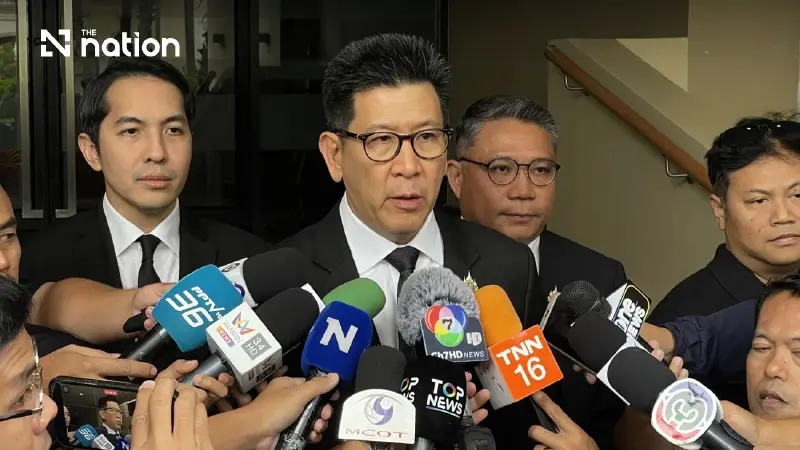


Finance Minister Ekniti Nitithanprapas says the 400-billion-baht emergency loan decree is vital to sustain Thailand’s economy, ease the impact of rising global oil prices and accelerate the country’s energy transition before a Constitutional Court ruling on July 9.
Deputy Prime Minister and Finance Minister Ekniti Nitithanprapas has defended the government’s 400-billion-baht emergency loan decree as essential to sustaining the economy in the short term and reducing the impact of rising global oil prices, which he said had contributed significantly to Thailand’s current account deficit.
His defence came ahead of a Constitutional Court ruling scheduled for July 9 on whether the decree, which authorises the Finance Ministry to borrow funds to address the energy crisis and support the country’s energy transition, complies with the Constitution.
Speaking to reporters after the presentation of the draft Budget Transfer Act for fiscal 2026 to the Senate, Ekniti said Thailand was facing overlapping crises and could not rely only on faster budget disbursement. He said funds should be transferred from projects that have not yet entered the procurement process to support measures aimed at sustaining the economy and cushioning the public from the impact of the crises.
Loan decree framed as economic security issue
Ekniti said the government would provide the Constitutional Court with accurate and complete information to explain the necessity of the decree, stressing that Thailand’s heavy reliance on energy imports had become a matter of economic security.
He said higher global oil prices had placed pressure on Thailand’s external accounts, with the current account deficit partly — and largely — driven by increased oil-import costs. He added that uncertainty over the war and damage to global energy infrastructure, including refineries, had kept diesel and petrol prices high.
The finance minister said Thailand could not afford to wait for a slower energy transition, warning that prolonged dependence on imported oil would further weaken the economy.
Private sector to be brought into transition push
Asked about contingency plans related to the court ruling, Ekniti said the government would seek cooperation from all sectors, particularly the private sector, to help accelerate the transition through co-investment.
He said the government was working with the private sector through the Joint Public and Private Sector Consultative Committee, or JPPCC, to address economic problems, adding that public-private partnerships would be central to the investment drive.
“No matter how the transition takes place, the private sector must be involved,” he said, noting that additional budget support would help speed up the process.
Solar, bioenergy and transport transition targeted
Ekniti said projects being considered under the energy transition agenda included clean-energy schemes such as solar power, as well as transport-related measures to promote the use of biodiesel, biomass and bioenergy.
He said such projects would not only reduce Thailand’s dependence on imported oil but could also generate additional income for farmers through the use of agricultural by-products in the energy sector.
The finance minister pointed to the “Thai Chuay Thai Plus” scheme as an example of short-term economic support already being implemented, saying more than 50 billion baht had been disbursed under the programme.
Budget scrutiny and investment push
On the fiscal 2027 budget, which is now under committee consideration, Ekniti said the process should be transparent, open and free of hidden agendas, while strictly observing fiscal discipline.
He said livestreaming every meeting of the budget committee would raise transparency standards and increase public confidence in the budget process.
Ekniti added that investment spending must be accelerated, with a focus on attracting foreign investment to support domestic investment. He said public-private partnerships would be promoted as part of the government’s effort to make the coming period a “Year of Investment”.
He said the government’s immediate priorities were to sustain the economy in the short term, accelerate the energy transition and speed up reforms to make Thailand more investment-driven.
