
Thai retail confidence strengthens amid subdued economic prospects


Government schemes drove a June rebound in same-store sales confidence and spending per bill, but the third-quarter RSI is expected to stay at 47–50.
- Thai retail confidence saw a significant short-term increase in June 2026, driven by government stimulus programs that boosted household purchasing power.
- The recovery was described as "unbalanced," primarily benefiting small, eligible retailers and food outlets while negatively impacting larger businesses like department stores and chain restaurants that were excluded from the programs.
- Despite the June improvement, the outlook for the next three months remains low, as the stimulus measures are not considered a long-term solution for generating sustained economic activity.
The June 2026 Retail Sentiment Index (RSI) survey pointed to a narrow-based recovery in Thailand’s economy after government measures provided short-term support to purchasing power.
The spending-per-bill index rose 15.5 points, while confidence for the next three months remained low at 47–50 points, reflecting concerns that purchasing power had yet to recover fully and that risks persisted on several fronts.
The June 2026 RSI showed a marked month-on-month improvement in retail sentiment, with the index rising by 16.0 points.
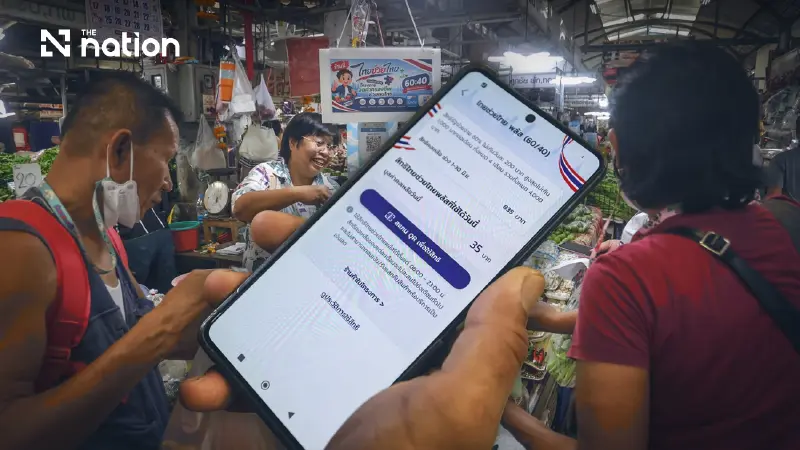
The gain was driven mainly by government stimulus measures, particularly the Thais Help Thais Plus (60/40) programme and the Pracharat scheme, which injected funds into the grassroots economy to support household purchasing power.
A breakdown of the index showed that the month-on-month confidence index for same-store sales growth (SSSG) rose from 36.6 points in May to 52.6 points in June, an increase of 16.0 points.
This was consistent with the spending-per-bill index, which rose by 15.5 points from 39.6 to 55.1, while shopping frequency increased by 10.3 points from 37.8 to 48.1.
The figures reflected brisk consumer spending, particularly during the first eight to 10 days of the month, when consumers began making full use of their entitlements under the government programmes.
Food and beverage spending rises under Thais Help Thais Plus
Statistics for the Thais Help Thais Plus (60/40) programme from Monday (June 1, 2026) to Tuesday (June 30, 2026) showed cumulative spending of THB43,218 million.
Of this, consumers paid THB18,407 million, and the government contributed THB24,812 million.
By category, food and beverage outlets recorded the highest spending at THB21,760 million, accounting for 50% of the programme total.
General retailers and Blue Flag shops followed, each recording THB10,052 million, or 23% apiece.
By location, Bangkok recorded the highest spending, accounting for 17% of the total, followed by Chon Buri at 5% and Samut Prakan at 4%.
Since registration opened on Monday (May 25, 2026), 26,040,623 people have registered for the programme.
A total of 1,171,850 shops had been approved to participate, of which 1,035,299 had begun accepting payments under the scheme, equivalent to 88% of all approved shops.
Although the overall index appeared positive, a source described the growth as “unbalanced” and “concentrated in specific segments”.
The programme’s eligibility conditions focused on small retailers, creating sharply contrasting effects among different groups of operators.
Direct positive impact: Small consumer-goods retailers, including local modern trade (LMT) operators and traditional grocery shops participating in the programme, recorded clear sales growth early in the month.
Indirect positive impact: Modern wholesale operators benefited as small retailers and restaurants returned to purchase raw materials and packaging to replenish their stocks.
Direct negative impact: Department stores, convenience stores, supermarkets in the modern trade segment and chain restaurants were adversely affected because they fell outside the eligibility criteria.
This caused them to lose a share of consumer spending, while customer traffic declined significantly.
The RSI for the third quarter, from July to September, is expected to remain low or recover only slightly within a range of 47–50 points.
Although government programmes can support purchasing power, they are not considered “strong medicine” capable of generating new economic activity over the long term.
