
Thailand to push double-track rail to support lower Northeast economy
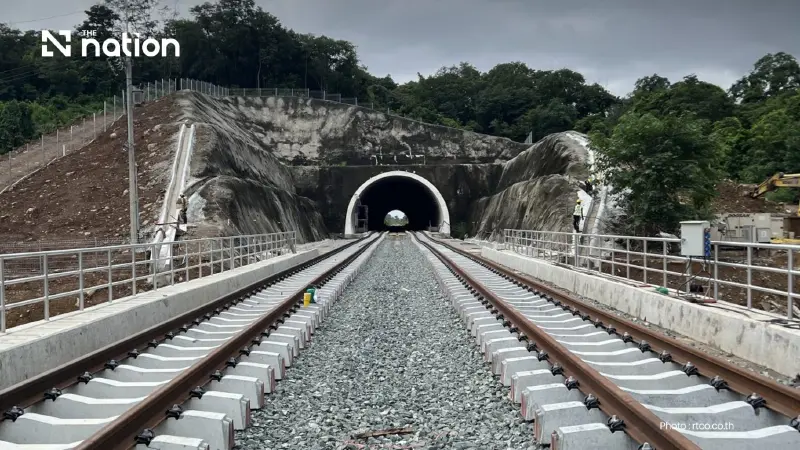


The THB44.09536 billion double-track line is planned to run 308 kilometres, with construction due to begin in 2028 and services scheduled for 2032.
- The Thai government is pushing for Cabinet approval for the Thanon Chira Junction–Ubon Ratchathani double-track railway project.
- The project is intended to support long-term economic expansion in the lower Northeast by improving transport for trade, agriculture, tourism, and connecting to border areas.
- Spanning 308 kilometers and costing over THB 44 billion, the railway will pass through the four provinces of Buri Ram, Surin, Si Sa Ket, and Ubon Ratchathani.
- The proposed timeline aims for Cabinet approval by the first quarter of 2027, with construction starting in 2028 and services beginning in 2032.
The Thanon Chira Junction–Ubon Ratchathani double-track railway is one of the megaprojects included in Phase 2 of the double-track railway development plan, but it has yet to receive investment approval.
Deputy Minister of Transport Siripong Angkasakulkiat has announced a push to take the project to the Cabinet as a key piece of infrastructure supporting the lower Northeast’s long-term economic expansion and connecting transport routes to border areas and neighbouring countries.
The project spans 308 kilometres and requires an investment of THB44.09536 billion.
The Ministry of Transport aims to submit it to the Cabinet for approval to extend and further complete the rail transport network.
Cabinet submission is initially targeted for the first quarter of 2027, followed by the start of construction in 2028 and the opening of services in 2032.

The line would pass through four provinces: Buri Ram, Surin, Si Sa Ket and Ubon Ratchathani.
These provinces form a strategic area important to the lower Northeast’s economy in agriculture, trade, investment, tourism and border trade.
Siripong also said the Northeast is a vast region with a large population, making transport infrastructure important to urban development and people’s quality of life.
He added that the Northeast has major trade checkpoints connecting transport routes to neighbouring countries, including the checkpoint in Nakhon Phanom, where exports and imports are worth tens of billions of baht.
Exports account for 70% of this trade and imports for 30%, which he said showed that Thailand ran a trade surplus there.
He also said the Nakhon Phanom checkpoint was attracting interest from business operators as an alternative transport route.
Investment in infrastructure across the Northeast would therefore support economic opportunities and growth not only within the region but also across the country, Siripong said.
He added that the Ministry of Transport prioritises not only major projects such as high-speed rail but also investment in double-track railways, which would give the public another travel option and allow goods to be moved by rail at a lower cost than by other modes of transport.
