
Uttapao and High-Speed Rail: EEC's Make-or-Break Infrastructure Bet
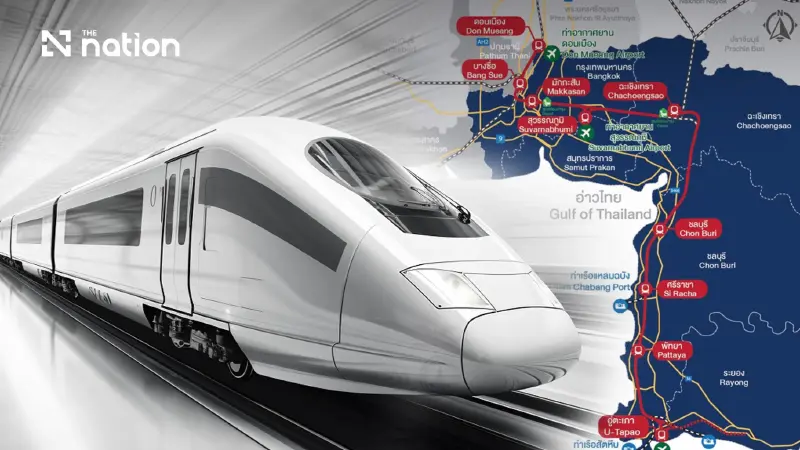


With Uttapao's construction notice issued and rail delayed, aviation, industrial and estate developers set a pragmatic path to keep mega-projects moving
- After significant delays, the U-Tapao airport expansion is proceeding with a smaller, more pragmatic initial phase and is no longer waiting for the stalled high-speed rail link.
- The high-speed rail project, a key anchor of the EEC, remains delayed, forcing developers to decouple their timelines and rely on existing motorways for connectivity.
- With the rail project deadlocked, a potential fallback solution is a scaled-down "Super Express" service with fewer stops to prioritize a fast connection between Bangkok and U-Tapao.
With Uttapao's construction notice issued and rail delayed, aviation, industrial and estate developers set a pragmatic path to keep mega-projects moving.
The physical hardware of the Eastern Economic Corridor (EEC) is being forced to adapt. For years, the U-Tapao airport expansion and the high-speed rail link connecting Bangkok's three major airports have served as the corridor's twin anchor projects—and its most visible bottlenecks.
Yet, discussions during the industrial and infrastructure track of the recent "EEC Never Stop: The Next Chapter" roundtable on Monday revealed a pragmatic shift: developers are recalibrating their scale and decoupling their timelines to get things moving.
Executives driving this logistics backbone—Wirawat Panthawangkun of U-Tapao International Aviation (UTA), Pajongwit Pongsivapai of WHA Industrial Development, and Sommat Khunset of the Federation of Thai Industries (FTI)—outlined how the region is adjusting to post-pandemic realities without abandoning its long-term ambitions.
U-Tapao: a smaller first step, not a smaller goal
Wirawat delivered the day's most concrete progress update. Following years of pandemic and geopolitical delays, UTA officially received its Notice to Proceed (NTP) on 3 April 2026, finally unblocking the 50-year concession and clearing the way for construction.
The bigger story is a strategic pivot. Originally envisioned primarily as a manufacturing and maintenance, repair, and overhaul (MRO) hub, UTA is now positioning U-Tapao as a gateway for high-value tourism.

This approach is designed to channel spending directly into the local economy and leverage the region's agricultural strength—noting that the surrounding area already accounts for 60–70% of Thailand's fruit exports.
On scale, Wirawat was candid. Pre-pandemic passenger numbers at U-Tapao peaked at around 2 million annually; today, the airport handles roughly 300,000. Rather than pursuing the original 16-million-passenger first phase, UTA has proposed a right-sized starting point of 3 million to the EECO.
Crucially, the ultimate expansion capacity of 60 million remains intact, matching the runway investments already made by the state.
"We are not lowering our readiness, only lowering the scale to match real demand," he explained, arguing for building capability first and letting volume follow.
Importantly, UTA is no longer waiting for the stalled high-speed rail link. Instead, it will rely on the M7 motorway as its primary artery while marketing the airport city to global investors.
U-Tapao, Wirawat said, must act as a "magnet"—drawing visitors who then radiate out to Pattaya, Rayong, Chonburi, and Chanthaburi, rather than relying on those destinations to justify the airport's existence.
WHA: the case for water, power—and a warning on land
Pajongwit framed the EEC's industrial competitiveness around its mature infrastructure, which gives Thailand a genuine regional edge: a natural-gas network, large-scale raw water supplies managed jointly by East Water and Wongsayam, efficient highways, and a highly stable power grid operated by the Electricity Generating Authority of Thailand.

However, this confidence came with two caveats:
Water security: Chachoengsao's industrial growth continues to lag behind Chonburi and Rayong due to insufficient and occasionally brackish raw water. WHA is urging the state to prioritise a cleaner, comprehensive water system, even as the company deploys its own reclaimed-water treatments to reach net-zero targets.
Land zoning constraints: Pajongwit raised a major red flag regarding a draft city zoning plan that could shrink designated industrial expansion land from roughly 2 million rai to just 300,000 rai.
With national data centre demand approaching 30,000 megawatts, he argued Thailand must stop passively accepting all investment and actively select high-value contributors—those bringing technology transfer, local supply-chain integration, and ESG-grade standards—while ensuring land supply doesn't choke off the semiconductor and advanced-technology clusters the EEC was built to attract.

FTI: defending industry, chasing rail and skills
Sommat pushed back on industry's role as the "usual suspect" for environmental complaints, arguing that most local pollution stems from untreated municipal waste rather than regulated factories, which face strict closure penalties for violations.
On electric vehicles (EVs), he credited Thailand's deep automotive manufacturing roots—anchored by Honda and Toyota—for attracting global players like BYD and Changan. The EEC has already logged roughly 200 EV-related investment applications worth 140 billion baht.
However, he warned of a severe skills gap in battery technology, software, and specialised engineering, stressing that training capacity must precede demand.
Sommat made a strong case for incorporating Prachinburi as the EEC’s fourth province, highlighting its road connectivity, proximity to Laem Chabang, and the vital water reserves of the Nong Prue Chinda Reservoir.
However, despite intense industry lobbying, the government confirmed in August 2026 that Prachinburi would not be included following widespread local opposition.
Turning to logistics, Sommat pointed to a major structural weakness: rail accounts for just 7% of regional freight, leaving roads across Chonburi and Rayong heavily congested with container trucks.
He noted that the upcoming Laem Chabang Port Phase 3 expansion—which will boost capacity to nearly 18 million TEUs—alongside rail-linked port initiatives, is projected to lift rail's share of freight transport to 30%.
Regarding the stalled high-speed rail public-private partnership (PPP), panellists broadly agreed the state might need to take a more active role in building core infrastructure if private talks remain deadlocked.
A pragmatic fallback was also floated: a "Super Express" service running at 140–160 km/h with fewer stops, prioritising speed between Bangkok and U-Tapao over comprehensive station coverage.
Ultimately, Sommat argued, the most valuable thing the government can offer private developers is not a faster train but policy clarity.

Background: rebuilding on the Eastern Seaboard
The EEC's logistics network builds on four decades of Eastern Seaboard infrastructure, originally centred on the Laem Chabang and Map Ta Phut ports.
The corridor's next phase depends on stitching together four unfinished pieces: two ports, one rail line, and one airport.
Independent analysis echoes the roundtable's consensus: the EEC already possesses ASEAN's strongest utility pipeline network, but converting that physical readiness into finished mega-projects—while reconciling zoning rules with industrial land needs—remains the central execution challenge of its second decade.
