
Bangkok bears brunt of estimated 25.3bn-baht Thai flood losses for Sept 24–27 as businesses struggle to cope
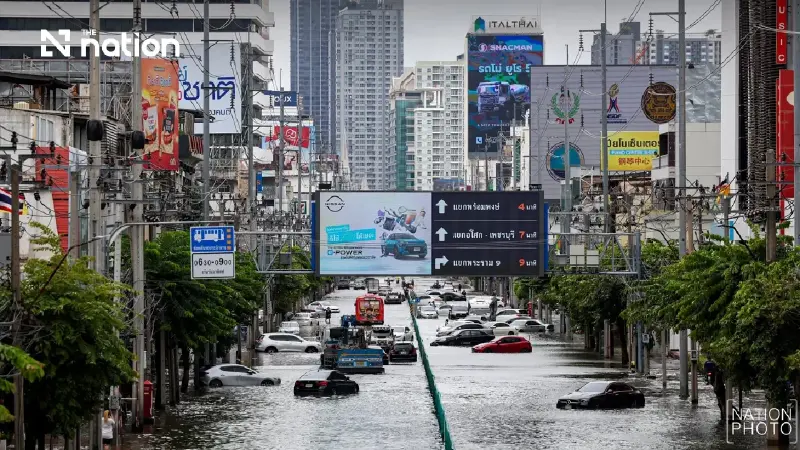


Bangkok bears the largest losses in a Rangsit University flood assessment, while businesses warn of disrupted production, deliveries and spending
- A study by Rangsit University estimates economic losses from the September 24–27 floods at 25.3 billion baht, based on a moderate-damage scenario.
- Bangkok is projected to bear the largest share of the losses, estimated at 10.586 billion baht, due to major disruptions to commerce, services, and travel.
- The study's full range of estimates for nationwide losses is between 16.9 billion and 33.8 billion baht, depending on the severity, with a potential impact of 0.36% to 0.73% on third-quarter GDP.
- A separate, more conservative estimate from the University of the Thai Chamber of Commerce placed the nationwide loss at 10 billion baht over a shorter three-day period.
Assoc Prof Aat Pisanwanich of Rangsit University’s Faculty of Economics estimates that flooding across 48 provinces, including Bangkok, during September 24–27, 2026 could cause economic losses of 25.345 billion baht under a moderate-damage scenario.
Bangkok accounts for the largest share of that estimate, at 10.586 billion baht, as flooding disrupts commerce, services and travel. Business leaders have warned that many companies were unprepared for the intensity and duration of the inundation.
The assessments follow persistent rain during September 24–26, when slow-moving, rotating rain clouds brought downpours that overwhelmed Bangkok’s drainage capacity and caused widespread flooding in the capital and surrounding provinces.
Economists assess losses over different periods
Aat’s assessment considers low-, moderate- and high-damage scenarios over four days. Estimated nationwide losses range from 16.896 billion to 33.793 billion baht, with a reported third-quarter gross domestic product (GDP) impact of 0.36–0.73%. The moderate scenario puts that impact at 0.55%.
In Aat’s moderate scenario, Bangkok’s estimated losses of 10.586 billion baht exceed those of the East, at 5.5208 billion baht, and the Central region, at 4.401 billion baht.
Aat’s regional breakdown assigns a reported third-quarter GDP impact of 0.23% to Bangkok, 0.12% to the East, 0.10% to the Central region, 0.04% each to the North and Northeast, and 0.02% to the South, totalling 0.55%.
Wholesale and retail activities account for 23.4% of Bangkok’s estimated losses in Aat’s analysis, followed by finance and insurance at 14.9% and public administration at 10.3%. The figures indicate that disruption extends beyond manufacturing to urban trade, services and administrative activity.
Thanavath Phonvichai, president of the University of the Thai Chamber of Commerce and chief adviser to its Centre for Economic and Business Forecasting, offered a separate estimate based on a shorter period.
Thanavath told Bangkok Biznews that preliminary checks identified flooding in 21 provinces. Restricted travel was expected to reduce spending during September 25–27, with flooding at some Bangkok shopping centres depressing sales and petrol stations potentially facing lower fuel volumes.
“The short-term impact over three days would cause nationwide economic losses of 10 billion baht and reduce GDP by only 0.05%, so the overall economic impact would not be substantial,” Thanavath said. “This assumes that problems in Bangkok and surrounding provinces last only three days, although flooding elsewhere could continue for around three to seven days.”
The estimates from Thanavath and Aat cover different periods and geographical assessments; they do not represent a single agreed loss figure.
CIMB Thai warns of weaker spending and calls for flood investment
Dr Amonthep Chawla, senior executive vice-president and head of research at CIMB Thai Bank, told Bangkok Biznews that the overall economic impact should remain limited if flooding in affected areas subsides within two or three days. Consumption, tourism, construction and confidence nevertheless require close monitoring, he said.
Amonthep expects households initially to postpone major purchases and direct more spending towards food and necessities. Repairs could generate additional spending after floodwaters recede, although weaker purchasing power and confidence may limit the recovery. Disrupted logistics could also prevent deliveries even where customers have money to spend.
Amonthep said flood coverage could discourage some domestic and international tourists from travelling, without necessarily prompting them to cancel their trips altogether. Visitors might switch from Bangkok to Chiang Mai, Phuket or other destinations, affecting hotels, restaurants, transport operators and retailers in flooded areas.
The property market faces additional pressure on already weak demand, according to Amonthep. Concerns about location and flood exposure could deter purchases of detached houses outside the city, while central Bangkok condominiums may face little additional impact beyond existing conditions. Some households could instead turn to renting city-centre condominiums.
Amonthep said cash assistance of 1,000 baht over two months would not fully compensate for flood losses. Continuing handouts into the following year would also be unlikely to resolve Thailand’s low growth and weak purchasing power, he argued.
Amonthep called for clearly allocated investment in flood prevention, practical arrangements for water-retention areas and jobs that involve local residents in the work, rather than reliance on cash payments alone.
Amonthep does not expect foreign direct investment to be significantly affected, while exports should remain operational. Flood damage to agricultural production could, however, reduce output and raise prices, weakening Thailand’s competitiveness.
“If flooding lasts only two or three days in some areas and the situation can be managed, the economic impact will be limited,” Amonthep said. “But confidence in the government’s ability to manage the situation must be watched. If that confidence is damaged, people may have to rely more on themselves, which would mean higher costs over the long term.”
FTI warns that businesses were unprepared
Pimjai Leeissaranukul, chair of the Federation of Thai Industries (FTI), said weather forecasts and warnings about heavy rainfall had not been translated into adequate preparations. Even retailers had not expected floodwater to accumulate on such a scale, she said.
Pimjai warned that industrial disruption could affect the entire production and supply chain, from raw-material procurement and workers’ journeys to transport and deliveries. Machinery, electrical systems, warehouses and inventories were also exposed.
The FTI urged businesses to assess risks urgently and review business-continuity arrangements. Companies should check raw-material availability, delivery commitments and transport routes, while preparing alternative routes and service providers to reduce the risk of prolonged disruption.
Brokerages differ on the market and growth impact
Gun Hathaisattha, chief investment strategist for retail research at CGS International Securities (Thailand), expects flood concerns to weigh on the Stock Exchange of Thailand (SET) Index by around 10–15 points on September 28.
Gun said property shares could face the strongest selling pressure because flooding may influence decisions to buy detached houses and condominiums. Retail shares could also experience volatility and selling as consumers curb spending.
Foreign investors were beginning to monitor the implications for tourism and restaurants closely, Gun said, with hotels in tourist provinces also potentially affected. CGS International maintained its 2026 GDP growth forecast of 2.5%.
Sorrabhol Virameteekul, assistant managing director and head of investment strategy at Kasikorn Securities, cited potential downside of 0.1–0.2% to its 2026 GDP forecast, against an existing growth projection of around 2%.
Sorrabhol identified the extension of the second phase of the Thais Help Thais Plus programme as a positive factor. However, a month-long flood could cause losses of 20–40 billion baht, equivalent to 0.15–0.25% of GDP, in his assessment.
Sorrabhol said the potential damage remained far below the scale of the 2011 disaster, when nearly 30 million rai, or 4.8 million hectares, were affected.
Kitpon Praipaisarnkit, deputy managing director of UOB Kay Hian Securities (Thailand), took a less pessimistic view. He said the economy retained growth momentum despite flooding in several areas and expected the SET Index to trade between 1,580 and 1,620 points, around the 1,600 level.
Kitpon does not expect the floods to cause damage severe enough to undermine economic fundamentals. He said conditions differed substantially from 2011 because water stored in the four main dams was considerably lower, leaving capacity to receive further inflows.
Home-repair and renovation businesses could benefit from demand for cleaning, refurbishment and repairs after floodwaters recede, according to Kitpon.
Kitpon said insurance shares could face pressure over anticipated claims, although actual payouts might fall below market expectations. His assessment cited differences between cover for parked vehicles inundated by flooding and vehicles driven through floodwater.
Motor-insurance coverage, however, depends on policy terms and the circumstances of the damage. Consumer-protection guidance distinguishes deliberate exposure to known deep flooding from an unexpected encounter with floodwater; driving through water does not by itself establish that every claim is excluded.
Source: Bangkokbiznews
