
Global finance leaders discuss Bangkok Blueprint on digital fraud
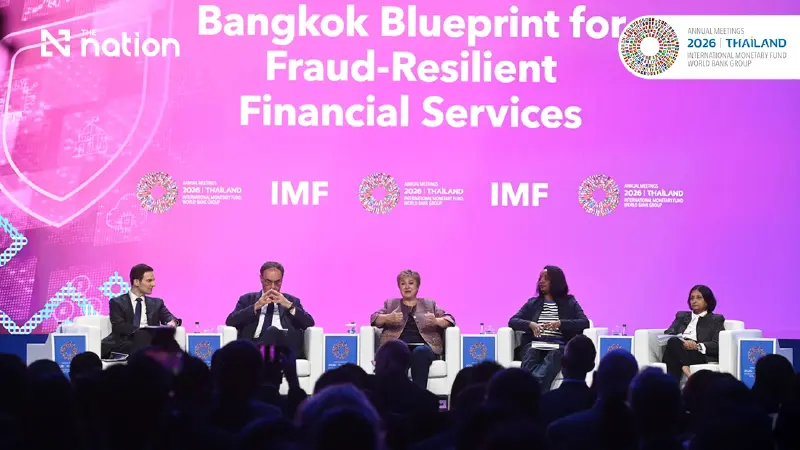


Financial leaders hail the Bangkok Blueprint as a key IMF–World Bank legacy, backing national adoption and cross-border data sharing to drive safe growth through digital finance.
- The Bangkok Blueprint was launched as a global strategic framework for financial services to prevent, detect, and respond to the growing threat of cyber-enabled fraud.
- Leaders from the IMF and World Bank identified digital fraud as a systemic risk to macroeconomic stability, warning that artificial intelligence is significantly increasing its scale and impact.
- Key strategies discussed include proactive prevention, building fraud protection into products by design, and fostering broad cooperation between governments, banks, and law enforcement.
- A central theme was the need for shared responsibility, with leaders calling for major technology and social media companies to be held accountable for fraudulent content on their platforms.
The Bangkok Blueprint for Fraud-Resilient Financial Services was officially launched in Thailand on Wednesday (October 14, 2026), during the Annual Meetings of the International Monetary Fund (IMF) and World Bank Group (WBG).
The report provides a global strategic framework to prevent, detect and respond to rapidly expanding cyber-enabled fraud linked to transnational organised crime.
At a special high-level panel, senior executives from international financial institutions and leading central banks shared their views and set a direction for cooperation to protect digital financial systems.
IMF warns fraud threatens macroeconomic stability
IMF managing director Kristalina Georgieva warned that financial fraud was no longer simply a consumer protection or routine law enforcement issue.
It had become a systemic risk with direct implications for macroeconomic stability.
Digital financial systems rely on “trust” as their foundation, she explained, referring to the benefits of financial access for individuals and small shops.
“Digital finance helps ordinary people access credit. But if that trust is destroyed, Bangkok’s street food vendors would be hit hard, and people could become so afraid that they withdraw from the system,” Georgieva said.

AI increases the scale of fraud
Georgieva warned that advances in artificial intelligence (AI) were enabling fraud to expand and become more damaging.
Estimated global losses from digital fraud had reached US$0.5 trillion to US$1 trillion a year, while the Bank of Thailand estimated losses at as much as 2% of gross domestic product (GDP).
“Imagine how much this money could do to drive the economy if we could prevent it from being lost.”
The IMF proposed three principles for tackling the problem:
Make tackling financial fraud a national strategy, with clear leadership and communication of risks from the top down.
Prioritise proactive prevention to reduce the subsequent costs of compensation and assistance.
Build a cooperative response that shares responsibility throughout society, rather than leaving the burden to the central bank alone.
World Bank calls for protection by design
Anshula Kant, managing director and chief financial officer of the WBG, highlighted the impact on individuals and households.
Digital financial services were central to creating economic opportunities and jobs in developing countries, she explained, citing small traders in India who used quick response (QR) codes to earn a living during the Covid-19 crisis.
Digital adoption had helped increase the proportion of adults in emerging markets with deposit accounts from 40% 15 years ago to 75% today.
Cybercriminals, however, were developing new fraud techniques even faster, inflicting heavy losses on households with limited financial resilience.
Their sophisticated methods also deceived highly educated people, including medical professionals.
Kant stressed that fraud protection must be built into financial products from the outset.
Measures needed to move beyond simply identifying customers through Know Your Customer (KYC) checks towards “Know Your Transaction”, analysing transaction behaviour to detect irregularities and disrupt mule account networks.
She also highlighted Thailand’s Anti Online Scam Operation Center (AOC 1441), which brings together police, banks, telecommunications operators and anti-money laundering (AML) agencies around the clock.
This cooperation had reduced victims’ losses by more than 42%.
Bank of England urges shared responsibility for Big Tech
Andrew Bailey, governor of the Bank of England (BOE) and chair of the Financial Stability Board (FSB), identified maintaining “trust in money” and “trust in technology” through human oversight and control as a central challenge for financial institutions and the FSB.
He referred to recent reports about the spread of AI agents that could take control of everyday digital devices.
Discussing the Cross-Border Payments Roadmap, Bailey acknowledged that the original deadline had passed and new obstacles had emerged.
Identifying those problems was nevertheless useful because it allowed countries to address them together.
The United Kingdom was ready to continue advancing the work during its presidency of the Group of Twenty (G20) in 2027.
“Making payments faster is of no benefit if the system is unsafe and makes fraud easier. Cross-border payments are the lifeblood of the global economy, so the FSB has brought the Financial Action Task Force (FATF) into the design process to apply its expertise in anti-money laundering and fraud prevention technology. Countries cannot tackle financial threats globally by working in isolation.”
Bailey also called for shared responsibility, arguing that the financial sector could not solve the problem alone.
Major technology companies and social media platforms needed to take responsibility for fraudulent content and advertisements appearing on their services.
“Print media in the past had legal responsibility for what they published. Yet today’s global digital platforms operate without responsibility for harmful and criminal content,” Bailey said.

Rwanda shares its experience of using AI to detect fraud
Soraya Munyana Hakuziyaremye, governor of the National Bank of Rwanda, shared lessons from Rwanda and Africa.
Financial inclusion in Rwanda had risen from 21% to 92%, driven largely by mobile money, which accounted for more than one billion accounts across Africa.
However, Hakuziyaremye acknowledged that most people still had low levels of digital financial literacy, citing a figure of just 30%.
This made them easy targets for attempts to obtain their personal identification numbers (PINs) or passwords.
Rwanda had developed digital public infrastructure alongside its instant payment system, eKash, with an eightfold reduction in transfer costs and connections bringing banks and mobile money providers into a single operations centre.
Rwanda’s key measures included:
- Using AI solutions to monitor and detect suspicious transactions and mule accounts in real time.
- Establishing a financial sector cybersecurity operations centre (FinOC) and an anti-fraud forum to share information among financial institutions, mobile operators, financial technology companies and law enforcement agencies.
- Working with telecommunications providers and local leaders to raise awareness among people in rural areas.
These measures had helped Rwanda reduce reported fraud cases by 30% during the first six months of 2026.
Turning the Bangkok Blueprint into global cooperation
The Bangkok Blueprint sets out five pillars and 12 key considerations, covering legal foundations, management of the fraud lifecycle, the use of anti-money laundering and combating the financing of terrorism (AML/CFT) measures, stronger cross-border cooperation and consumer protection.
Georgieva described the report as an important legacy of the 2026 IMF–World Bank meetings in Bangkok.
The IMF, World Bank, FSB and central banks worldwide would work together to use the blueprint to assess risks, promote its adoption in national policy and build cross-border information-sharing networks, helping digital finance support safe, inclusive and sustainable economic growth for everyone.
Before the discussion ended, Georgieva offered a final warning: “If anyone receives an email from Kristalina Georgieva telling you that US$5 million is waiting for you to collect ... do not believe it.”
