
IMF Warns Global Economy is 'Standing on One Leg' as AI Boom Masks Cracks
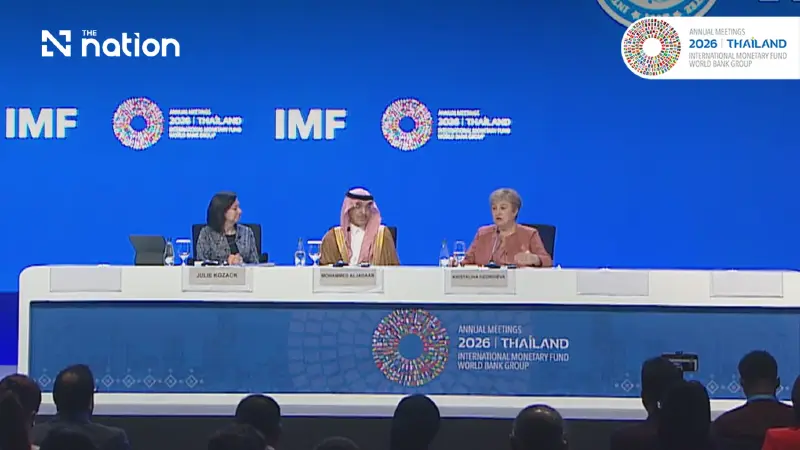


Georgieva says resilience rests on the AI boom, while debt, inflation and war widen the gap between winners and losers; ministers pledge cooperation
Georgieva says resilience rests on the AI boom, while debt, inflation and war widen the gap between winners and losers; ministers pledge cooperation.
The global economy is proving resilient but increasingly lopsided, and its dependence on a single engine of growth, artificial intelligence, is a risk in itself.
That was the message from IMF Managing Director Kristalina Georgieva as the 2026 IMF and World Bank Annual Meetings drew to a close in Bangkok on Saturday (October 17).
Speaking at a press briefing alongside Mohammed Aljaadan, chair of the International Monetary and Financial Committee (IMFC) and Saudi Arabia's finance minister, Georgieva said the week had been "marked by both optimism and worry".
The optimism came from the economy's resilience, the promise of AI and the dynamism of Asia. The worry came from AI itself, along with inflation, high debt, wars and climate risks.
Three takeaways from the IMF chief
Georgieva's first point was that good policies and institutions have anchored the global economy. "Resilience doesn't fall from the sky," she said.
She added that the AI boom is currently the main source of support, which makes it a vulnerability too.
"When we are dependent on one particular driver of growth, it is like we stand on one leg," she said.
She also noted that the foundations of that resilience are showing cracks. Energy and fiscal buffers are being depleted, inflation remains stubborn, and rising interest rates are adding to the debt-service burden of countries already heavily indebted.

Her second point concerned divergence.
Conversations in different rooms, she said, differed sharply depending on whether a country is riding the AI investment wave or sits in a region affected by war.
Energy exporters and members of the AI value chain are pulling ahead. Energy-importing countries outside that chain "are falling further behind", she said, "from a position of vulnerability to begin with".
The third was AI's speed. Policymakers want the benefits, but also the guardrails to protect people, businesses and the future of countries, Georgieva said.
She was struck by the spirit of cooperation between governments, AI companies and other stakeholders. She noted that the meetings were held beside a large replica of the Thai royal barge, "a reminder we are all in the same boat".
What it means for policymakers
Georgieva said there was "a great deal of agreement" on the response. Central banks should remain "laser-focused" on price stability. Finance ministries must urgently "repair the cracks in the fiscal house" and bring down debt where it is high.
Regulators and supervisors should watch for risks from rising leverage, non-bank financial institutions, cyber attacks and fraud. On digital finance, she said Thai authorities had led members towards the Bangkok Blueprint, a step towards a safe, inclusive and responsible framework.
That echoed a panel earlier in the week, at which central bankers and an AI developer warned that AI-driven attacks are growing faster and cheaper.
On the Fund itself, she said members welcomed its recent policy reviews, which make its work more granular and risk-based and help to spot vulnerabilities early.

This week the IMF secured more than $100 million in new capacity-development commitments from ten partners: France, Germany, Ireland, Italy, Japan, Kazakhstan, Luxembourg, the Netherlands, Spain and Switzerland.

The chair's summary
Aljaadan, whose term as IMFC chair has been extended by a year, said the world economy "continues to undergo profound challenges while demonstrating remarkable resilience".
He listed wars and conflicts with a heavy humanitarian toll, disruption to critical waterways and trade routes that threatens energy and food supplies, supply-chain strains and price pressures.
High public debt and rising sovereign bond yields, he said, are amplifying financial vulnerabilities and tightening conditions. AI, he added, offers significant productivity gains but "also carries risks that could widen economic disparities", especially in low-income countries and fragile states.
"The message from the IMFC members is clear: there is no room for complacency," he said.
Members called for credible medium-term fiscal plans to rebuild buffers while protecting vulnerable people and growth-enhancing investment.
They stressed that central bank independence is essential to price stability, that structural reforms should support private-sector-led growth, and that international cooperation is needed to address excessive global imbalances and trade tensions.
Members also reaffirmed their commitment to more timely, predictable and coordinated debt restructuring, including through the G20 Common Framework.
They underlined the importance of secure energy flows and freedom of navigation, backed stronger IMF capacity to support low-income countries, and reaffirmed their commitment to a strong, quota-based and adequately resourced Fund.
"Lasting stability and prosperity can only be achieved through greater economic integration, not fragmentation," Aljaadan said.

Support for the poorest
Asked how the IMF advises low-income, oil-importing countries excluded from the AI boom during a period of fiscal consolidation, Georgieva emphasised that reform must start at home.
Governments must collect revenue fairly, ensure the wealthy pay their share, and prioritise spending that protects the vulnerable while fostering growth.
"Inflation is like a tax on the poor," she noted.
She highlighted Fund reforms that allow for more than triple the volume of concessional lending compared to pre-reform levels, along with new funding for capacity development.
She praised low-income countries for edging their debt-to-GDP ratios down—even as those of advanced economies rose—though she noted that higher interest rates have pushed their debt-servicing costs from 8% to 14% of revenues.
Countries facing unsustainable debt must restructure "fast and effectively", while those with liquidity issues require coordinated international financing.
Middle East and North Africa outlook
Addressing the Middle East and North Africa, Georgieva noted that the IMF had lowered its regional growth forecast by 2 percentage points.
The outlook would be worse, she added, had several nations—particularly within the Gulf Cooperation Council—not built strong buffers and pursued structural reforms. Iraq has requested a formal programme, Lebanon is in "very intense discussions" towards a deal, Egypt’s programme is set for completion by year-end, and Jordan’s agreement remains on track.
Aljaadan observed that the region is split between nations that entered recent shocks prepared and those that were "already tired", expressing hope that stronger economies would help de-escalate conflicts and encourage a return to reform.
The 2026 IMF and World Bank Annual Meetings took place in Bangkok from 12 to 18 October. Closing the event, Georgieva quoted the late King Bhumibol Adulyadej of Thailand, reminding delegates that positive outcomes "do not arise on their own" but must be cultivated and strengthened over time.
