
Thailand's Growth Keys: KBank Forum Says Funding, Tech and Talent Must Unite
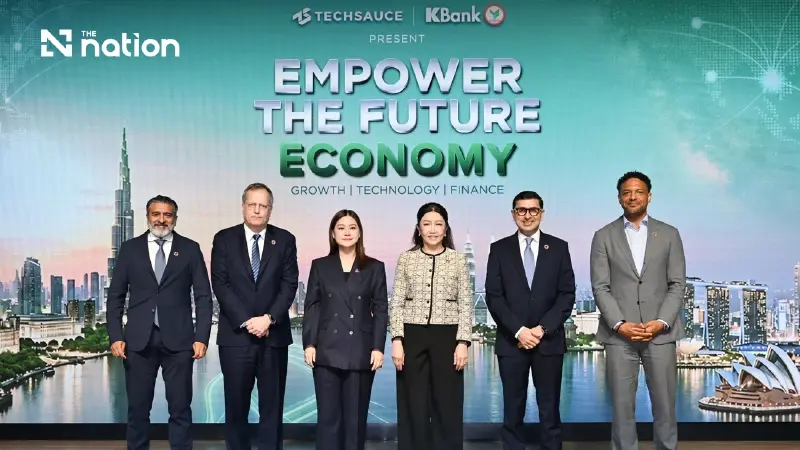


At a forum coinciding with the IMF–World Bank meetings, Thailand's deputy PM and global business leaders said funding, AI and skills must advance together
- At a KBank forum, Thai and global leaders identified the strategic integration of funding (capital), technology (specifically AI), and a skilled workforce (talent) as essential for Thailand's future economic growth.
- Thailand's Deputy Prime Minister outlined a national strategy focused on linking trade with capital and technology, urging businesses to shift from competing on price to competing on brand, design, and value.
- Speakers emphasized that while AI is a critical technological driver, its value is maximized when guided by human talent, with skills like judgment, adaptability, and curiosity becoming more crucial for the workforce.
- A key focus of the strategy is to empower Small and Medium-sized Enterprises (SMEs) by improving their access to funding and encouraging the adoption of data and AI to help them compete globally.
At a forum coinciding with the IMF–World Bank meetings, Thailand's deputy PM and global business leaders said funding, AI and skills must advance together.
As Bangkok hosted the IMF–World Bank Group Annual Meetings 2026, one of Thailand's largest lenders used the parallel global spotlight to put a blunt question to business leaders: who will capture the next wave of growth, and who will be left behind?
KASIKORNBANK (KBank), together with the technology and business media platform Techsauce, convened "EMPOWER THE FUTURE ECONOMY" on 14 October at Casean Rama IV in the ThaiBev Quarter. Staged alongside the annual meetings, the forum brought together Thailand's deputy prime minister with senior figures from the International Finance Corporation (IFC) a member of the World Bank Group, Standard Chartered Bank, Microsoft and Accenture to bridge global policy with local enterprise.
Their shared message: capital, technology and people must advance together, and no economy can manage it alone.

"A future economy is not something we wait for," said Kattiya Indaravijaya, KBank's chief executive officer, in her welcome address. "It is something we can all help to build."
World trade is being reordered; she argued, artificial intelligence (AI) is changing how businesses create value, and sustainability now shapes every investment decision.
Reaffirming KBank's commitment to bridging capital, technology and opportunity, she noted that Thailand has the capacity to be a significant part of the answer, thanks to its production base, entrepreneurs and gateway position to ASEAN.

THE FOUR KEYS
The keynote came from Suphajee Suthumpun, Deputy Prime Minister and Minister of Commerce of Thailand, who framed Thailand's task as one of reimagining trade rather than defending it.
"We cannot stop the world from changing, but we can choose how we trade in a changing world," she said. "Change is the lock, reimagined trade is the key, and growth is waiting behind the door."
She set out four "keys". The first is to rethink partnerships. Thailand, she said, is deepening cooperation with China on green industry and future food, working with Indonesia on energy, and pressing for faster free-trade talks with the European Union, which takes less than 10 per cent of Thai exports. The guiding question, she said, should shift from what Thailand has to what the world needs.
The second is to redefine value, moving from competing on price and volume to competing on brand, design, intellectual property and standards. Thai white rice, she suggested, should leave the price wars behind and be sold as a premium, health-focused, low-carbon product.
The third is to link trade with capital, technology and people. Investment promotion applications reached 1.47 trillion baht in the first half of the year, up 37 per cent, with more than half in digital sectors.
The fourth is to build trust and resilience, as environmental rules such as the EU's carbon border mechanism turn sustainability from a trend into a condition of market access.
Her sharpest remarks concerned small and medium-sized enterprises (SMEs).
"SMEs account for over two-thirds of all Thai exporters but represent only 12 per cent of total export value," she said. "Our mission is not just to protect SMEs but to empower their capabilities so they can compete on the world stage."
She urged SMEs to move from price to value, instinct to data and AI, a single sales channel to many, and solo operation to alliances. Closing, she invited Thai and international business to treat Thailand as a "trusted partner".
"No single country holds all the keys alone," she said. "Thailand holds some keys – our strategic location at the heart of ASEAN, our markets, and our trusted neutrality. International partners hold other keys – capital, technology, and global networks. The door to growth will only open when we turn these keys together."

A DIVIDED GLOBAL PICTURE
The panel discussion that followed, titled "Powering the Future Economy", widened the lens. Sarvesh Suri, Regional Vice President for Asia and the Pacific, International Finance Corporation : IFC (World Bank Group), said the IMF projects global growth of 3.1 per cent, but that its distribution is strikingly uneven.
"There hasn't been that many years where growth has been so divergent across countries," he said. "32 countries comprise 95% of that growth, powered by AI economies."
Thailand and Malaysia, he noted, sit among those riding AI investment and supply-chain shifts, while economies hit by conflict or lacking technology are falling behind.
The stakes are most acute for jobs. Suri said 1.2 billion young people in developing countries will enter the workforce over the next 10 to 15 years, yet only about 420 million jobs are on course to be created.
The World Bank Group mobilised $112 billion in private capital in the last fiscal year, up from $32 billion three years earlier, and has launched a strategy for micro, small and medium-sized enterprises (MSMEs).
Lenders, he said, should look at cash flows and supply chain data rather than land collateral and reach small firms through platforms such as Grab, which finances 32 million businesses across South-East Asia. Thailand's own numbers illustrate the gap.
"In Thailand, MSMEs represent 99.6% of registered firms and 70% of jobs, yet 1% of companies constitute 80% of trade exports," Suri said. "To make growth inclusive, we must ensure the benefits of the AI-driven economy percolate down to small and medium enterprises."

DAY ZERO
For Jan Metzger, Global Head of Coverage Banking, Standard Chartered Bank, the defining feature of the era is speed. Firms such as OpenAI, Anthropic, ByteDance and Nvidia were barely on the radar a decade ago.
He described "Day Zero", the moment an outsider overturns an industry overnight, as BYD did to the traditional car trade.
"Day Zero is the day somebody outside your industry comes in and totally disrupts it," he said. "Competition from outside your industry used to happen every 80 years. It's going to happen to everyone in the next 20."
Companies, he said, are responding by trading efficiency for resilience, accepting roughly 10 per cent higher operating costs to build plants that can make several products and withstand geopolitical shocks.
Governments, meanwhile, are more involved at company level than at any point in 70 years. The consequences for workers are as profound. As AI makes knowledge abundant, Metzger said, the premium moves to curiosity, empathy, judgement and adaptability.
"Every person in school today who has a successful career will have six different careers in their lifetime – not just six jobs," he said. "You need to be mentally ready to keep learning."

AI WITH HUMANS IN CHARGE
Azar Koulibaly, Regional Vice President and Associate General Counsel, Corporate, External and Legal Affairs, Microsoft Asia, said growth should be measured by the real-world impact of AI in communities and described Thailand as one of the world's fastest-growing countries in AI adoption.
He pointed to the TH2OECD project, in which the government used AI built by Thai firm ST Intelligence on Microsoft platforms to process 270,000 documents and cross-check 70,000 Thai laws for its OECD accession bid in 8 to 12 months rather than the usual two to five years.
"It proves that innovation born here can be scaled globally," he said. Yet technology, he cautioned, depends on those guiding it. "AI will be the scooter or motorcycle for the mind. But you need to know how to operate that motorcycle, and you need to know where you are taking it... We need humans in the loop to ensure technology remains trusted and in the service of humanity."
Anoop Sagoo, CEO, Southeast Asia, Accenture, took the argument from principle to the boardroom. Companies chasing "micro-fragments of savings" in back-office tasks, he said, are missing the prize, which lies in redesigning entire supply chains and operations.
That demands a firm mandate from the top, an end to silos in the executive suite, and what he called the "foundation tax" of building robust data platforms.
"To get maximum value out of AI, you have to pay the foundation tax – investing in solid data platforms," he said. "Without data, there is nothing AI can do for you."
He urged business leaders to adopt a mindset of "human in the lead", adding: "AI allows us to superpower our own skill set, but judgement remains human."
He also linked AI with sustainability: both depend on clean data, and AI's appetite for energy and water means firms should tailor models to specific tasks rather than deploy one-size-fits-all systems.
Through initiatives like this forum, KBank continues to position itself at the forefront of this economic transformation—ensuring that Thai businesses are equipped with the capital, technological backing, and strategic insights needed to navigate the future.
As the speakers concluded, the opportunity of ASEAN's expansion will ultimately go to those who combine funding, technology and skilled people and who bring small businesses along for the journey.
As Suphajee put it, the doors to growth open only when the keys are turned together.
