
Commerce Ministry addresses concerns over Thai imports of US pork
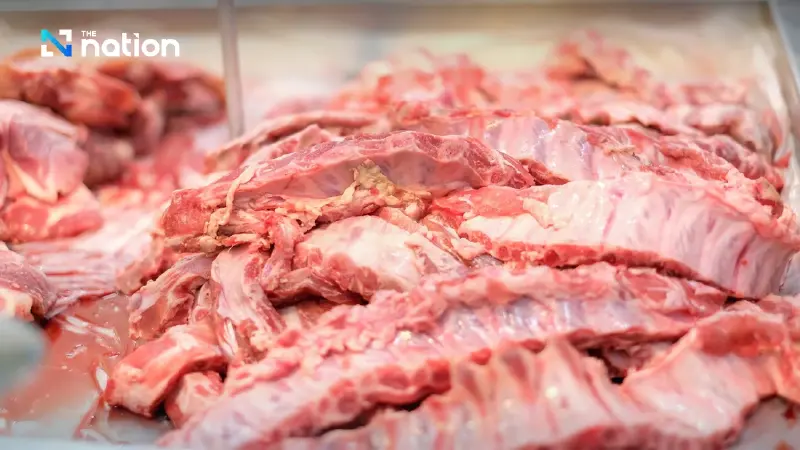


Some products will have a transition period before tariffs fall. The ministry says measures to cut feed costs must also protect Thai maize growers.
- The Commerce Ministry stated it has not negotiated to open the market to US pork products that would harm public health, specifically addressing concerns about the use of lean muscle growth promoters.
- The ministry reaffirmed its commitment to protecting the interests of Thai farmers and businesses and minimizing any adverse effects from the trade agreement.
- Full details on the terms for opening the market to specific products like pork cannot be disclosed yet due to the confidentiality of the ongoing negotiations.
- The agreement is not yet in force, as it still requires several steps under Thai law, including a legal review, Cabinet approval, a public hearing, and parliamentary consideration.
Poonpong Naiyanapakorn, permanent secretary at Thailand’s Ministry of Commerce, said the ministry wanted to give the public a full picture of the benefits and effects of the Agreement on Reciprocal Trade (ART) with the United States.
Speaking after the two countries signed a joint statement on the agreement, he highlighted the concerns of Thai farmers and businesses.
The US has become an increasingly important market for Thai exports.
Its share of Thailand’s total export value rose from 18.3% in 2024 to 21.4% in 2025 and reached nearly a quarter in the first nine months of 2026.
Thailand exported goods worth US$74.934 billion to the US in the first nine months of 2026.
Imports from the US totalled US$22.4 billion, leaving Thailand with a trade surplus of about US$52.5 billion.
The US recorded its fifth-largest bilateral trade deficit with Thailand, which ranked 11th in 2024 and seventh in 2025.
In baht terms, two-way trade was put at around THB2.3 trillion to THB2.4 trillion for those nine months, with the full-year figure expected to exceed THB3 trillion.
At least 2 million people work in jobs linked directly or indirectly to Thai exports to the US.

Poonpong said it was vital for Thailand to hold on to its US market, where it faced competition from other regional exporters, particularly Malaysia, Indonesia and Vietnam.
If Thai goods faced higher import tariffs than competing goods from those countries, it would affect competitiveness, orders, production, investment and employment throughout the supply chain.
Addressing concerns about opening Thailand’s agricultural market, particularly to US pork, and about the use of substances that promote lean muscle growth, Poonpong said the ministry had not negotiated to open the market to products that would harm public health.
The ministry could not yet disclose all the details because some remained subject to the confidentiality terms of the negotiations.
“No one went into these talks to open the market to products that would harm Thai people’s health,” Poonpong said.
The ministry reaffirmed that it had sought to protect the interests of Thai farmers and businesses and to minimise any adverse effects on them.
In drawing up its negotiating position, it consulted government agencies, the private sector and bodies with expertise in each field.

It sought views from across the supply chain so it could weigh the issues carefully.
Feed maize was another concern.
Thailand produces about 5 million tonnes a year, while domestic demand is about 9 million tonnes, so it still needs imports to meet part of that demand.
Sourcing imports more widely would give the animal feed industry another way to manage its raw material supplies and cut costs.
Lower feed costs would benefit pig, chicken, shrimp and fish farmers.
Measures to cut those costs would have to go hand in hand with support for Thai maize growers to protect domestic maize prices.
Farmers’ representatives will take part when the Maize Policy and Management Committee considers what measures to take.
Poonpong said signing the joint statement did not bring the agreement into force.
Several steps remained under Thai law.
The text still had to undergo legal review and be submitted to the Cabinet for approval to sign.
The details would then be published, a public hearing held and the agreement submitted to Parliament for consideration before it could take effect.
Signing did not mean agreeing to terms first and considering the details later.
From the outset, negotiators had to balance the interests of industry, exporters and farmers.
The government had to protect businesses and people in Thailand from harm that could bring them into conflict with one another.
“It’s not a matter of signing today, saying anything goes and leaving it all for later. No. From the start of the negotiations, we have to balance the interests of industry, exporters and farmers. We have to look after our people so that no one suffers to the point where we end up quarrelling among ourselves here at home,” Poonpong said.
Poonpong said neither side gained everything or lost everything in trade negotiations.
There had to be a balance in what each side gained.
In deciding whether an agreement was worthwhile, Thailand had to weigh several factors, including retaining export markets, employment, the use of domestic raw materials and maintaining its production base over the long term.
“If signing today meant Thailand would lose out, or lose more than it gained, we wouldn’t sign. So we think what we’ve done is worthwhile, but we still have to wait and see the details,” Poonpong said.
Chotima Iemsawasdikul, director-general of the Department of Trade Negotiations, said negotiators had consulted closely with the relevant government agencies and the private sector so they could take all sides’ proposals and concerns into account when deciding Thailand’s position on the ART.
The terms for opening the market to individual products could not yet be disclosed in full.
Chotima said the agreement did not require Thailand to open its market to every product immediately without giving businesses and farmers time to adjust.
The terms varied by product.
For some goods, businesses and farmers would have a transition period to adapt before tariffs fell.
She said she could not yet disclose how long the maximum transition period would be.
Several agencies already have funds and other means of supporting those affected by trade liberalisation.
They include the Ministry of Agriculture and Cooperatives, the Fiscal Policy Office and the Office of Small and Medium Enterprises Promotion (OSMEP), which has a fund for small and medium-sized enterprises (SMEs).
These resources can be used to help those affected by free trade agreements (FTAs), and their use need not be confined to trade with the US.
Chotima said Thailand wanted the US to cut its tariff linked to forced labour from 12.5% to 10%, but there had been no official reduction.
The US had put the 12.5% rate into effect around the middle of the year and would first have to amend its notice to lower it.
Thailand had discussed the reduction with the US and submitted a proposal, which the US was considering.
Thailand was also awaiting the outcome of a separate Section 301 investigation into excess capacity. The US had said it would announce its findings soon.
It could consider possible tariff reductions in the two cases together or announce its decisions separately.
Thailand wants a tariff rate close to those faced by its main regional competitors so that Thai goods can remain competitive in the US market.
This is particularly important for agricultural products such as rice, cassava and shrimp.
A tariff of 36% or more would make it harder for Thai goods to compete.
