
Fatal Bangkok balcony collapse highlights old-building risks
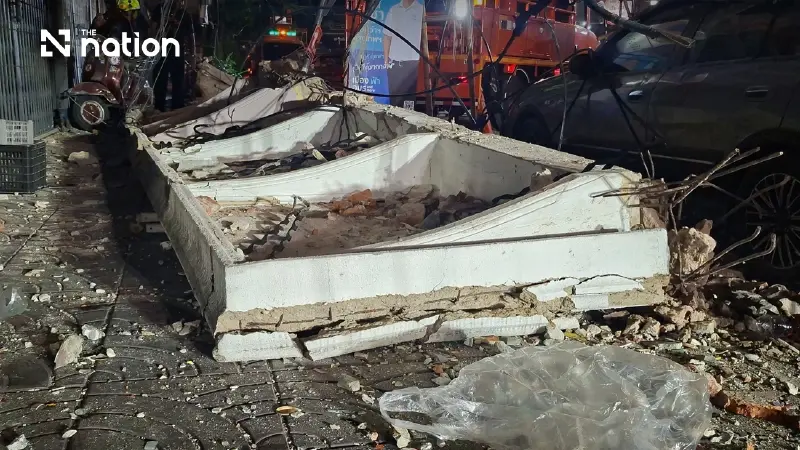


A structural engineer says ageing materials, corrosion and weak anchor points may have contributed to the fatal collapse on Rama IV Road.
- A fatal balcony collapse from an old commercial building in Bangkok, which killed one person, has highlighted the safety risks of aging structures.
- An expert identified the likely causes as a combination of factors including material deterioration from age, rust, a vulnerable cantilever design, and insufficient anchor points using outdated steel bars.
- The incident has prompted calls for Bangkok officials to urgently survey and inspect buildings over 50 years old, particularly those with projecting structures like balconies, to prevent similar tragedies.
The collapse of a balcony canopy from a two-storey commercial building at Mo Mi intersection on Rama IV Road, which fell onto the road and vehicles and left one person dead, has highlighted safety risks in old buildings in Bangkok.
A structural engineering expert said the problem could recur if buildings are not systematically inspected and maintained.
Structural engineer identifies four initial issues in balcony collapse

Prof Amorn Pimanmas, president of the Thailand Structural Engineers Association and a lecturer at the Faculty of Engineering, Kasetsart University, said the part that collapsed was not the whole building, but a balcony canopy projecting from the building.
The actual cause still required detailed examination, he said.
However, four main preliminary assumptions could be made.
First, the building was an old structure that had been built long ago.
Its structural materials may have deteriorated with age, particularly the reinforcing steel inside the concrete, which may have rusted after long exposure to sunlight, rain and accumulated moisture.
The rainy season could further accelerate corrosion.
Second, the balcony structure was a cantilever, with support fixed on only one side, making it more vulnerable to sagging or collapse than a conventional structure.
Third, investigators need to check whether heavy objects had been placed on the balcony, which could have caused the structure to carry loads beyond those for which it was designed.
Finally, further checks are needed to determine whether the balcony structure had been extended at a later stage, as any such extension could have affected the stability and strength of the original structure.
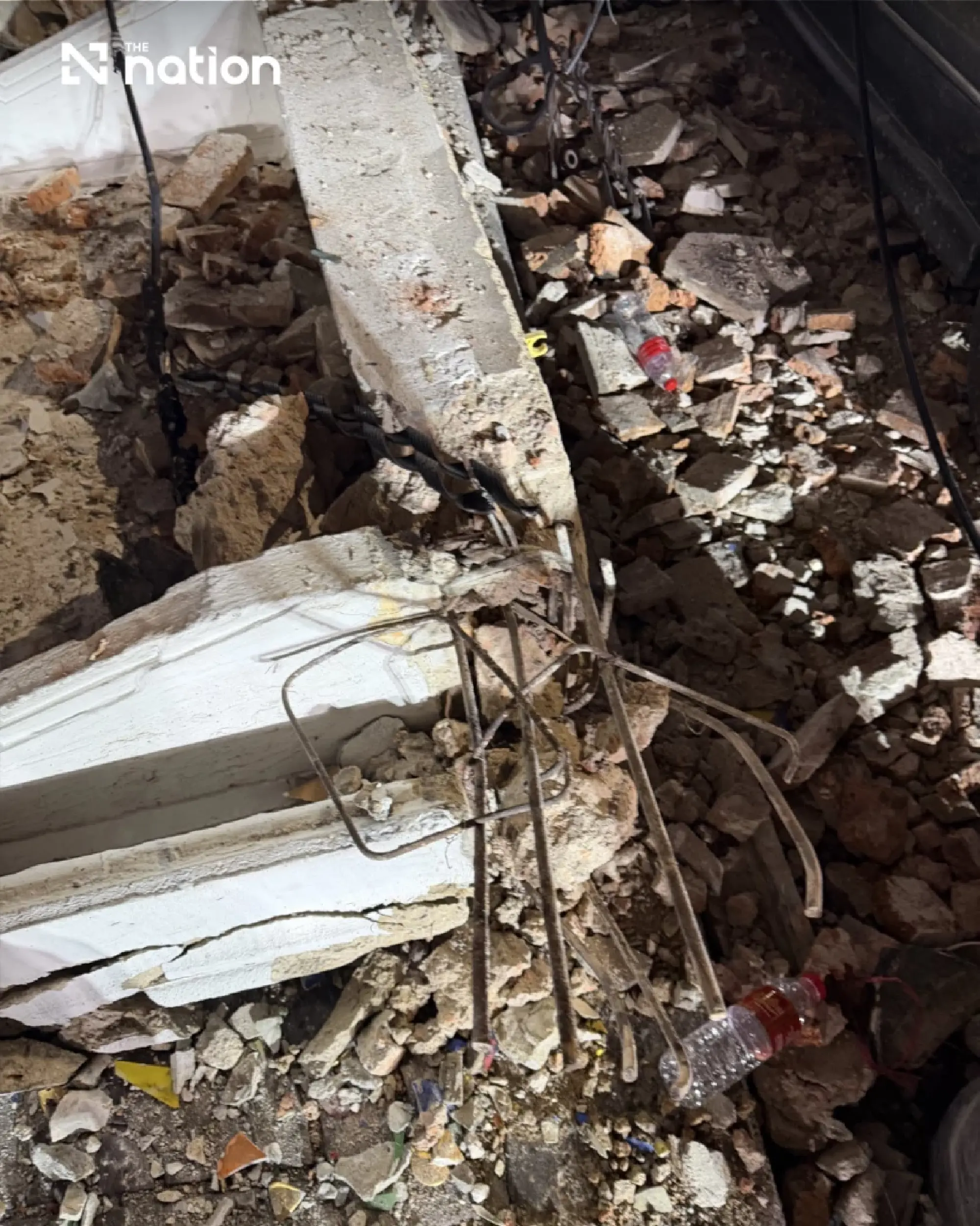

Site inspection finds "few anchor points and plain round bars"
After inspecting the building debris on the evening of the incident, Prof Amorn said he found additional information that could be an important factor in the collapse.
The inspection found that the number of anchor points between the balcony floor and the main building was limited, and that plain round steel bars had been used as anchoring material.
These have less bonding efficiency than the deformed bars commonly used today, meaning the strength of the anchor points may have been insufficient.
The cause of this collapse may therefore have involved several combined factors, including deterioration in an old building, rust in the reinforcing steel, and insufficient anchor points.
Together with the cantilevered nature of the structure, these factors increased the risk of collapse.
Urgent checks are urged on the remaining structure and nearby buildings
Prof Amorn said relevant agencies should urgently inspect the remaining parts of the building to assess whether the main structure had been damaged and whether it could still be used safely.
Nearby buildings with similar construction styles should also be inspected, as there could be a risk of a repeat incident if they have the same type of structural deterioration.

Old Bangkok buildings seen as a hidden danger
Prof Amorn said Bangkok had many old buildings, particularly in the inner city.
Many are 50-100 years old or more.
Although they are not very tall, projecting parts such as balconies and canopies are often key weak points because they are heavy concrete structures and are sometimes used to place additional items.
According to engineering principles, buildings have a limited service life, generally around 50-60 years.
After that, construction materials, including concrete and reinforcing steel, begin to deteriorate.
This is especially true of buildings constructed in the past, when materials and construction technology were not as advanced as they are today, such as low-strength concrete or smooth, round steel bars that have lower bond strength than deformed bars.
When these materials are exposed continuously to weather, sunlight, rain and moisture over long periods, deterioration and rust corrosion can occur more easily.
Five risk factors for projecting structures
From a review of similar incidents in the past, five key risk factors can be summarised:
- A building has exceeded its service life, with deteriorated materials and rust.
- The structure is a cantilever with support fixed on only one side.
- The number of anchor points is insufficient, or the anchor points lack strength.
- Heavy objects have been placed on the structure.
- Extensions have been made without regard to safety.
In the case of the building on Rama IV Road, the main factors are expected to be items 1-3.
The issue of possible later extensions still requires further investigation.
Bangkok urged to survey buildings over 50 years old
Prof Amorn proposed that the Bangkok Metropolitan Administration urgently draw up proactive measures to prevent a repeat incident, using its powers under the Building Control Act and a 2020 ministerial regulation that allows local officials to take action on buildings that may pose a danger to public life and property.
Key proposals include surveying and creating a database of old buildings aged over 50 years, especially those with projecting structures such as balconies and canopies; systematically assessing building strength with the participation of civil works technicians, building inspectors and volunteer engineers; and issuing orders requiring building owners to repair or correct buildings found to pose risks, with serious enforcement of the law.
The collapse of the balcony canopy on Rama IV Road was not the first such incident in Bangkok and may be an important warning sign of the problem of "deteriorating old buildings", which is becoming a hidden danger for city residents and needs urgent action before further losses occur in the future.
