
AWC makes Ruby the Opening Move in a Drive to Lift Asset Values and Earnings
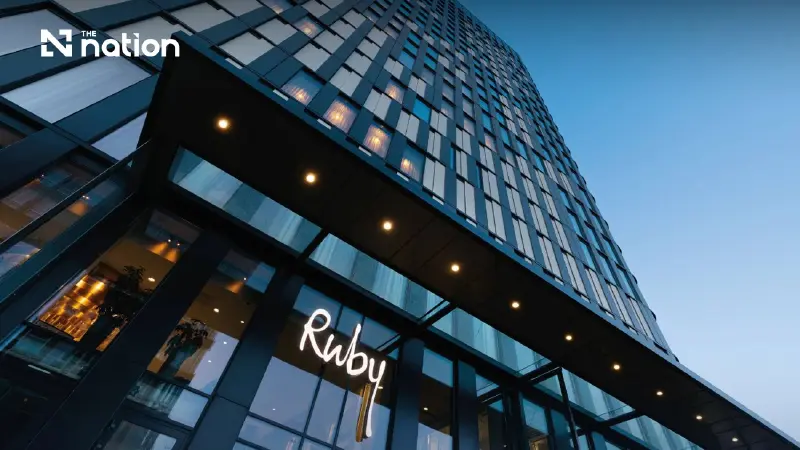


Rebranding Holiday Inn Express Sathorn is the first step in AWC’s plan to lift rates and returns by pairing its assets with IHG’s global brands
- Asset World Corp (AWC) is initiating a new strategy by rebranding its Holiday Inn Express Bangkok Sathorn into a "Ruby" hotel, the first of IHG's urban lifestyle brand in Asia-Pacific.
- This move is designed to increase earnings by replacing a budget-oriented hotel, which had limited pricing power, with a premium lifestyle brand that can command higher room rates.
- The rebranding aims to lift asset values, with the new Ruby hotel valued at over one billion baht, and serves as a template for repositioning other older properties in AWC's portfolio with global brands.
- Beyond raising room rates, the strategy seeks to broaden earnings by turning the hotel into a social hub with a 24-hour bar and live music, generating new revenue from food, beverages, and events.
Rebranding Holiday Inn Express Sathorn is the first step in AWC’s plan to lift rates and returns by pairing its assets with IHG’s global brands.
Asset World Corp (AWC) has turned a hotel rebranding into a statement of strategy. By converting its Holiday Inn Express Bangkok Sathorn into Ruby, the first hotel under IHG’s urban lifestyle brand in Thailand and Asia-Pacific, the property group is showing how it intends to raise the value of existing assets, lift room rates and broaden its earnings.
The 184-room hotel, in the Silom–Sathorn central business district, is due to open in the third quarter of 2027. AWC said the asset is worth more than one billion baht, and it expects the repositioning to deliver rates well above those of the budget-orientated hotel it replaces.
From occupancy to pricing power
Wallapa Traisorat, AWC’s chief executive and president, was candid about the commercial logic. The Holiday Inn Express, she indicated, already performed well on occupancy. The constraint was the room rate, which a limited-service brand struggles to push higher.
Moving into lifestyle hospitality is meant to break that ceiling. IHG’s Rajit Sukumaran, senior vice-president and managing director for East Asia and Pacific, described Ruby as an “urban premium lifestyle” brand built on an efficient operating model.
Roughly half its rooms measure 16 to 18 sq m, and it targets properties of more than 100 rooms. For owners, he said, that means efficiency at a premium price.

AWC did not give a room rate. The company said it would hold back on setting a budget and rate target until IHG’s proposals are in, and that it would update the market in the coming quarters. Rajit noted that Bangkok’s premium segment has historically run at 60–70 per cent occupancy and said Ruby should perform at or above that level.
The commercial case rests on more than the room rate. Ruby’s 24-hour bar, nightly live music, Marshall speakers in every room and guitars for guests to borrow are designed to turn the ground floor into a social space.
The “Co-living Lounge” will combine a café, a mixologist bar, DJ sets and creative talks, aimed at Sathorn residents and office workers as well as guests. That widens the revenue base beyond overnight stays to food, beverage and events.

A template for the portfolio
Wallapa framed Ruby as the “next chapter” of a long partnership with IHG, saying the shared aim is to “accelerate growth, elevate hospitality standards and create long-term value” for both companies and their stakeholders.
AWC’s press release describes the approach as collaborating with leading global hospitality brands to unlock long-term value from its assets. IHG’s network of more than 7,100 hotels and over 160 million loyalty members gives AWC a distribution engine it could not build alone.
Wallapa said the goal is twofold: to attract the investment that expands AWC’s projects and to draw travellers from around the world to fill them. The pipeline shows how far the model extends.
Beyond the InterContinental Chiang Mai The Mae Ping, AWC and IHG have signed for InterContinental and Kimpton in Bangkok’s Chinatown, Kimpton Hua Hin, InterContinental and Kimpton in Chiang Rai and Kimpton Pattaya.

The Hua Hin hotel is a conversion of the former Imperial property, a project AWC said would take about two years, with an opening at the end of 2028.
In a short exchange, Wallapa said repositioning older properties with global brands is part of a bigger plan covering many of AWC’s assets nationwide.
She added that AWC will pursue new opportunities where it can bring a global network to good locations. AWC is also building non-hotel experiences around these assets. An electric heritage tram will open in Chiang Mai on 18 November, linking to the InterContinental, and a similar link is planned for Chinatown.
Why Bangkok, and why now
Rajit said Bangkok has been a proven launchpad for IHG brands. IHG chose it as the first Asia-Pacific home for Ruby, which it acquired last year, because it is a global city that is creative and vibrant and suited to testing new concepts.
Today’s travellers, he said, want experiences and a connection with the destination rather than just a bed. Wallapa made a similar point from the owner’s side.
She said Ruby’s model suits a younger traveller who wants atmosphere, activity and music, and noted that her own children want exactly that. Its location, a short walk from AWC’s Empire Tower suits the CBD’s mix of office workers and residents.
Ruby operates about 40 hotels worldwide, with about 40 more in the pipeline. IHG expects roughly 120 further urban properties over the next decade. Singapore, Kuala Lumpur and Tokyo are among the cities on its radar.
Within Thailand, Rajit named Phuket, Pattaya and Samui as places that could suit the brand, though no deals were announced.

Confidence in Thai tourism
The briefing came after a dip in arrivals, which a journalist raised directly. Rajit put the decline at about 3 per cent and called it a short-term blip in a business that thinks in the long term. He gave three reasons for confidence.
Thailand is IHG’s largest market in Southeast Asia and Korea, with 42 hotels open across 11 brands in 11 destinations. IHG has another 40 hotels in the Thai pipeline, ahead of Vietnam, its next-fastest-growing market.
And local partners are still building, which he called the ultimate test of confidence. Bangkok has also been the world’s most-visited city for two consecutive years.
Sufyan Siarabi, AWC’s hospitality group officer, said the city should celebrate that achievement while keeping its targets high. He pointed to a positive 2027 outlook and to citywide events such as the recent World Bank and IMF meetings.
On performance, Rajit said IHG grew year on year in Thailand despite geopolitical disruption elsewhere, without giving figures. AWC pointed to its first-half results and said it sees 2026 as a positive year for growth, with luxury and upscale brands doing well. Third-quarter results are due in November.
Community and sustainability
Wallapa said new hotels should create jobs and spread income into communities through local sourcing and collaboration with artists and social enterprises. Tourism, she noted, has a high multiplier effect on the wider economy.
She linked this to AWC’s “Building Better Future” mission and IHG’s pledge to improve the lives of 30 million people by 2030. For AWC, Ruby is the first test of whether repositioning a mid-market hotel can raise value and extend the model across its portfolio.
Rajit said IHG intends to keep growing in Thailand alongside AWC. The first answer will come when Ruby opens in the third quarter of 2027.
