
Supalai Returns to Chiang Mai High-Rise Market with THB2.55bn Tower Launch
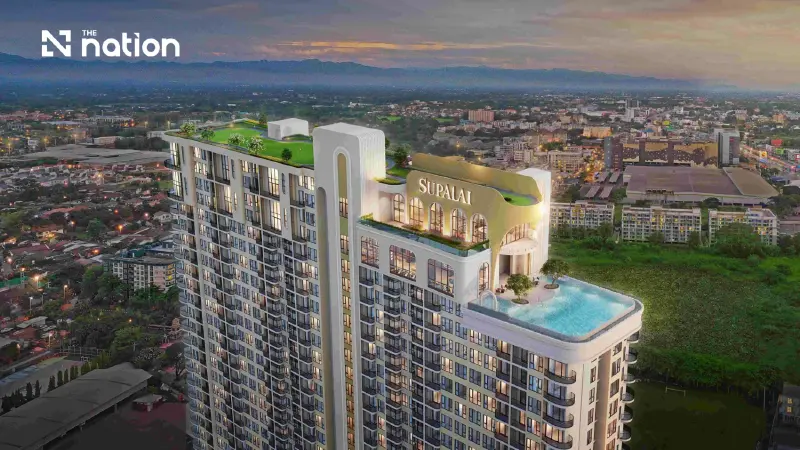


Developer bets a well-located, premium tower will defy a broader slump in northern Thailand’s property transactions
- Developer Supalai is returning to Chiang Mai's high-rise condominium market after a 12-year absence with the launch of Supalai Tyme, a 33-storey tower valued at THB 2.55 billion.
- The launch proceeds despite a slump in the local property market, as Supalai bets on a scarcity of new high-rise supply and strict zoning regulations to drive demand for a premium project.
- Located on the Chiang Mai–Doi Saket Road, the tower will feature 755 residential units that are larger than the market average and include advanced features like PM1.0 air filtration and updated earthquake safety standards.
- The project targets a diverse buyer base, with data showing less than half of the company's Chiang Mai buyers are local residents, with significant interest from Bangkok, other provinces, and foreign purchasers.
Developer bets a well-located, premium tower will defy a broader slump in northern Thailand’s property transactions.
Supalai Plc is returning to Chiang Mai’s high-rise condominium market after more than 12 years. It will open pre-sales on 21–22 November for Supalai Tyme Chiang Mai, a 33-storey tower worth more than ฿2.55 billion (about US$77 million) on the Chiang Mai–Doi Saket Road, opposite Central Festival Chiang Mai.
The launch comes when condominium sales in the northern capital are far below their peak. Supalai argues that this is when a well-located, differently designed project has the best chance. The project has 755 residential units and two shops on more than five rai (about two acres).
Units range from 35 to 205 square metres, have 2.7-metre ceilings and come fully furnished. Prices start at 2.09 million baht (about US$62,800), averaging roughly 67,000 baht per square metre (about US$2,010).
A market that has shrunk but also run dry
Speaking at a media briefing in Chiang Mai on Monday (October 26), Tritecha Tangmatitham, Supalai’s managing director, acknowledged the weaker numbers.
Annual property transactions have fallen from about 4,500 units in 2018–2019 to about 2,000. Condominium sales have dropped from about 1,500 units a year in 2018 to about 500 in 2024–2025. He blamed tighter bank lending, a problem he said was nationwide rather than local. But he argued that raw sales figures mislead without the supply side.
Data from the Real Estate Information Center, shown in his presentation, indicate that condominium sales exceeded new launches in seven of the past eight years. The exception was 2023.

The pattern follows a boom and bust. Around 2014, roughly 35 condominium projects were launched in Chiang Mai in a single year, after only one or two a year before.
That surge fed the “oversupply” label that still colours perceptions of the city. Launches have since fallen to about three projects a year.
“That oversupply has been absorbed,” Tritecha said, adding that only about two high-rise projects remain on sale, roughly 75–85% sold. “Sales cannot be high if there is nothing open for people to buy,” he said.
In his view, subdued transaction volumes partly reflect a lack of stock, not just a lack of demand.

Zoning makes new supply hard to build
The second pillar of the argument is regulatory. Much of central Chiang Mai lies under the flight-path restrictions of Chiang Mai International Airport.
Under the 2012 city plan, only two locations permitted high-rise condominiums without height limits: the San Dek intersection, where the project stands, and the Nong Prathip intersection.
A revised city plan, newly in force in 2026, widens the zones where condominiums of any height are allowed. Tritecha said the extra land is less useful than it looks, because towers must also front a sufficiently wide road. He counts just six intersections where large towers remain realistic.
Launch data for 2023–2026 show the effect. Most new condominiums were low-rise, mainly north of the city, where land is cheaper and height limits matter less, and only a handful of high-rise towers appeared.
Tritecha said Supalai had considered a cheaper site where a tall building was also permitted but chose this one as the best fit for its buyers.

Who is buying
Supalai’s sales records suggest the buyer base is wider than the local market. Of its Chiang Mai condominium buyers, 84% are Thai and 16% foreign.
Among Thai buyers, 55% come from Chiang Mai, 23% from the Bangkok area, 17% from other northern provinces and 6% from elsewhere. With foreign buyers included, local residents account for under half of all purchasers.
The company said this is its largest out-of-town share in any province, achieved without agents targeting foreigners. Tritecha said condominiums suit part-time residents, such as Bangkok buyers who work in the city a day or two a week. A house needs gardening and upkeep, whereas a condominium can simply be locked.
Early registrations of interest for Tyme reflect this mix. Some 55% of registrants intend to live in the unit, 25% to invest or rent it out and 22% to use it as a vacation home (multiple answers were allowed).
By unit type, 40% want one bedroom, 33% one bedroom plus, 20% two bedrooms and 7% three or more. Tritecha said demand for larger units was proportionally higher than the share Supalai is offering. The rental market supports the investment case, with caveats.
September 2026 listings on PropertyHub and FazWaz put the median condominium rent at about 17,000 baht a month (about US$510), against 20,000 baht for a townhouse and 27,000 baht for a house.
The company cites an indicative gross yield of 5–7%, but the figures come from online advertisements rather than completed leases. Tritecha gave an example of rental demand.
At a landed project south of the city near international schools, foreigners who cannot buy houses outright wanted to rent. Supalai matched them with investor buyers, and the arrangement has become the project’s main source of sales.

How Supalai Tyme differs from competitors
Tritecha said about 80% of Chiang Mai condominium projects are built around compact units of roughly 30 square metres. Supalai has deliberately started at 35.
The range covers one-bedroom, one-bedroom plus (with a flexible multipurpose corner) and two-bedroom units. At the top are two formats the company calls rare locally: the Private Garden Residence, which links living space to a private garden, and a two-storey Duplex Residence of three to four bedrooms, a first for Supalai in Chiang Mai.
Chaiyajak Watanyu, Supalai’s senior director of product creation and development, said the design follows a “Timeless” concept that draws on local culture and modern living. Its lines, proportions and gold tones are meant to echo the city’s light and sky.
Nearly two rai of green space run from ground floor to rooftop. The 27 facilities, which Tritecha said are the most among Chiang Mai’s high-rise condominiums, include an infinity-edge pool with jacuzzi, a sky lounge, a sky jogging track and a viewpoint.
Air quality and earthquake safety
Two features address long-standing concerns in northern Thailand: seasonal smog and seismic risk. Each unit has air-conditioning with filtration down to PM1.0, and enclosed common areas have fresh-air and high-efficiency filtration rated at 0.3 micron. Tritecha acknowledged that open-air areas cannot be controlled.
During construction, Supalai says it will apply dust control and waste management measures already used on its Bangkok sites. The project is designed to the latest seismic standards of the Department of Public Works and Town & Country Planning, which Tritecha said give about 10% more structural strength.
He said Tyme would be only the third Chiang Mai project built to the newest criteria, which were introduced after the region’s major earthquake last year.
Lifts have sensors that stop at the nearest floor and open their doors during a quake. Supalai also offers a 10-year structural warranty and a three-year warranty on unit fittings, against legal minimums of five and two years. Tritecha said the company introduced the 10-year cover three to four years ago as a way to back its engineering claims.

Location and outlook
Supalai has built 25 projects in Chiang Mai over 16 years, with a cumulative value of more than 20 billion baht (about US$600 million) and some 3,500 households.
The province ranks 12th nationally by gross provincial product at about 300 billion baht (about US$9 billion), fourth in population at 1.78 million and seventh in employment at 1.05 million.
Tritecha argues that its mix of agriculture, industry and tourism makes it less exposed to single-sector shocks than provinces built on one industry. The site connects to both the Chiang Mai–Lampang Super Highway and the Doi Saket Road.
It is close to Central Festival, Big C, Index Living Mall, Dara Academy, Prince Royal’s College, Payap University, Bangkok Hospital Chiang Mai and the Arcade bus terminal, with the airport within easy reach.

The company says the project has received environmental impact assessment approval, and Tritecha suggested construction could begin sooner than planned.
Risks remain. Mortgage approvals are tighter, sales volumes are far below the 2018–2019 level and a buyer base that relies on out-of-town and second-home purchasers can shift quickly with the economy.
Tyme’s larger, fully furnished units also sit at a higher price point than the compact products that dominate the local market. Supalai’s wager is that this combination, scarce stock, a site in one of a few permitted zones and a product unlike its rivals’, will hold up better than the wider market.
The pre-sales on 21–22 November will provide the first real test.
