
Thailand links AI and agriculture in new industrial strategy
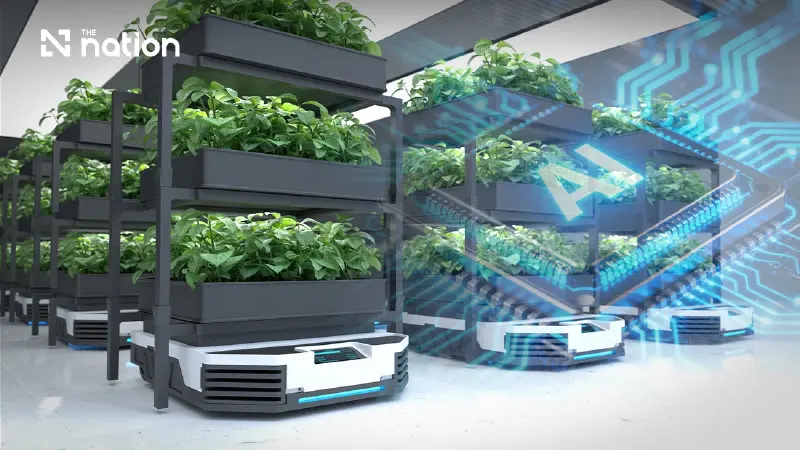


Thailand is linking artificial intelligence with agriculture innovation to raise farm value, deepen local supply chains and support sustainable industrial growth.
- Thailand has launched a new industrial strategy, dubbed "AI squared," which aims to integrate artificial intelligence with agricultural innovation to boost the economy.
- The strategy seeks to upgrade traditional farming into a high-value agritech industry by applying AI, IoT, and robotics to areas like precision agriculture, advanced food processing, and carbon credit management.
- In parallel, the plan uses AI to push Thailand into more advanced industrial sectors like semiconductor design and automation, with a focus on strengthening domestic companies and SMEs rather than relying on foreign investment.
- The overarching goals are to increase national productivity, enhance food security, and ensure the benefits of technology are spread more widely to address a "K-shaped" economy.
Thailand is seeking to combine artificial intelligence with agriculture innovation as part of a broader industrial strategy aimed at raising productivity, strengthening domestic businesses and spreading the benefits of technological growth more widely across the economy.
Industry Minister Varawut Silpa-archa outlined the approach at the Delta Future Industry Summit 2026 on Friday (August 14), describing artificial intelligence and agriculture as two engines that should work together to support Thailand’s next stage of development.
AI and green industries drive growth strategy
The government unveiled an economic strategy focused on artificial intelligence, advanced digital technology and green industries, with the goal of placing Thailand among the world’s 20 most competitive economies.
The AI and advanced digital technology sector, including domestic semiconductor and chip-design capabilities, is projected to reach 100 billion baht by 2027, he noted.
Under the Green Thailand policy, the government is also seeking more high-value clean-energy investment, smart electricity grids, expanded electric-vehicle infrastructure and credible carbon-accounting and emissions-trading systems.
Thailand’s exports rose 17.6% year on year in the first half of 2026, supported partly by a 45.1% rise in technology-related shipments linked to the global AI boom.
However, Varawut cautioned that much of the benefit was still being captured by multinational production bases rather than domestic companies, while many high-technology industries remained reliant on imported components, intellectual property and specialised talent.
He added that the benefits did not always flow deeply enough into Thai supply chains, SMEs, small businesses and local communities, making wider participation in the high-tech economy a central policy challenge.
Agriculture as a strategic asset
Services account for about 55-60% of Thailand’s GDP, while industry and manufacturing contribute around 25-30%. Agriculture represents about 8.7% of GDP but employs more than 28% of the workforce.
“We must look far beyond that 8.7 per cent. Because agriculture is not merely another economic sector. It is a foundation of national security,” Varawut stressed.
He argued that food security had become increasingly important amid geopolitical tensions, climate volatility, ageing populations, rapid technological disruption and more fragmented global supply chains.
Thailand’s water, fertile soil, agricultural knowledge and production capacity could provide a renewable form of national wealth, he added, citing Charoen Pokphand Group senior chairman Dhanin Chearavanont’s description of these resources as “our oil above the ground”.
Combined with advanced food processing, biotechnology, automation, logistics and Thailand’s location in Southeast Asia, these strengths could allow the country to move beyond being a food exporter and become what Varawut described as a “safe haven for food for the world”.

‘AI squared’ for industrial transformation
Varawut described the strategy as “AI squared”, linking artificial intelligence with agriculture innovation to address Thailand’s increasingly K-shaped economy.
Artificial intelligence represents an opportunity for Thailand to move into higher-value industrial activities, including advanced semiconductor packaging, thermal management, power electronics, industrial automation, data infrastructure and more sophisticated chip design.
But he warned that import dependence could keep the benefits concentrated within a narrow part of the economy unless policy deliberately strengthened domestic capabilities.
The Industry Ministry’s approach has four priorities:
- Leverage the comprehensive, world-class services and infrastructure of the Industrial Estate Authority of Thailand, which currently oversees a nationwide network of more than 60 industrial estates.
- Streamline regulations, accelerate smart manufacturing adoption across industrial supply chains and employ AI-driven technologies to improve industrial circularity and environmental protection.
- Maintain a careful balance between rapid technological and industrial expansion and the long-term security of Thailand’s energy, water, environment and natural resources.
- Strengthen Thai SMEs by providing the skills, technology, finance, standards and opportunities necessary for them to become genuine participants in AI and advanced digital supply chains.
“The true measure of industrial development is not simply how much investment enters Thailand. It is how much capability remains in Thailand,” Varawut stressed, highlighting the importance of building local suppliers, skilled engineers and globally competitive Thai companies.
Turning agriculture into a high-value industry
The second part of the strategy focuses on upgrading traditional agriculture into higher-value agri-food and agritech industries.
Citing the Global FoodTech Investment report, Varawut noted that Asian food demand was projected to rise by 39%, while the global agritech market was expected to exceed US$500 billion by 2034.
The ministry is focusing on biotechnology, novel foods, medical substances, precision agriculture, advanced food processing and smart agricultural manufacturing.
Integrating the Internet of Things, AI, automation and robotics could raise productivity, cut waste and energy use, improve traceability and increase the value and income generated from agricultural land, Varawut said.
The government is also developing high-value agro-industrial estates in strategic locations with supply-chain, logistics, processing and innovation ecosystems.
Varawut highlighted the potential for agriculture to create carbon value as satellite technology, sensors, AI and electrification improve the measurement of greenhouse-gas reductions.
He cited Varuna (Thailand), a domestic technology startup using AI in carbon-credit management through alternate wetting and drying rice farming, which has the potential to generate up to one million internationally transferred mitigation outcomes (ITMOs) by 2030.
“This is where Thailand’s two AIs converge: artificial intelligence meeting agriculture industry, technology meeting the land, innovation meeting opportunity and the upper branch of the K-shaped economy helping to lift the lower branch upward,” he remarked.
Government-industry partnership
Varawut also stressed that industrial transformation would require cooperation among government, companies, universities, entrepreneurs and workers.
He pointed to collaboration between the Department of Industrial Promotion (DIPROM) and Delta Electronics Thailand through the DIPROM x Delta Angel Fund, which has supported 237 startups and generated economic value of more than one billion baht.
The broader goal, he explained, was not simply to attract technology or produce more goods, but to build domestic knowledge, create greater value and ensure that growth reaches businesses, workers, farmers and communities.
“If we succeed, Thailand will not merely participate in the next industrial revolution, Thailand will help to shape it. We will not simply manufacture technologies designed elsewhere; we will innovate them here.”
“We will not simply export products; we will export knowledge, solutions, sustainability and value. And we will build a Thailand where technology does not widen the divide between those who have and those who have not, but becomes the bridge that brings our people forward together,” Varawut concluded.
