
Thai exporters risk losing orders as ESG rules tighten, EXIM warns



EXIM Thailand warns exporters could lose orders as the EU, US and China tighten ESG rules, while offering reporting support and green loans from 2.75%.
Thai exporters risk losing orders and access to major markets unless they accelerate compliance with tightening environmental and sustainability rules, EXIM Thailand has warned, as the state-owned bank prepares ESG-reporting assistance and green loans carrying interest rates from 2.75%.
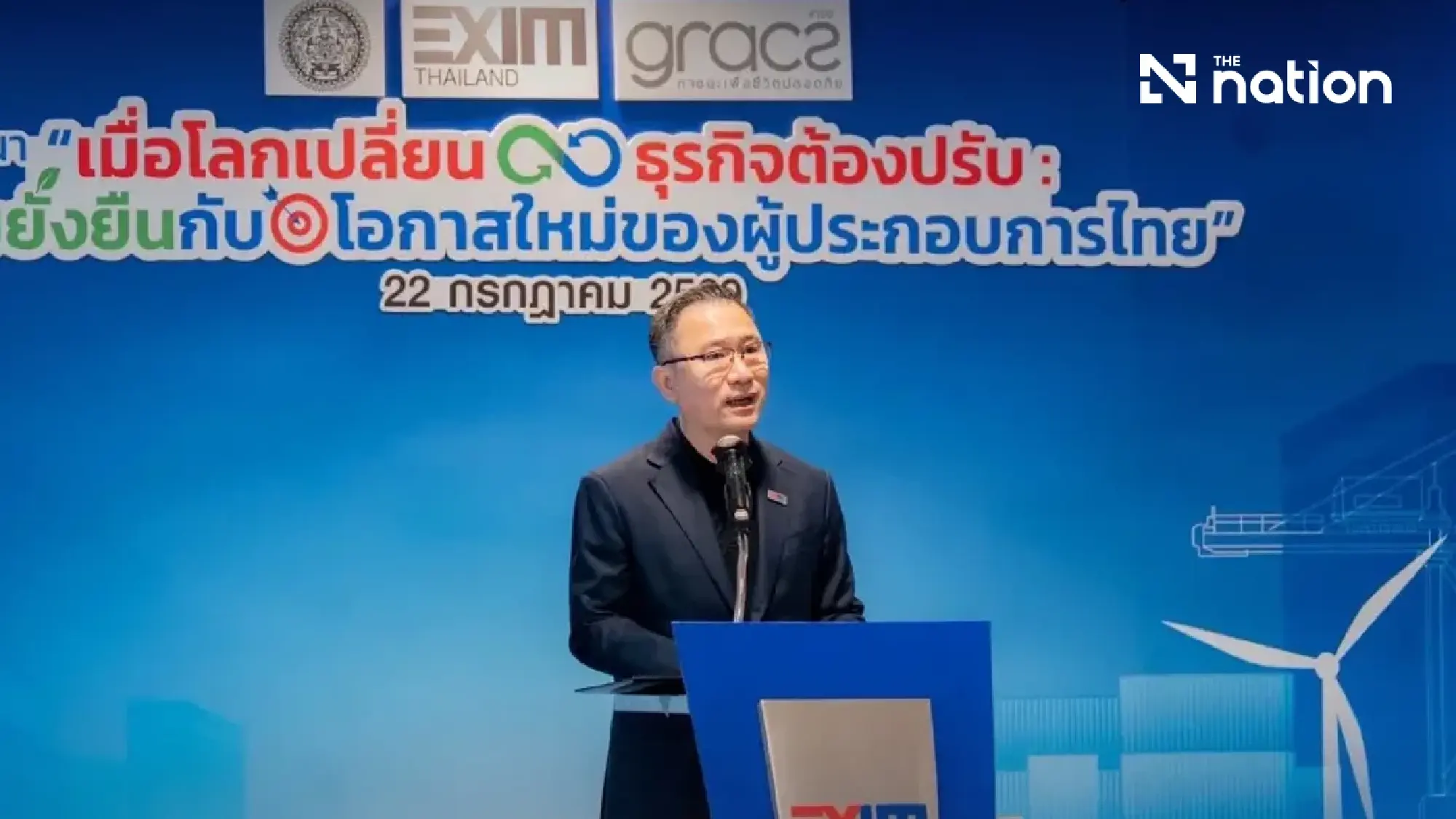
The United States, European Union and China, which together account for more than 40% of Thailand’s export value, are steadily raising environmental, carbon and sustainability standards, according to Charat Rattanaboonniti, President of the Export-Import Bank of Thailand.
The changes will have a direct impact on Thai exporters and manufacturers operating in global supply chains, requiring them to adapt their products, production processes and data-reporting systems to retain their competitiveness.
Charat said environmental requirements were no longer separate from trade policy but were becoming the “new rules of global trade”, influencing market access, purchase orders and companies’ ability to secure financing.

EU regulations raise compliance pressure
The European Union is moving most rapidly to incorporate environmental requirements into trade and corporate regulation under its European Green Deal.
According to EXIM Thailand, the bloc has introduced more than 3,400 environmental measures, many of which are gradually entering into force and will directly affect Thai suppliers.
Among the key regulations is the Packaging and Packaging Waste Regulation, or PPWR, which will begin to apply on August 12, 2026.
The rules introduce new requirements covering packaging design, reductions in material use, reuse and recycling as the EU seeks to promote a circular economy.
Thai companies exporting packaged consumer products, food, electronics and industrial goods may therefore need to review their materials, packaging formats and waste-management practices.
The EU’s Carbon Border Adjustment Mechanism, or CBAM, is another major concern for exporters.
The mechanism currently covers iron and steel, aluminium, cement, fertilisers, electricity and hydrogen, but its scope could eventually be expanded to additional industrial and agricultural products.
Exporters of carbon-intensive goods will increasingly need reliable emissions data to demonstrate the carbon footprint of their products and calculate their potential exposure to carbon-related charges.


Deforestation and disclosure rules widen impact
Thai exporters must also prepare for the EU Deforestation Regulation, which requires companies to show that specified commodities were not produced on land affected by deforestation.
The regulation covers products including natural rubber, palm oil, coffee, cocoa and timber, along with a range of related agricultural and processed goods.
Compliance will require greater traceability, including information on the origin of raw materials and production sites throughout the supply chain.
The EU’s Corporate Sustainability Reporting Directive is also raising disclosure expectations for companies doing business with European groups.
Although many Thai businesses may not be directly covered by the directive, they could still be required to provide environmental, social and governance information to European customers or multinational companies seeking data from their suppliers.
The information must be systematic, verifiable and traceable, increasing pressure on Thai firms to develop reliable ESG data-management systems.
US and China move to strengthen standards
Environmental trade measures are also advancing in the United States.
Charat said US policymakers were pushing the PROVE IT Act, which would establish a framework for measuring the greenhouse-gas intensity of industrial products.
The proposed Foreign Pollution Fee Act would impose charges on imported goods with higher carbon intensity than comparable products made in the United States.
Although the measures remain under consideration, they signal growing pressure on foreign manufacturers to measure and disclose emissions associated with their products.
China has not introduced a carbon-border mechanism comparable to the EU’s CBAM, but it is developing the China Sustainability Disclosure Standards.
The national framework is intended to align corporate ESG reporting with international standards and respond to rising demand for sustainability information from global investors.

ESG becomes an ‘export passport’
Charat said the regulatory changes were reshaping the structure of competition in global trade.
Thai companies will need to make adjustments across their operations, from product and packaging design to raw-material sourcing, energy management and production technology.
They will also be expected to reduce greenhouse-gas emissions, collect ESG information and establish traceability systems throughout their supply chains.
In practical terms, sustainability credentials are becoming an “export passport”, determining whether companies can remain approved suppliers, receive new orders and enter higher-value markets.
The requirements could increase costs for businesses in the short term, particularly SMEs that lack staff, technology or expertise in emissions accounting and sustainability reporting.
However, companies that adapt quickly could gain a competitive advantage.
Reliable and transparent sustainability information could strengthen buyers’ confidence, improve companies’ positions in global supply chains and increase their access to green finance.
EXIM prepares ESG-reporting support
EXIM Thailand is preparing services to help SME and exporter customers collect the data and produce the sustainability reports required by overseas buyers.
The services are intended to help businesses respond to information requests from importers, multinational companies and supply-chain partners.
The bank said stronger ESG reporting would reduce the risk of exporters losing orders because they could not provide sufficient evidence of their environmental and sustainability performance.
It could also help companies expand into new markets where ESG information is increasingly included in supplier-selection and procurement processes.
EXIM Thailand is also working with partner organisations to provide businesses with technical knowledge, financing and other support at an affordable cost.
The assistance is expected to provide a foundation for companies seeking green loans and transition finance to fund their shift towards lower-carbon operations.
Green loans start at 2.75%
EXIM Thailand currently offers green-transition loans with interest rates starting at 2.75% per annum during the first two years.
SMEs may apply for financing of up to 100 million baht, with repayment periods of up to 10 years.
The bank offers two main products.
EXIM Solar D-Carbon provides financing for solar-power generation and energy-storage systems, while Green X Transformation supports investments in energy efficiency, production-technology upgrades and the use of electric vehicles in business operations.
The products are designed to help businesses reduce energy costs, improve operational efficiency and strengthen their competitiveness in overseas markets.
Additional rate incentives offered
The bank also provides working-capital facilities at special rates for exporters and companies in export value chains that operate in an environmentally responsible manner.
Businesses applying for energy and sustainability transition loans or qualifying working-capital facilities by the end of July 2026 may receive an additional interest-rate reduction of 0.25 percentage points per annum for up to one year.
EXIM Thailand is also helping businesses that install solar-power systems to register carbon credits under its programme of activities within Thailand’s Voluntary Emission Reduction Programme, or T-VER.
In partnership with the Stock Exchange of Thailand, the bank is promoting the SET Carbon system through the EXIM Know Your Carbon initiative.
The system assists companies in measuring and reporting their organisational greenhouse-gas emissions.
EXIM Thailand loan customers that prepare emissions reports through the system may receive an additional interest-rate reduction of up to 0.25 percentage points per annum for the duration of their loan agreements.
Charat said the competitiveness of Thai exporters would increasingly depend on more than product quality and price.
Their ability to operate according to ESG principles and disclose sustainability data in line with international standards would become essential to retaining existing markets, entering new ones and securing finance.
