
Top 5 rail-line land price rises revealed, Green Line Khu Khot-Lam Luk Ka leads
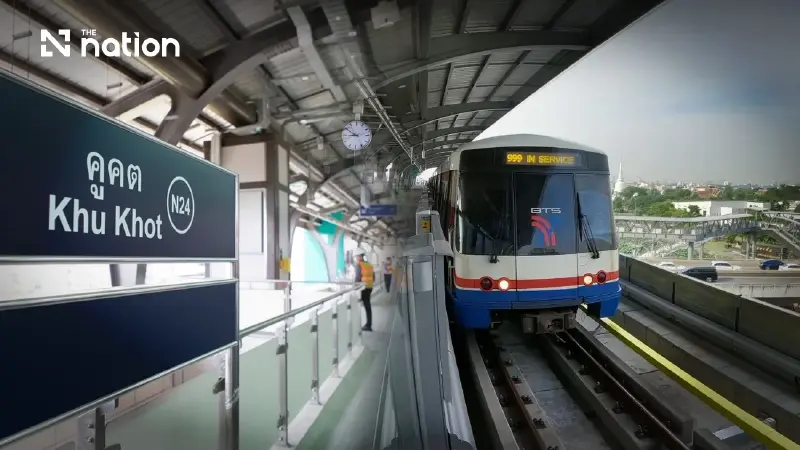


REIC data shows land prices along mass transit routes continued to climb in the second quarter of 2026, led by the Green Line extension from Khu Khot to Lam Luk Ka.
The rise in land prices across different areas is supported by several factors, but one of the clearest drivers is the expansion of electric rail networks.
Mass transit routes raise the potential of locations, improve travel convenience and attract private-sector investment.
Once a rail system reaches an area, property developers often move quickly to acquire land for residential projects, both low-rise developments and condominiums.
At the same time, retail operators, office developers and mixed-use project investors also seek out high-potential locations. This steadily increases land demand and becomes a key force pushing up prices in line with each area’s development potential.
Top 5 rail-route land price increases
The Real Estate Information Centre (REIC) of the Government Housing Bank found that prices of vacant land before development along electric rail routes in the second quarter of 2026 rose most strongly in five locations when compared year on year.
Most of the top-ranked plots are located along rail routes that are already in service.
1. Green Line: Khu Khot-Lam Luk Ka
The highest increase was recorded along the Green Line, Khu Khot-Lam Luk Ka section.
The land price index stood at 360.6 points, with prices rising 17.6% year on year.
2. Pink Line: Khae Rai-Min Buri
Second was land along the Pink Line, Khae Rai-Min Buri section.
The index stood at 318.5 points, with land prices increasing 9.7% year on year.
3. Orange Line: Thailand Cultural Centre-Min Buri
Third was land along the Orange Line, Thailand Cultural Centre-Min Buri section.
The index stood at 488.5 points, with prices rising 7.4% year on year.
4. BTS Sukhumvit Line and Airport Rail Link
Fourth place was shared by land along the BTS Sukhumvit Line and the Airport Rail Link.
Their land price indices stood at 504.2 points and 459.9 points, respectively, with prices on both routes increasing 7.3% year on year.
5. Yellow Line: Lat Phrao-Samrong
Fifth was land along the Yellow Line, Lat Phrao-Samrong section.
The index stood at 451.2 points, with prices increasing 6.3% year on year.
