
Greater Bangkok land prices rise as mass-transit networks expand
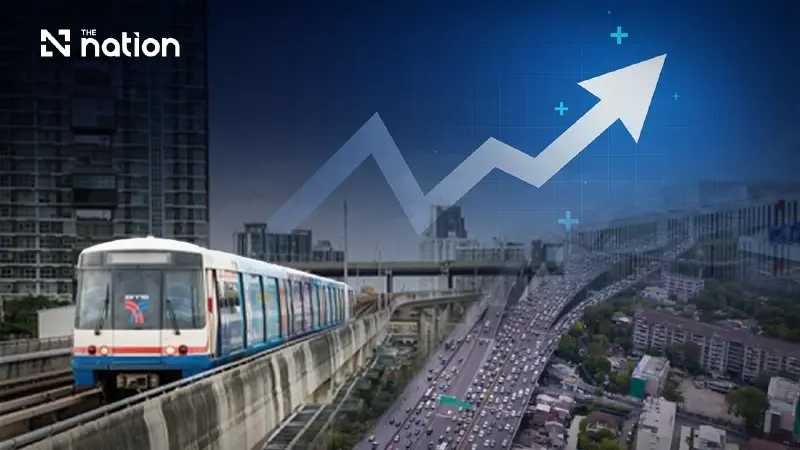


Greater Bangkok’s land price index rose 6.2% year on year, while eastern districts, outer areas and rail-linked locations recorded strong gains.
- Land prices in Greater Bangkok rose 6.2% year-on-year, with growth concentrated in areas along expanding mass-transit networks.
- The Phra Khanong–Bang Na area recorded the highest price increase at 36.3%, driven by its links to multiple transport systems and business district expansion.
- Specific transit lines are key drivers of value, with land along the future Green Line extension rising 17.6%, and areas along the Pink, Orange, and Yellow lines also seeing significant price growth.
- The trend reflects a shift in property development from the city center to suburban areas and surrounding provinces made accessible by new transport infrastructure.
Although Greater Bangkok’s land price index eased from the previous quarter in the second quarter of 2026, it remained 6.2% higher year on year.
The figures reflected “selective growth by location”, with eastern Bangkok and areas along mass-transit routes continuing to attract investment capital, while locations around the capital were emerging as a new competitive arena for property development.
Land price index remains on upward trend
The Real Estate Information Centre (REIC) of Government Housing Bank said the price index for vacant land before development in Greater Bangkok stood at 440.9 points in the second quarter of 2026.
It increased 6.2% from the same period a year earlier but declined 1.8% from the first quarter.
The figures showed that the land market remained in an upward cycle, but buying demand was no longer spread evenly across all areas as it had been in the past.
Investors and property developers were selecting locations with the potential to support urban expansion, transport systems and large-scale developments.
Phra Khanong–Bang Na area leads with 36.3% rise
The Phra Khanong–Bang Na–Suan Luang–Prawet area recorded the highest land-price increase during the quarter, rising 36.3% year on year, a rate several times higher than the market average.
Key factors included the expansion of business districts in eastern Bangkok, links between multiple transport networks, and the continuing development of mid- to upper-market housing and mixed-use projects.
As a result, demand for land for new developments increased markedly.
Outer Bangkok and surrounding provinces emerge as growth areas
Beyond Bang Na, locations in outer Bangkok and surrounding provinces also recorded notable land-price growth:
- Bang Khen–Sai Mai–Don Mueang–Lak Si–Min Buri–Nong Chok–Khlong Sam Wa–Lat Krabang: up 21.1%
- Mueang Nonthaburi–Pak Kret: up 17.2%
- Samut Sakhon: up 16.0%
- Mueang Pathum Thani–Lat Lum Kaeo–Sam Khok: up 11.8%
The pattern reflected the outward expansion of Bangkok’s “growth ring” into suburban areas and surrounding provinces.
As city-centre land prices continued to rise and development costs increased, developers turned to locations that still offered development potential and more favourable cost levels.
Mass-transit routes remain a key driver of land prices
Analysis of land along mass-transit routes found that infrastructure remained the main factor driving land prices:
- The Green Line’s Khu Khot–Lam Luk Ka section ranked first, with land prices rising 17.6%. Although it remained a future project, the increase reflected speculation and confidence in long-term urban expansion.
- The Pink Line’s Khae Rai–Min Buri section recorded a 9.7% increase.
- The Orange Line’s Thailand Cultural Centre–Min Buri section recorded a 7.4% increase.
- The BTS Sukhumvit Line and Airport Rail Link recorded a 7.3% increase.
- The Yellow Line’s Lat Phrao–Samrong section recorded a 6.3% increase.
Most of the routes were already operating or under construction, helping improve travel accessibility and steadily increase land values along their corridors.
Data for the second quarter of 2026 clearly showed that land prices were not rising solely because of market conditions but were being driven mainly by “infrastructure”.
Whenever a mass-transit project moved forward, surrounding areas became targets for property developers, investors and businesses, causing land prices to rise ahead of actual urban development.
At the same time, growth in locations around the capital reflected a transition in Thailand’s property market from competition in the city centre to competition along mass-transit routes and in surrounding provinces, where substantial long-term development opportunities remained.
Although the overall land price index slowed slightly from the previous quarter, the 6.2% year-on-year increase confirmed that “quality land” continued to attract interest.
This was particularly true of locations connected to new transport networks, which remained a key bet for developers in the next property cycle.
