
Thailand signs full Peru FTA to expand exports to Latin America
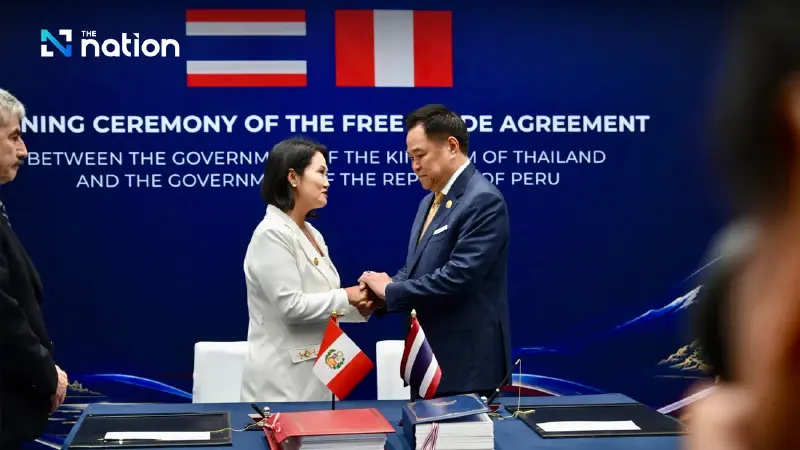


Thai firms are expected to benefit from the full Peru trade deal in 2027, subject to parliamentary approval and domestic procedures.
- Thailand has signed a full free trade agreement (FTA) with Peru to expand and diversify its export markets, with a specific focus on Latin America.
- The agreement is expected to take effect in 2027, following necessary parliamentary approval and completion of domestic procedures in Thailand.
- The deal aims to boost Thai exports of products such as vehicles and parts, food items (like fruit and fish), machinery, and construction materials.
- This strategic move is intended to counter global trade volatility and leverage new infrastructure, like Peru's Chancay Port, to strengthen trade routes.
Thailand has signed a full free trade agreement (FTA) with Peru as part of its push to diversify export markets, with Thai businesses expected to benefit in 2027 following parliamentary approval and completion of domestic procedures.
Deputy Prime Minister and Commerce Minister Suphajee Suthumpun signed the agreement with Peru’s Minister of Foreign Trade and Tourism, Rogers Martín Valencia Espinoza, during the 33rd Asia-Pacific Economic Cooperation (APEC) Economic Leaders’ Meeting in Shenzhen, China, on Thursday (November 19, 2026).
Thai Prime Minister Anutin Charnvirakul and Peruvian President Keiko Sofía Fujimori Higuchi witnessed the signing.

Suphajee described the deal as part of Thailand’s response to volatile global trade and intensifying competition, combining efforts to retain established export markets with a search for new opportunities, particularly in Latin America.
Parliamentary approval required for full FTA
The Ministry of Commerce will submit the agreement to Parliament for approval, then complete domestic procedures and other required steps before it enters into force.
“Signing the agreement is an important milestone, but our priority now is to ensure Thai businesses can make practical use of the opportunities it creates,” Suphajee said.
“That includes expanding markets for goods, operating in the services sector and building partnerships with Peruvian companies,” Suphajee added.
“The Ministry of Commerce will therefore expedite the necessary procedures to bring the agreement into force as soon as possible, allowing Thai businesses to take full advantage of it,” she said.

The signing followed the resumption of negotiations in 2025, after talks had stalled in 2014.
Vehicles, food and machinery among export opportunities
Suphajee identified Peru as one of Latin America’s economies with the strongest growth potential, with demand for products in which Thailand has export strengths.
Potential export products include vehicles and parts, tyres, dietary supplements, catfish and tilapia meat, pineapples, papayas and processed fruit.
Peru’s infrastructure development is also increasing demand for machinery and construction materials, while plastics and veterinary supplies for pets offer further opportunities, according to Suphajee.

The minister expected the FTA to create jobs, raise incomes and distribute those gains more widely, helping to improve living standards in both countries.
Chancay Port could strengthen Latin American trade links
Development of Chancay Port, a major port north of Lima, could improve shipping capacity and strengthen trade routes between Asia and Latin America, Suphajee said.

Faster, more convenient shipping and potential logistics savings would help Thai businesses expand in Peru and other regional markets, she added, with the full FTA offering an opportunity to make better use of those connections.
Trade with Peru grows 33.66% in first nine months
Bilateral trade between Thailand and Peru reached US$555.24 million in January–September 2026, an increase of 33.66% from the same period a year earlier.

Peru ranks as Thailand’s fourth-largest trading partner in South America, after Brazil, Argentina and Chile, and its 60th-largest worldwide.
Thailand’s main exports to Peru include vehicles and parts, canned and processed seafood, washing machines, dry-cleaning machines and their parts, machinery and parts, and rubber products.

Thailand’s principal imports from Peru include fresh, processed and semi-processed aquatic products, natural gas, vegetables and fruit, metal ores and related products, and plants and plant-based products.
