
Red and blue APEC scarves highlight Shenzhen's cultural heritage
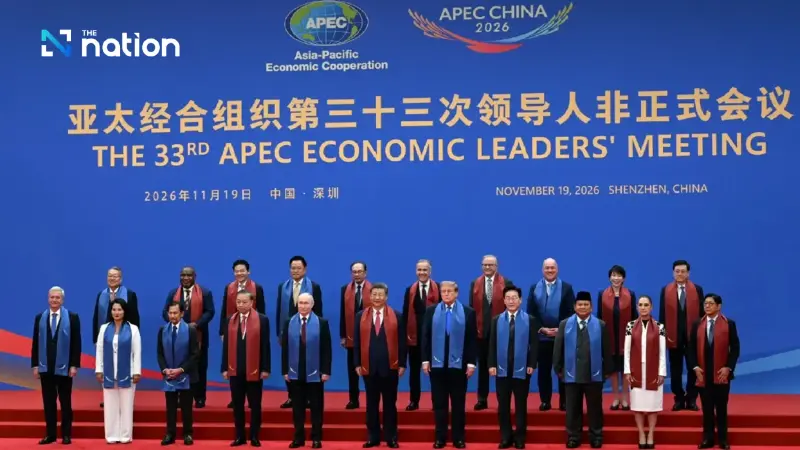


The red and blue scarves worn for the APEC 2026 group photo feature 21 interwoven feathers, reflecting Shenzhen's heritage and cooperation among member economies.
The red and blue scarves worn by world leaders at the Asia-Pacific Economic Cooperation (APEC) summit in Shenzhen, China, carried a cultural message linking the host city's heritage with cooperation among the forum's 21 member economies.
The scarves attracted attention during the traditional group photograph at the summit, held in Shenzhen, Guangdong province, on November 18–19, 2026.
Chinese President Xi Jinping was among the leaders who chose red, while US President Donald Trump, Russian President Vladimir Putin and Thai Prime Minister Anutin Charnvirakul wore blue.

A mythical bird representing regional cooperation
The design incorporates the summit's official emblem, embroidered near the ends of each scarf.
The emblem features 21 interwoven feathers forming the outline of the Dapeng, a giant mythical bird associated with Shenzhen's traditional nickname, Pengcheng, meaning the City of the Peng Bird.
Each feather represents one of APEC's 21 member economies. Their interconnected arrangement symbolises the diversity of the economies, their mutual dependence and their commitment to working together towards a shared Asia-Pacific future.
The scarves also reflect a shift in APEC's longstanding practice of incorporating the host economy's cultural identity into the clothing worn by leaders for their official group photograph.
How APEC's traditional dress custom began
The tradition dates back to 1993, when US President Bill Clinton presented leather jackets to visiting leaders at the first APEC Economic Leaders' Meeting on Blake Island, near Seattle.
The gesture was intended to encourage a more informal atmosphere among participating leaders, establishing a custom that subsequent hosts developed through their own national and regional clothing traditions.
Over the following decades, APEC group photographs featured a wide range of distinctive garments, including Malaysian batik shirts and Vietnam's traditional ao dai.
However, elaborate designs and unfamiliar cuts did not always sit comfortably with the formal business attire preferred by many leaders.
Some garments featured striking colours, intricate patterns or loose-fitting designs, prompting later hosts to adopt more restrained approaches that retained a connection to local culture without requiring participants to change their formal clothing.

From traditional garments to simpler accessories
Peru demonstrated this change when it hosted the summit in 2016.
Rather than repeat the loose alpaca-fibre ponchos worn by leaders at its previous summit in 2008, Peru selected shawls made from fine vicuña fibre.
The more understated design allowed leaders to wear the traditional textile over their business suits.
South Korea followed a similar approach in 2025, choosing scarves inspired by the traditional hanbok.
The decision marked a departure from the long silk coats worn by leaders when South Korea previously hosted the summit in 2005.
Both examples reflected an emerging preference for accessories that could convey the host's cultural identity while preserving the formal appearance of the international gathering.

China's evolving approach to APEC fashion
China has also used traditional clothing to present its cultural heritage at previous APEC summits, while adapting historic designs to contemporary styles.
At the 2001 summit in Shanghai, leaders wore Chinese-style silk jackets inspired by traditional Tang-style clothing. The garments featured decorative peony patterns surrounding the APEC initials.

When Beijing hosted the summit in 2014, China introduced carefully tailored garments described as a new Chinese style.
The designs combined traditional elements associated with different Chinese dynasties with modern tailoring.
They also incorporated Song brocade, a traditional silk-weaving craft associated with the Song dynasty (960–1279) and recognised as part of China's intangible cultural heritage.
The garments demonstrated how traditional Chinese textile techniques and ceremonial designs could be adapted for contemporary diplomatic occasions.
The scarves selected for the 2026 Shenzhen summit represent a further development of that approach.
By incorporating the mythical Peng bird into a simple accessory, the host maintained APEC's tradition of showcasing local culture while emphasising the interconnectedness of the Asia-Pacific region.
The result was a more understated expression of Chinese heritage, allowing leaders to retain their formal suits while participating in a shared diplomatic custom.
