
English programmes face lack of teachers


Play
Problem poses challenge to plan to expand EP, MEP schemes
The Office of the Basic Education Commission (Obec)’s plan to increase enrolments in the English Programme (EP) and Mini-English Programme (MEP) is a positive initiative that will boost this much-needed skill among students, but like other education policies, obstacles threaten to compromise its quality.
People involved with the programmes say that to maintain quality, more students require more teachers, and that this is something that also affect students in non-English programmes.
Obec Secretary General Chinnapat Bhumirat recently announced the commission’s plan to allow more than 200 schools offering such English programmes and special science and mathematics programmes to increase enrolment in them from 20 per cent of all new students to 30 per cent.
Watanaporn Ra-ngubtook, PhD, director of the English Language Institute of Obec in charge of EP and MEP, said that with limited resources, if this plan is to be implemented, the school would have to reduce the number of students enrolled in regular programmes conducted in Thai.
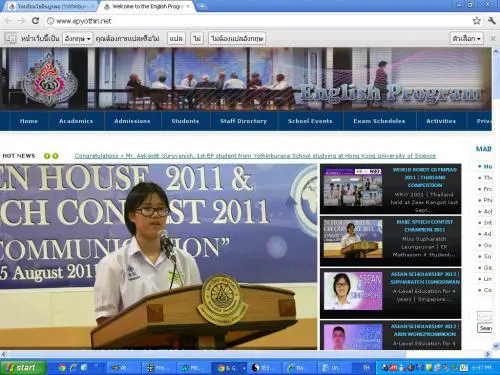
Yothinburana School Deputy Director Manoch Wangtrakul said the school would hold a meeting of its board to discuss whether the school will be able to increase enrolment in its EP, because it has limited space to build more classrooms. “If we agree to increase enrolment in EP, we will have to reduce enrolment in normal programmes and hire more foreign teachers.”
Watanaporn said that foreign teacher recruitment was also a problem as it was difficult to find eligible teachers who were fluent in English, flexible enough to adjust to teaching in a Thai classroom context, and had good teaching techniques and academic qualifications.
“The schools cannot import only native English speakers, as it difficult to find ones who have all the required qualifications. Some are good at English, but not good at math and science. So, they hire teachers from the Philippines who are fluent in English and good at math and science,” she added.

“They have to spend more on salaries for foreign teachers than the Obec schools do, because they have not received any financial support from the government,” said Chanwit.
“If Obec really wants to increase student enrolment in EP in Thailand in response to the demands, the government will have to allocate funds to the private schools, too, so, they will be able to hire more foreign teachers,” he added.
Watanaporn said the quality of teachers was crucial. As a result, the schools had to strictly assess all the teachers’ abilities. Obec also has EP and MEP coordinating centres in different parts of the country to give advice to the schools and survey what they need and report to Obec so it can give them assistance.
Meanwhile, Obec has to conduct internal assessments at the private schools every three years, while the Office for National Education Standards and Quality Assessment does an external assessment every five years, Chanwit said.
He the schools had to keep the education quality high as parents whose children study in EP had higher expectations than those whose children were in normal programmes.
According to Obec, on average, three students compete for every seat in the special programmes.
The ratio is even higher at Yothinburana, a state school which has offered EP for 14 years. At this popular school, there is only one seat for every 10 applicants, according to Manoch.
EP and MEP are seen as good choices for middle class parents who want their children to be equipped with English, although they study in Thailand, as both programmes are much cheaper than international programmes.
Given the overwhelming demand, more schools are trying to grab this opportunity in both the state and private sectors.
Watanaporn said about 70 state schools had submitted requests to launch EP and MEP programmes, and that these were under consideration. Most are in the North and Northeast.
Chanwit said fewer than 10 private schools had submitted requests to open EP courses. Opec found that many of the private schools had been opened in response to an influx of foreign and Thai parents working at industrial estates.
Due to the free flow of labour in the upcoming Asean Economic Community, Chanwit wanted the government to equip skilled vocational students with English so they would be more competitive. Only six private vocational institutes provide EP now.
