
PM might have made a blunder by ignoring Aung San Suu Kyi
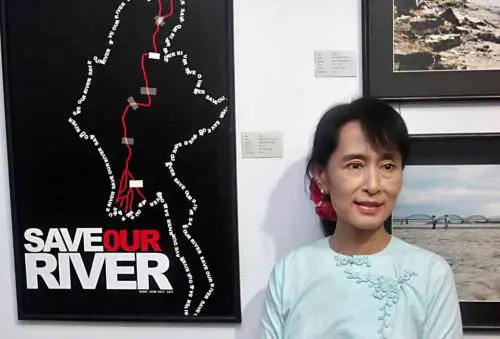


Prime minister's short visit and her failure to meet democracy icon cuts Thailand's role in reforming Burma
Making her first visit to Burma yesterday, Prime Minister Yingluck Shinawatra missed a golden opportunity to go along with the country’s reforms and put Thailand in the right position in the changing regional geopolitics by her failure to meet pro-democracy leader Aung San Suu Kyi.
Yingluck landed in Burma’s new capital of Naypyidaw in the afternoon and spent only 10 hours with senior officials, including President Thein Sein, discussing bilateral cooperation between the two countries.
She handed over meteorological equipment to help Burma improve its weather forecasting as well as witnessed a signing ceremony on road construction and the repair of a friendship bridge.
She also paid homage to Uppatasanti pagoda in Naypyidaw.
President Thein Sein hosted a dinner for Yingluck and her delegation before her departure from the capital city at the end of her official visit late at night.
Before the visit, a government source said the prime minister’s discussions with her Burmese counterpart would focus on economic cooperation such as energy cooperation as Thailand imports a lot of natural gas from Burma.
Thai construction firm Italian-Thai is developing a mega deep seaport, a highway and an economic zone in Dawei to link economic activities between Thailand and Burma.
Nothing is wrong with such A visit, other than the message it sends is that the two countries have just a conventional relationship.
However, Burma is not a normal neighbouring country with which Thailand wants to simply ensure relations of mutual economic interest.
Burma is situated in one of the world’s strategic locations and shares borders with two regional powerhouses: China and India.
Political conflict in Burma, notably between the government and ethnic minorities, poses a lot of troubles to Thailand.
Furthermore, Burma is in the process of reform towards democracy and reconciliation. The international community, including the United Nations, United States, European Union and Asean, are carefully looking at changes inside Burma.
Aung San Suu Kyi is a crucial part of these reforms and national reconciliation. She is now free and allowed to see foreigners and to exchange views on the changes in her country. Many senior officials from the UN, US and EU have met with her to ask her opinion about Burma’s future.
Indonesian Foreign Minister Marty Natalegawa, as the chair of Asean, is to visit Burma soon and will meet Aung San Suu Kyi to ask her opinion whether Burma should take the Asean chair in 2014.
Aung San Suu Kyi does not know Yingluck personally but she congratulated Yingluck immediately after she won the July election and became Thailand’s first female prime minister. Aung San Suu Kyi hoped Thailand’s newly elected government would be an inspiration and that the new PM could help her country to install democracy and restore national reconciliation.
So far, Yingluck has not yet said a single word to support Aung San Suu Kyi and political reform in Burma.
