
Monks on a mission to restore hope
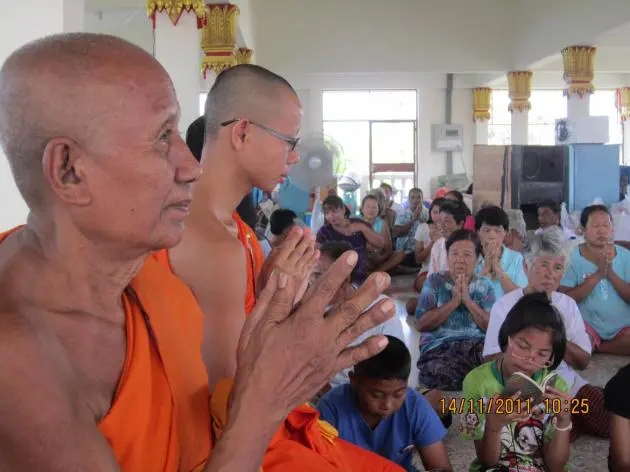


"Let the water flood your house. Don't let your mind get flooded with suffering," Phra Sabchoo Mahavero tells evacuees at Parayrai Temple in Nonthaburi.
Before him are men, women, the aged, boys and girls whose homes have been inundated for more than a month. According to Phra Sabchoo, these people did not lose only their external tangible possessions but also internal resilience to accept the truth that one or two metres of water are in their house.
“That’s why we’re here, to provide them emotional help, to restore their hope and to make them able to look forward rather than look back to what they have lost,” says the monk.
Phra Sabchoo is a volunteer with the Dharma for the Mental Rehabilitation of Flood Victims Project, which is a collaboration of Sa Ket Temple and the National Buddhism Office, on behalf of the Supreme Sangha Council.
With the aim to ease the suffering and stress of flood victims, the project has dispatched volunteer monks with training in Buddhist psychology and counselling from various temples to evacuation centres. Some volunteer monks come from far-flung provinces such as Narathiwat and Pattani.
“During a normal situation, monks have to rely on Buddhist layman [by offering food]. During a crisis, monks must be the ones layman can lean on,” says Phravijitrdhammabhorn, assistant abbot of Sa Ket Temple.
Phravijitrdhammabhorn, also the secretary-general of the Office of Morality, Ethics and Security of the National, Religion and Monarchy Promotion of Wat Sa Ket, which is responsible for the initiative, says volunteer monks will not simply rush in and try to fix flood victims’ psyches with Dhamma, but provide them some certain principles to empower their minds and spirits to get through the crisis.
Central Thailand has been inundated for more than three months. Though the waters have receded in many areas, 7,210 villages and communities in 23 provinces, including the capital of Bangkok, are still submerged. The emotional and psychological problems of more than 1.3-million flood victims have become a vital concern, as a psychiatric check-up by the Public Health Ministry found 1,154 affected people at risk of committing suicide. More than 7,300 were feeling depressed and 6,170 were under stress.
“Their stress and emotional burden must be eased and Buddhist psychology can be a means,” says Phravijitrdhammabhorn.
By telling the affected people not to let their minds be flooded with suffering caused by the flood, Phra Sabchoo is asking them to give him some good things that they see from the floodwaters. Dhamma books and amulets are used to draw the victims’ attention as rewards for those who come up with an answer.
“Brought all of us here together,” “allowed monks [of the project] to come see us,” “got free kanom [sweets] from visitors” are among the answers Phra Sabchoo received from people of all ages.
“Keep in mind that amid the harsh situation, there are still good things. You can lose anything but your willpower to continue living,” says the volunteer monk to the flood victims while handing them books and amulets.
It is true that hope cannot be restored within one or two hours. But the short time the monks spend with the flood victims means a lot to them.
“So happy being visited by the monks. This means our suffering is seen by them. We aren’t left alone,” says Ampai Sairoong, 69, who has been here since late last month.
Phra Sabchoo wishes the moral support the victims get today would help them generate more internal strength and be able to get through the flood crisis.
The Dharma for the Mental Rehabilitation of Flood Victims Project, financed partly by the National Buddhism Office, started early this month. More than 50 volunteer monks are involved and more than 5,000 people at about 100 evacuation centres have been visited.
