
Fugitive Arisman surrenders in Pattaya


Play
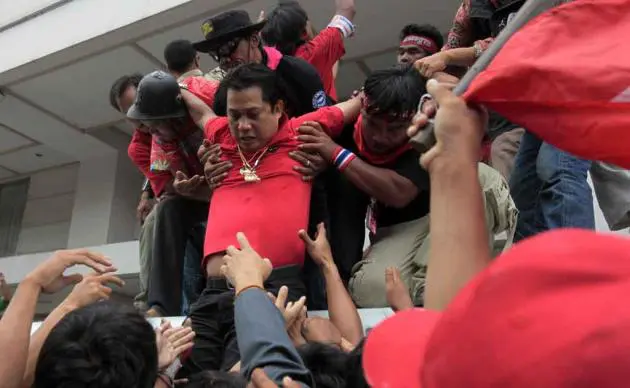
Fugitive red-shirt leader Arisman Pongruangrong yesterday surrendered to the Pattaya Provincial Court in connection with the case relating to the disruption of the Asean Summit in 2009 by red-shirt protesters, according to a source.
Arisman was accompanied by his lawyers when he arrived at the court yesterday afternoon. He was later granted temporary release with a bail of Bt2 million, according to the source.
Court officials will hold a press briefing this morning to give more details about Arisman’s surrender and the legal proceedings regarding the case, the source said.
The government was forced to cancel the 2009 summit in Pattaya after a large group of red-shirt protesters stormed into the conference venue at a local hotel.
Arisman will surrender to the Department of Special Investigation (DSI) at 10am today to face charges related to five violent incidents during last year’s political mayhem. He will be booked at the DSI before acknowledging his indictments at the Office of the Attorney-General. DSI director-general Tarit Pengdith said public prosecutors would be responsible for bail review.
Arisman will be booked at the Department of Special Investigation (DSI) before acknowledging his indictments at the Office of the Attorney General.
DSI director-general Tharit Pengdith said public prosecutors would be responsible for bail review.
Arisman fled Bangkok following the dispersal of the crowd at the Ratchaprasong rally site in May 2010. He reportedly sought and received safe haven in Cambodia.
He was a key organiser of red-shirt street protests at the Rajdamnoen and Ratchaprasong rally sites from March to May last year.
The five violent incidents with which his is linked are the siege of and trespass on Parliament grounds; the raid at the ThaiCom satellite uplink station; involvement in terrorism; the theft of anti-riot weapons; and the use of force to resist arrest at the SC Park Hotel.
Justice Ministry permanent secretary Kittipong Kittayarak said the outcome of the bail review for Arisman would hinge on details of the five incidents.
Meanwhile, Deputy Prime Minister Chalerm Yoobamrung said yesterday he had learned that the Reuters news agency hired “international detectives” to investigate the death of news photographer Hiroyuki Muramoto, who was shot dead near the Democracy Monument during a clash between protesting red shirts and soldiers in April last year.
He said the investigators had presented a 60-page report containing their findings to Thai police. “They [Reuters] said they did not submit the report earlier because the previous government’s outline was inconsistent with what their independent detectives found. They only sent it [to police] after they discovered that I am serious about this case,” Chalerm said.
Chalerm, who is in charge of police affairs, denied he was trying to influence the police investigation into the case, before going on to say that he was sure state security personnel were responsible for the Japanese cameraman’s death.
Findings by independent investigators probing the death of the Japanese cameraman during last year’s red-shirt protest were inconsistent with the version of events provided by the previous government, he said.
In response to Chalerm’s claim, opposition leader and former prime minister Abhisit Vejjajiva, who led the administration that oversaw the crackdown on the protests, yesterday described the deputy prime minister’s latest remark as an attempt to influence a police investigation into the matter.
Abhisit, who leads the Democrat Party, said yesterday that Chalerm appeared to be politicising the case.
He urged police investigators to handle the case straightforwardly and not to allow their probe to be influenced by any politician, as they would eventually be responsible for the contents of their report.
“The government should allow the investigators to work independently. I hope the authorities will act straightforwardly so that the truth will be discovered and justice will be served,” Abhisit said. “Politicians should step back and allow people responsible for finding facts to do their duty.”
When asked why he thought Chalerm was coming forward with details on this matter now, Abhisit said: “He probably wants to please someone. Maybe it has something to do with the imminent Cabinet reshuffle.”
He also said he had no concerns about facing police questioning this Friday in connection with the deaths of red shirt protesters during the government crackdown and ensuing riots.
Abhisit and another Democrat heavyweight, Suthep Thaugsuban, who served as deputy premier in charge of the previous government’s Centre for Resolution of the Emergency Situation, are blamed by their political enemies for the deaths of protesters killed in the incident.
In a related development, the House committee on studies for national reconciliation plans to invite people involved in the political conflict to testify, committee member Chavalit Vichayasut said yesterday.
Chavalit, from the ruling Pheu Thai Party, said the panel was trying to determine the key factors that could resolve the differences at the heart of the political conflict, and eventually to reconciliation. He added that the panel had made “much progress” in its work.
The panel’s chairman, General Sonthi Boonyaratglin from the Matubhum Party, said after yesterday’s committee meeting that it was agreed among participants from different parties that forgiveness could bring about reconciliation.
Supachai Jaisamut, a panel member from the Bhum Jai Thai Party, said that for him justice and the principle of “forgive and forget” would bring an end to the political conflict. He said many other countries with worse conflicts than Thailand’s had been able to use the model to achieve reconciliation.
