
Tax breaks await those who help repair effort


Play
Public donations for the repair of flood-ravaged historical sites will soon qualify for tax breaks.
“After the tax incentives are finalised, we will request help from the private sector,” Culture Minister Sukumol Kunplome said yesterday.
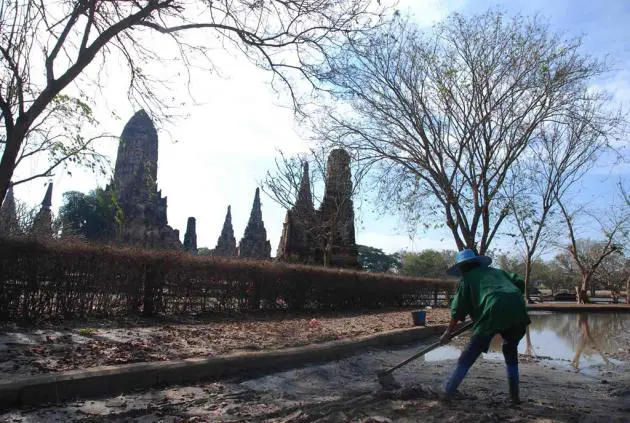
The worst floods in decades have submerged ancient structures for months, especially those in the world heritage zone in Ayutthaya.
After flood waters in the former capital of Thailand subsided, a team of experts from the United Nations Educational, Scientific and Cultural Organisation (Unesco) inspected the damage last week and found the wall of Choeng Thar Temple blemished by salt stains and a section of the wall of Ayothaya Temple crumbling.
The foreign experts and their local counterparts have held discussions on how best to return the damaged structures to their original condition.
Next a team from Japan will be coming on December 18.
The local experts had a wealth of work experience but the foreign specialists could provide new techniques.
The ministry is considering reviving a network of moats to protect sites from flooding in the future.
The Cabinet has already approved in principle her ministry’s request for a Bt1.48 billion budget to restore 313 sites and has given the green light for the Bt45 million plan to repair 141 mosques and Christian churches.
Anek Seehamart, director-general of the Fine Arts Department, instructed Chaiyanan Bussayarat, director of the Phra Nakhon Si Ayutthaya Historical Park, to strictly monitor tourist activities inside Chaiwattanaram Temple, which remained partially flooded.
“Boat rowers have sometimes hit the temple’s ancient wall with their oars. Some parts of the brick wall have fallen off,” he said. Some visitors were also seen walking on the base of the temple’s pagoda.
“Such activities may harm the pagoda. Please don’t do that,” he said.
