
Unesco surveys damage to Ayutthaya World Heritage site


Play
International experts have expressed concern about the stability of floodhit historic sites in Ayutthaya.
Tim Curtis, chief of Unesco Bangkok’s Culture Unit, said: “There is a need to closely monitor the condition of the sites and the affected monuments, especially in the next few months as foundation and structures dry out, as well as, of course, over the long term.”
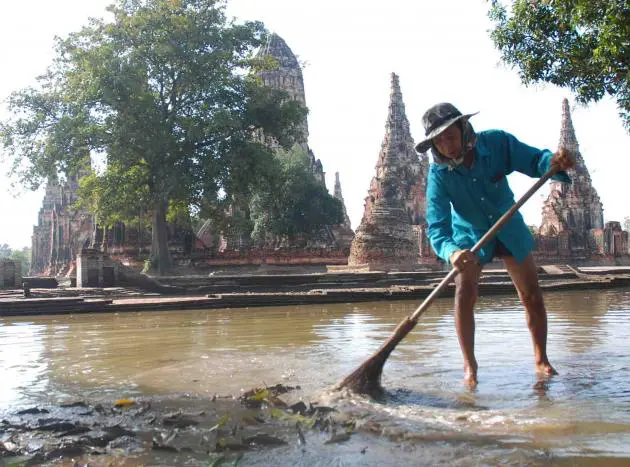
The entire historic island of Ayutthaya and its surrounding area was submerged by floods for over a month starting on October 4. In some areas, the flood waters reached a level of approximately 3 metres. While the water has receded in the inner island, a number of monuments in the outer periphery remain flooded. More than 100 historic monuments in and around Ayutthaya World Heritage Site have been affected by floods, according to the Ministry of Culture’s Department of Fine Arts.
In response to the flooding crisis, the first official international expert mission to Thailand to assist in the restoration of the Ayutthaya Historical Park and cultural monuments in Ayutthaya was organised last week at the request of the government to plan for the postflood recovery. It included damage assessment, emergency stabilisation, restoration and longterm mitigation planning.
With support from Unesco, the mission included Mr Carlo Giantomassi, mural painting expert from Italy, and Dr Zoran Vojinovic, watermanagement specialist from UnescoIHE Institute for Water Education in the Netherlands.
Giantomassi said the situation regarding the city’s historic murals is of serious concern. The murals have been damaged by water and salt, and also show cracking. Due to capillary action, the water has risen up from 80 cm to 2 meters high. Based on rapid field testing, both sulphate and nitrate salts were found.
“The situation is very bad in 90 per cent of the cases, because of the humidity from the 80cm to the 2metre level and the presence of sulphate and nitrate. A great problem in Thailand is the humidity and capillarity. Every wat [temple] I visited was affected by this problem. If you don’t stop it completely, there will be a lot of damages in the future,” he said.
Vojinovic suggested that water management needs to be carried out at both micro and macro level. The flow capacity of the waterways in Ayutthaya is approximately 1,500 cubic metres per second. As the measured inflow on October 4 was 3,300 cubic metres per second, flooding occurred.
“A combination of both structural and nonstructural solutions needs to be considered; one without the other will not be sufficient,” he said.
The field survey mission was undertaken on November 30 and December 1 to key monuments in Ayutthaya, some of which are still partly flooded, such as Pom Phet Fort and Wat Chaiwattanaram, while others are already dry, such as Wat Phra Si San Phet. A detailed assessment will be required to determine the extent of any damage.
The international experts were working alongside Thai specialists from the Asian Institute of Technology, the Department of Public Works and Town Planning, the Engineering Institute of Thailand, ICOMOS Thailand and the Association of Siamese Architects. The mission was accompanied by specialists from the Fine Arts Department and representatives of the embassies of Portugal and the Unites States.
The historic city of Ayutthaya was inscribed on the World Heritage List in 1991.
