
Compensation to be paid by Chinese New Year : Yongyuth


Play
Compensation will come in two parts; one in cash, remainder in govt bonds
The government's compensation package for victims of political unrest over the past six years will be partially paid in the form of Government Saving Bank lottery deposits or unit investment in mutual funds, a senior Cabinet figure said yesterday.
Deputy Prime Minister and Interior Minister Yongyuth Wichaidit said the total compensation for each case of death or severe disability is Bt7.75 million, which will be paid in two parts.
The first part of Bt3.25 million will cover compensation for traumatic consequences (Bt3 million) and funeral expenses (Bt250,000), while the remaining Bt4.5 million will be compensation for the loss of life or loss of limbs. He said the first Bt3 million payment, initially for families of those who lost their life, would start as early as Chinese New Year’s Day, which falls on January 23.
The remaining Bt4.5 million per case would be paid in the form of Government Savings Bank lottery deposits or fiveyear unit investment in mutual funds.
“This will give victims’ families savings as well as a chance to win a big reward. They can withdraw the money once the fiveyear investment comes to an end,” he said.
This payment could be made within a month and a half at the earliest or within two months at the latest.
Yongyuth said a subcommittee would be set up by next week to implement the compensation package, which was approved by the Cabinet on Tuesday, to consider which ministry should be made responsible for the payments.
Deputy Prime Minister and Interior Minister Yongyuth Wichaidit said the total compensation for each case of death or severe disability is Bt7.75 million, which will be paid in two parts.
The first part of Bt3.25 million will cover compensation for traumatic consequences (Bt3 million) and funeral expenses (Bt250,000), while the remaining Bt4.5 million will be compensation for the loss of life or loss of limbs. He said the first Bt3 million payment, initially for families of those who lost their life, would start as early as Chinese New Year’s Day, which falls on January 23.
The remaining Bt4.5 million per case would be paid in the form of Government Savings Bank lottery deposits or fiveyear unit investment in mutual funds.
“This will give victims’ families savings as well as a chance to win a big reward. They can withdraw the money once the fiveyear investment comes to an end,” he said.
This payment could be made within a month and a half at the earliest or within two months at the latest.
Yongyuth said a subcommittee would be set up by next week to implement the compensation package, which was approved by the Cabinet on Tuesday, to consider which ministry should be made responsible for the payments.
Yongyuth, speaking in his capacity as chairman of the government’s committee for coordination, was following up on recommendations made by his Truth for Reconciliation Commission of Thailand (TRCT).
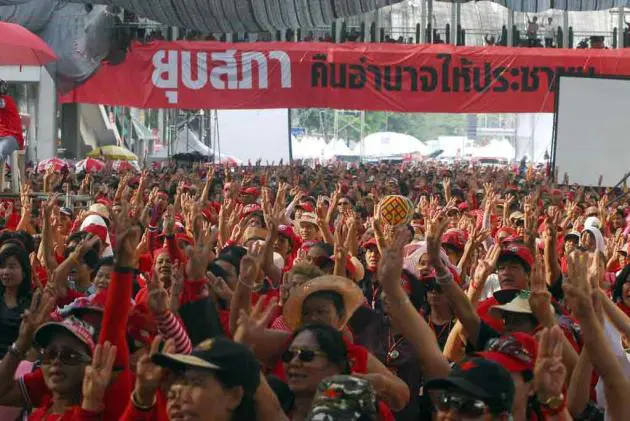
At the suggestion of the panel, the Cabinet has agreed to pay compensation for casualties of political unrest over the past six years – from late 2005, when protests broke out during the Thaksin Shinawatra government, until May 2010 during the time of Abhisit Vejjajiva’s regime.
Apart from the Bt7.75 million payment for those who died or became severely disabled, people who lost their organs will be given between Bt1.8 million and Bt3.6 million, while the injured will get between Bt200,000 and Bt1.12 million, depending on the severity of their wounds. All medical costs will be covered and distraught families will be compensated for the emotional impact they have suffered.
“These payments are not being made to appease the red shirts, who demanded compensation earlier. The remedy is part of recommendations from the TRCT, which was set up by the previous government,” Yongyuth said, adding that the initial focus would be on the 91 deaths caused during the 2010 political unrest.
“The compensation will be paid as early as possible – many of the victims have been waiting for it since before the [September 2006] coup,” he said.
However, the opposition Democrat Party said yesterday that the government was rewarding its redshirt supporters for staging street protests in 2010 in a bid to oust Abhisit’s administration.
Democrat MP Satit Pitutacha said he would file a petition with the Administrative Court as he considered the compensation payments as preferential treatment, adding that the families of those killed in the Tak Bai and Krue Se crackdowns in the South during Thaksin’s tenure also deserved similar aid.
“I do not think reconciliation can be achieved by giving money to the violators of law,” the opposition MP said.
Yongyuth said yesterday that the government was also considering whether to pay similar compensation for casualties of insurgent violence in the southern border area.
“Prime Minister Yingluck Shinawatra is worried about this matter and there is a committee looking into it,” he said. Justice Minister Pracha Promnok and Deputy Prime Minister Chalerm Yoobamrung oversee this panel.
Chalerm said yesterday he did not know when the government would be able to decide whether or not to pay compensation to distraught families in the deep South.
“If I could make the decision alone, I would give them compensation,” he said.
