
Return of banned politicians will create 'dream team'


Play
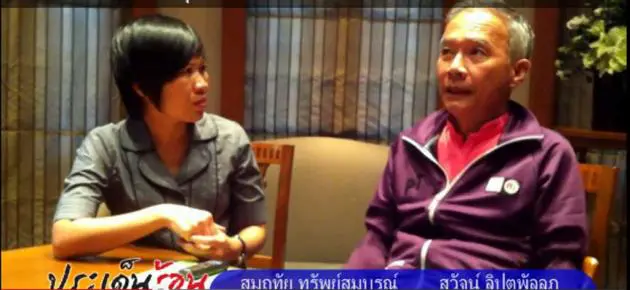
Veteran politician Suwat Liptapanlop tells The Nation's Somroutai Sapsomboon that a major Cabinet reshuffle is inevitable, but believes that reconciliation can be achieved if all parties talk to each other
Veteran politician Suwat Liptapanlop predicts a seismic shift in Thai politics when the 111 politicians hamstrung by a five-year court ban are finally freed in two months.
“There will be a Cabinet reshuffle and I expect it will be a big shake-up,” he said.
The 111 senior politicians, who were banned five years ago following the dissolution of the Thai Rak Thai Party on May 30, 2007, have a wealth of experience in politics and administration. They had the ability to rescue the country from crises many times in the past. The public could be confident of the Cabinet if they get in, he said.
The former deputy prime minister and holder of many ministry portfolios compared the Cabinet to a soccer team.
“There are a lot of substitution players because the real players have been given a red card. So, when the real players can come back into the game, it will be a dream team that will make the team stronger.”
However, Suwat said he did not know exactly how many of the 111 would return to politics.
“Some might think that staying home is safer than going outside. They might be hit on the head or have an accident, so they keep out of politics.”
Suwat declined to confirm whether he had met former boss Thaksin Shinawatra in Dubai recently and to say clearly whether he would return to the political fray.
THINGS HAVE CHANGED
He said politics now is completely different from the past as all parties, including small ones, are important because the cabinet has to be formed by many parties.
Politics has been divided into two corners, like a boxing ring – one was red and the other blue.
“The two big party system is good for politics. It makes for a strong government but there is more confrontation in political society.”
It was a hard time for small parties, including his former party, Chart Pattana, he said. Small parties have to become something like provincial or local parties if they want to be independent from the two major rivals.
National reconciliation, what many factions are calling for, would come about if there were informal talks among all parties. The discussions should be led by a respected figure.
Although reconciliation has not yet arrived, the country has already passed the crisis point.
“Before the general election, we were worried that people might not accept the result. We were worried that the government could not be formed. But we have nothing to worry about now,” he said.
Asked if the charter amendment movement could create a deeper division in the country, Suwat said the amendment should be strictly in keeping with democratic principles.
“If the amendment is done by the representatives of the people and for the country’s sake, not for any individual, the amendment will not be a problem.
“The constitution is very fragile. The charter drafters need toughness with care,” he said.
After seven moths of experience in office, the country’s first woman prime minister, Yingluck Shinawatra, is now tougher and stronger in many respects.
“It’s like she goes to a fitness centre every day so she gets stronger. From a greenhorn politician, she now knows more about politics and is more confident in handling things,” he said.
“Yingluck’s femininity helps to make everything around her look good.”
