
ABAC students' project made dreams come true


Play
PR assignment taught two groups much about life and giving
It’s true how our dreams, the things we hope for, usually get smaller and smaller every day as we grow bigger. For some children, these dreams, right from the beginning, are never big.
As public relations students from Albert Laurence School of Communication Arts, Assumption University (ABAC), we learned all the theories about PR in every angle from both inside and outside class. And as a requirement, we needed to integrate all this knowledge and experience for our final project on how to conduct a public relations campaign for an organisation.
Our group of eight, calling ourselves “OMNIFIC”, tried hard to choose a nonprofit organisation which was really in need. Eventually we received a recommendation from a lecturer who is also our adviser, Ajarn Chatkaew Nuntapanich, who was eager to share with us stories about Yaowawit School in Kapong district of Phang Nga province. She worked there during its first few years of operation before moving back to rejoin ABAC. She is still a long-time volunteer at Yaowawit.
“If I were you, I would support an organisation that believes in self-sustainability. I don’t mind which organisation you choose to work with because it is your project, but if I were you I would go for Yaowawit,” Chatkaew said.
We hesitated a bit at first due to the distance. However, we finally decided to choose Yaowawit as our client.
Right after our decision we made our first 800km trip to the school. The aim was to find out what problems the school had that would be something we could use our PR skills to help solve.
“It just didn’t look anywhere near what I imagined a school for needy children would be like,” Purivat Samervong, one of our members said.
Its buildings looked beautiful, unlike other schools for underprivileged children, but we chose it because it is a boarding school for more than 100 underprivileged children with a tough burden coping with the operational costs in running the school.
It is located in a valley in the Kapong district, surrounded by beautiful green clearings, which get fogged up – especially in the morning. In 2005, just a year after the tsunami, the school founder, Philipp Graf von Hardenberg from Germany, collected enough money to start building the school for impoverished children, from tsunami orphans to children from the poorest of the poor families.
The school received a lot of support during its construction, and for the resources and responsibility needed to take care of underprivileged students. But it still needed to seek enough income to cover all its operational costs.
“This is something people out there do not see,” Sabine Kraus, the volunteer project manager said. “Someone used to say that it’s like driving a Mercedes Benz, but still needing money for the gas to run the car.”
We found many students wanted to work in the airline industry, but at first their hopes seemed too big a dream.
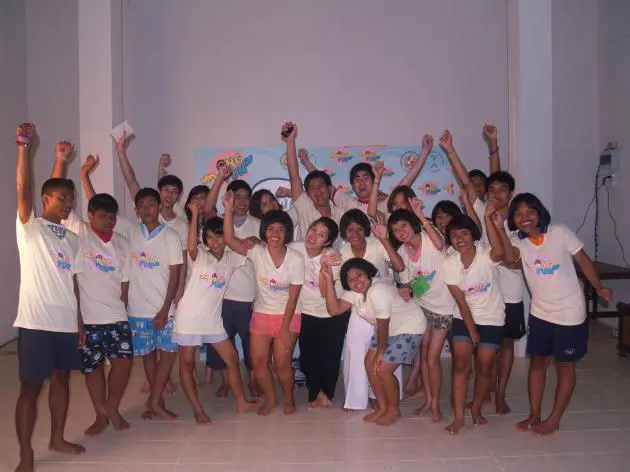
From that trip, we came up with a project called “Long Fun”, which in Thai means “taking a journey to the dream”. The object was to make known what the school had been doing and its problems, which would help them with their search for more financial support and to bring them closer to the dream.
We invited the media to join a trip to the school to see how it helped the students and dealt with its own problems. Five people from newspapers and magazines joined this trip and will publish articles to help us gain publicity.
Yaowawit has its own hotel where the students provide real service for guests. This hotel earns income for the students, but not enough.
With support from Air Asia, the students’ dream became possible. We brought five selected secondary students up on a plane for their very first flight and to explore careers in the industry. Also, they were allowed to observe the selection of new flight attendants.
Before flying back to Kapong, Surachate, one of the selected students said: “Now, I really want to be a flight attendant. I never thought before that I would ever dream of becoming one,” and all the five students added that the kind of information they’d received was something they could never find in their classrooms.
“It was indescribable – the look in their shimmering eyes when the plane was taking off. It’s like they were really travelling in a journey to their dreams,” said Kanchana Jasaen, from the airline’s staff, who accompanied the children from Phuket International Airport to Bangkok, instructing them along the way.
There have been so many lessons learned in these three months working on this project. We have learned to come up with a strategic plan to be implemented in real practice and to deal with real professionals from media to business.
As ABAC students, we seem to have more resources than these children. We feel so thankful that we could be a part of transferring the wealth that we enjoy to benefit those who are in need.
At first, we started the project merely because it was our final task that must be completed for the course. Now, we realise how fulfilling it is to see those smiles and the eyes of those looking ahead to pursue their dreams.
