
Thein Sein: No plans to change the oath


Play
Myanmar president puts ball in Suu Kyi's court; vows to 'never make a U-turn' on democratisation
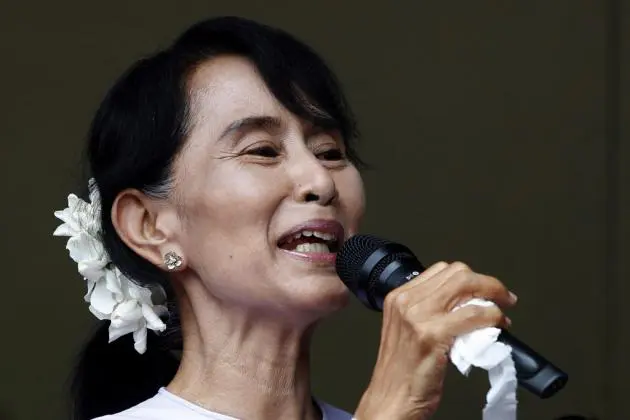
Myanmar President Thein Sein rejected a demand from Aung San Suu Kyi’s National League for Democracy (NLD) that the government change the parliamentarian oath of allegiance, while the European Union (EU) decided yesterday to suspend most of its sanctions against the country for a year.
It appeared the honeymoon period between the NLD and the military-backed government could be over, when the party insisted that the words “safeguard the constitution” be replaced with “respect the constitution” in the oath taken by new members of parliament.
In its campaign for the April 1 by-election, Suu Kyi’s NLD promised that it would get the military-sponsored 2008 Constitution amended in order to reduce the military’s role.
The NLD won by a landslide, taking 43 of the 45 seats on offer, but it is still far from holding a two-thirds majority in the 664-seat Parliament needed to rewrite the charter.
Yesterday, the new NLD MPs did not show up when the Parliament convened in the capital of Nay Pyi Taw.
These MPs have been appealing since last week that the oath of allegiance be changed, but Thein Sein told a group of journalists in Japan that his government had no plans to do so.
“Suu Kyi needs to decide whether she wants to enter Parliament or not,” Kyodo News quoted Thein Sein as saying. “Myanmar’s parliament is in favour of her entrance and is very much welcoming her.
“For the benefit of Myanmar’s people, I would like to cooperate with her by moving in the same direction,” the president said, adding that he would “never make a U-turn” in the ongoing democratisation process.
Thein Sein was in Tokyo for the Japan-Mekong summit over the weekend, and his comments came at a time when EU foreign ministers were meeting in Luxembourg to review the sanctions against Myanmar, which were imposed decades ago in a move to punish the military junta and its associates.
They decided to suspend the sanctions as a reward for the ongoing reforms in the country. The EU said it wants to support progress in the Southeast Asian nation, “so it becomes irreversible”, said EU foreign policy chief Catherine Ashton, who will be travelling to Myanmar this week.
EU sanctions currently target more than 800 companies and nearly 500 people, and include the withholding of some development aid. The sanctions also prohibit technical assistance related to the military and ban investment in the mining, timber and precious metals sectors.
Though it has lifted many of the sanctions, the EU still retains an embargo on arms sales, an official said. European and US officials have pointed to significant reforms in Myanmar over the past year, including greater freedom for the media and political opposition parties.
The EU decision yesterday did not go beyond expectation as many other countries have already given some kind of reward to Myanmar’s current regime for its effort to reform the country.
The United States is tipped to name its Myanmar envoy, Derek Mitchell, as ambassador after an upgrade of ties, while the Treasury Department last week decided to permit financial transactions to support certain humanitarian and development projects.
Japan decided to write off Bt3.7 billion of Myanmar’s debt and Australia said it would ease financial and travel restrictions on 260 Myanmar nationals and normalise trade relations with the country.
The rift over the parliamentary oath is not likely to affect international attitudes on Myanmar and many political observers are saying that the NLD’s point of contention is far too minor to have any real meaning for political development in the country.
