
Abhisit vows to back probe into 91 deaths
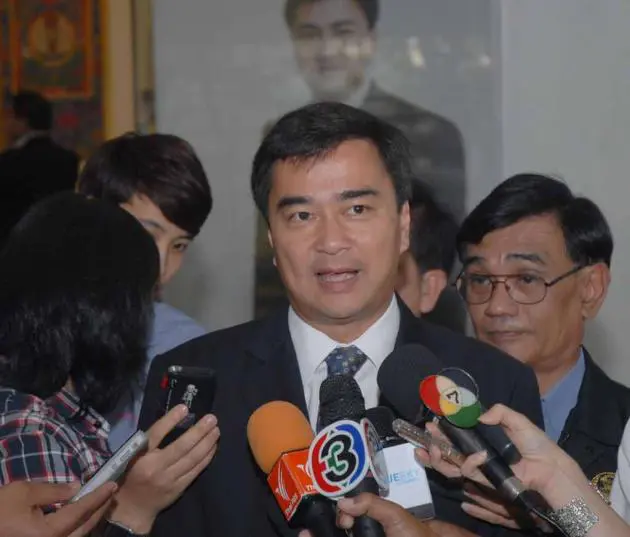


Every Thai is responsible, in one way or another, for the death of 91 people and thousands others being injured in April-May 2010, Opposition leader and then-premier Abhisit Vejjajiva said.
“We are all responsible in one way or another. Let’s be frank about that,” the former PM said when asked if he felt even partially responsible for the deadly crackdown. He was speaking at the Foreign Correspondents’ Club of Thailand (FCCT) on Tuesday night.
Abhisit said that the 91 deaths and the injuring of 2,000 people in 2010 – during his time as premier – did not happen in clashes in key places. He reiterated that there would have been no loss of life if there were no armed men in black. He was referring to the first deadly clash on April 10, 2010 when mysterious armed men showed up and attacked soldiers tasked with dispersing red-shirt protesters on Rajdamnoen Avenue.
The former premier insisted that for six hours that day nobody was killed.
“The trouble began when grenades were launched … Weapons were stolen. And there was chaos. I tried at every stage to find solutions. Every time negotiations broke down,” he said, adding that he and his then-deputy Suthep Thaugsubhan, are still willing to go through the justice system and find out what happened.
“I find it difficult to understand why somebody like Thaksin [Shinawatra] should say ‘forget everything’,” Abhisit said.
The former premier touched on several subjects at the FCCT, including calling his Democrat Party “almost a natural minority party”, explaining that the Democrats usually formed a coalition government when majority political blocks split. “If it takes two [general] elections rather than one election for us to win, that is okay.”
He also described his party as Thailand’s “only properly institutionalised party”.
As for charter reform, Abhisit warned that the Constitution reform process was being “hijacked by a government that wants to pursue an amnesty agenda [for Thaksin].
“Amnesty disguised as reconciliation will not be smooth and will cloud Thai politics for some time and create more division,” Abhisit warned. “There will be a wider division.”
The Democrat leader also said that if Thaksin returned to serve even a short period in jail for his conviction and then won a royal pardon, it would be fine. He also insisted that he was not afraid of Thaksin returning. “It’s not about fear. It’s about what is right … He should come back. He should come back today, tonight.”
As for the economy, Abhisit criticised Yingluck Shinawatra administration’s rice and tapioca price-pledging schemes, saying they were plagued with corruption at almost every stage. Rice purchased at a very high price affected Thailand’s competitiveness at the international level, Abhisit warned.
In addition, the Bt300 minimum wage is starting to affect the investment climate since some companies are thinking of moving elsewhere. “It’s not promising,” he said, adding that the situation was compounded by high inflation and the rising cost of living.
“We’re really testing the patience of investors.”
