
Prem accord leaves the red shirts simmering


Play
Although Wichian Khaokham emerged as the election candidate for president of the Udon Thani Provincial Administration Organisation, conflicts between factions in the ruling Pheu Thai Party and red-shirt groups are still far from over.
The dispute in the Udon Thani local election reflects the red shirts’ dissatisfaction with former prime minister Thaksin Shinawatra’s move to seek a compromise with conservative General Prem Tinsulanonda, seen as representing the elite.
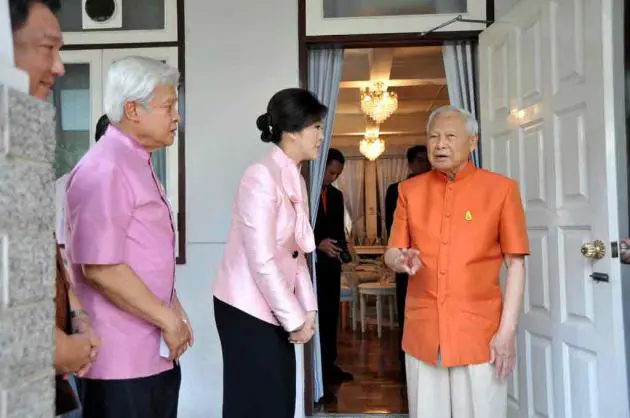
Thaksin’s sister, Prime Minister Yingluck Shinawatra, together with three of her deputies, visited Prem’s residence to pay respects after Songkran.
To the red shirts, Thaksin and Yingluck have already caved in. The fighting against the establishment over the past years, which claimed many lives among them, came to naught. Thaksin simply used them as his stepladder to power.
The failure of Pheu Thai in the recent local election in Pathum Thani was a lesson to teach Thaksin and party leaders that the red shirts, who are their main supporters, are unhappy with the compromise.
The “Pathum Thani model” might strike fear in Thaksin as it could be repeated in many provinces where the ruling party fields candidates in local races. Elections for PAO chiefs and by-elections for representatives to the House will be held in many provinces this year.
Red shirts in many provinces have their own candidates for the races. In many provinces they disagree with the candidates proposed by the ruling party. In Udon Thani, Wichian was a compromise candidate as the red shirts disagreed with the party’s choice.
Thaksin does not want to lose his strong support base in the North and Northeast. He instructed famous speakers of the red shirts who are now holding cabinet portfolios such as Deputy Agriculture Minister Nattawut Saikua to help the campaign in local elections in many provinces where the red shirts are active.
The red shirts no longer want to be passive supporters for the party and Thaksin. They want more participation in the party. A recent proposal from the red shirts for a “primary” to select election candidates for the party was raised to pave the way for their men to join the races.
Some key Pheu Thai leaders likely agree with the idea for primaries for elections at all levels but they remain indecisive. Many of them, however, went to ask Thaksin’s opinion as the final say on who would be the party’s candidates.
Thaksin probably is struggling to find a solution to deal with the red shirts’ demand. The red shirts’ proposal is very advanced for the Thai political party system. If primary elections are adopted by the Pheu Thai Party, the party might become a real mass-run party, but Thaksin and his clan might lose their grip on the party.
If Thaksin dumps the red shirts who made the proposal and demanded more participation in the party’s decision-making, he and his party might lose strong support from the red shirts. It is very difficult to estimate how many red shirts are really loyal to Thaksin and answer only to his instructions.
Time is running out. Thaksin cannot think too long about this matter. PAO chiefs in 76 provinces across the nation will end their terms this year and the polls for this position alone will take place throughout the year, not to mention elections at lower levels of local administrations such as districts and subdistricts. Altogether 3,118 local administrative bodies have to hold elections to fill vacant seats this year.
If the ruling Pheu Thai Party fails to find some proper solutions for the nominations of its candidates and to allocate decision-making power to its red-shirt supporters, other parties in the race such as the Democrats and Bhumjaithai will take the disillusioned red shirts under their wing.
