
Govt retreat averts a crisis - for now


Play
Charter, reconciliation bills to wait until next House session; no vote on court order
In what looks like a tactical government retreat, the third reading of the charter amendment bill and the debate on the reconciliation bill will not now take place during this parliamentary session, which the Cabinet has decided will end next Tuesday.
Meanwhile, Parliament yesterday failed to vote on whether it must comply with the Constitution Court’s order to halt the third reading of the charter change bill, as it lacked the required number of supporting votes to take such a step.
After almost three hours of discussion, the joint House-Senate meeting voted 318 to two in favour of whether it should vote on the binding effect of the court’s order. There were two abstentions, while another parliamentarian failed to cast a vote.
The number of supporting votes therefore fell just short of the 325 votes out of 644 House and Senate members required for a decision to take place on a non-legislative issue.
Yesterday’s developments mean the government’s crucial agenda – to set up a constitution-drafting assembly and pass reconciliation measures – will have to wait until Parliament reopens in August.
As a result, parliamentary, and possibly street, showdowns have been at least put on hold and a constitutional crisis averted for the moment.
The Cabinet yesterday decided that the closing date of the parliamentary session should be June 19.
Government Spokeswoman Sansanee Nakpong said the Cabinet would seek a royal decree to this effect, to be forwarded by the government whip.
She said Prime Minister Yingluck Shinawatra had said during the meeting that the third reading of the charter amendment bill would still take place, but it had to be postponed in order to reduce rising political tension and to give time for society to understand what was behind the amendments set out in the legislation.
A government source said the premier had said during the Cabinet meeting that even though charter amendment was a legislative issue, the government also had to look after the harmony of the country.
“This [pushing for quick parliamentary approval] can lead to conflict in society. We shouldn’t go forward amidst a [growing] conflict,” the source quoted Yingluck as saying.
The source also said that during the meeting, Deputy Agriculture Minister Natthawut Saikua – a red-shirt leader – said that while he still preferred Parliament to vote on the third reading in the current session, he understood the need to avoid creating conditions for the opposition to attack the government.
Deputy Prime Minister Chalerm Yoobamrung agreed with the premier’s postponement of the bill’s third reading, the source said, adding that Chalerm had said there was no hurry for the charter amendment bill to be passed and that ministers had to listen to society’s views on the matter.
A Pheu Thai source said the government and the party would wait for the Constitution Court’s decision on the charter bill before taking it up in Parliament. They believe the court will eventually dismiss the complaint about the constitutionality of the bill. “If we proceeded to vote [at this stage], political problems could be prolonged,” the source said.
The proposed amendment of Article 291 aimed at setting up a charter drafting assembly, had been on its way to a final vote in Parliament. The process was, however, interrupted when the Constitution Court on June 1 accepted a petition asking it to consider whether the proposed amendment was constitutional.
The court then sent a letter instructing the President of Parliament to halt the third reading of the charter amendment bill until it had reached a final decision on the matter.
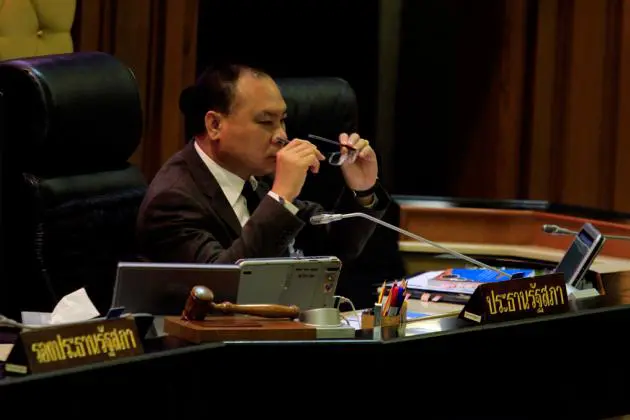
Parliament President Somsak Kiatsuranont announced yesterday he would not put the third reading of the charter amendment bill or discussion of the reconciliation bill on the agenda within the current parliamentary session.
He asked parliamentarians to end the discussion carried over from the meeting last Friday.
However, Pheu Thai MPs insisted it was for Parliament as a whole to decide on the matter, and not just its President.
Mukdahan Senator Jit Sriyoha Mukdatanapong proposed an urgent motion for the parliamentarians to vote on, but Opposition Leader Abhisit Vejjajiva got to his feet and said it was not in Parliament’s mandate to consider whether to follow the Constitution Court’s order.
Abhisit then led Democrat MPs and senators in a walk-out from the joint session.
At the time of quorum checking, 323 out of the total of 644 parliamentarians were in the chamber.
The voting – on whether to vote on complying with the court’s order – was required as the parliamentary session is a legislative session that allows only matters of law to be deliberated. The consideration on any other issue needs the support of more than half of parliamentarians .
Korkeaw Pikulthong, a Pheu Thai MP and co-leader of the red shirts said that while he respected Somsak’s decision, he disagreed with it and was disappointed that the post of President of Parliament was being controlled “under the wrong judicial power”.
