
Future of Thailand 'depends on whether people put the country first'


Play
What Thailand will become when its democracy turns 100 - in 20 years time - depends largely on its people, who will have to think more for the country's sake and less for themselves in order to ensure its best possible future, opposition and Democrat Part
Abhisit said that judging from developments today, there were three possible scenarios for Thailand when its democracy is 100 years old – a country torn by civil war, one that is bankrupted by overspending and “addictive” populist policies, or a democratic nation with a bright future after the ongoing divisive crisis is overcome.
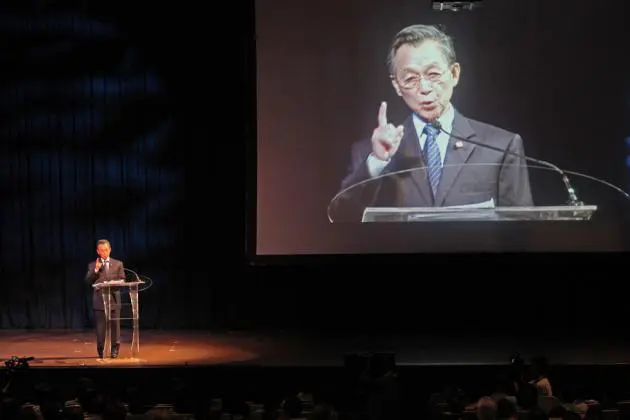
“The future of Thailand depends on us. We can choose what kind of future we want for our country,” he said during the charity talk show “2032: Looking into the Future”, which featured the Democrat Party’s two former prime ministers Abhisit Vejjajiva and Chuan Leekpai.
The sold-out event was held on Sunday night at the 800-seat M Theatre, on Phetchaburi Road, to mark the 80th anniversary of the end to absolute monarchy and the adoption of a constitutional monarchy. (According to Chuan, just five hours after the talk show was announced early last week, some 780 of the Bt1,000 tickets were reserved.)
The talk show was billed by the organisers – the pro-Democrat Blue Sky satellite-TV Channel – as the first by a pair of former Thai prime ministers. Part of the proceeds went to the Thai Red Cross.
During his talk, Abhisit asked his compatriots to look into the experiences of other countries such as Rwanda and Yugoslavia, where hatred and conflict between their people led to civil war and even the break-up of a nation.
“The current situation in Thailand is worrying. The conflict is getting volatile and severe,” he said, pointing to attempts by unnamed politicians to instil hatred between different groups of people with the goal of dominating politics and controlling all major institutions of the country.
He warned that expensive populist policies would lead to citizens being over-dependent on the government and worse corruption. He noted that recent surveys showed more people tolerated corruption as long as they would benefit.
Abhisit also pointed out that in world history, economic collapses often led to some form of dictatorial rule, such as Adolf Hitler in Germany and Benito Mussolini in Italy.
He called on Thais to join forces – in a peaceful way – in a bid to prevent any selfish politician from “taking Thailand hostage” for his benefit. He said former United Nations secretary-general Kofi Annan, when in Thailand to advise on reconciliation efforts, noted that the Kingdom’s crisis was not as complex as earlier thought. “The question is whether Thaksin wants to prioritise on his benefit or the country’s interest,” Abhisit quoted Annan as saying, referring to ex-premier Thaksin Shinawatra.
Abhisit was preceded at the talk show by Chuan Leekpai, the former Democrat leader and prime minister. Chuan said that during the first 80 years of its democracy, Thailand made much progress in many areas, although many things still needed to be improved.
He said that during that period, the country experienced many crises, such as World War II, the Cold War, the threat of communism, and numerous political disputes that led to military coups.
Chuan blamed the country’s political crisis on greedy and corrupt politicians who buy their way to power and view their political rivals as business competitors who deserve to be annihilated.
During their talk show, that lasted over two hours, the soft-spoken Chuan and the confident Abhisit presented their fans with many jokes although there were times when the jam-packed auditorium was quiet as the audience listened attentively.
Before the show, Abhisit got a superstar welcome from his fans, who mobbed him in front of the auditorium for a chance to get a photo with him or to take his photo. A group of women displayed LED signboards and iPad screens with messages: “Heart Abhisit” and “Love Mark” (Abhisit’s nickname).
