
Model UN conference provides vital insights


Play
Role-playing event at AIT for students from 46 countries
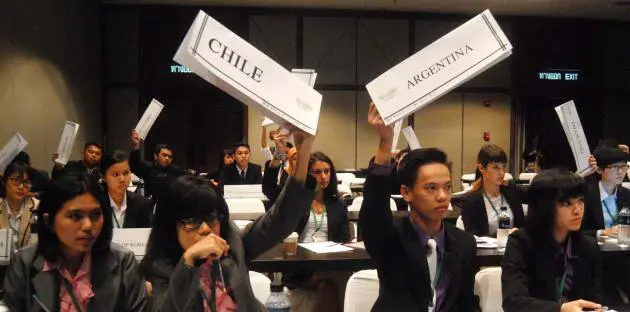
What would you do if you were representing your country and speaking for many people at the United Nations or another international organisation? Hundreds of college and university students from 46 countries have found the virtual answer, as they are playing that role at the Asia-Pacific International Model United Nations.
Held for the first time, APMUN kicked off last Thursday and concludes today in Bangkok.
About 350 young undergraduates from 46 countries are addressing global issues ranging from peace to water management at the international sessions.
“This is a good opportunity for me. I’ve learned a lot more about global problems,” said Ladawan Arunraj, 19, a Thai student from Chulalongkorn University. She was assigned to act as a delegate from Australia.
Ladawan hopes to become an ambassador in the future and APMUN has inspired her to try even harder to make her dream come true.
“In my opinion, a good ambassador needs to understand his or her country very well and to learn about other countries too,” she said.
Arif Johan Winanda, a 20-year-old Indonesian from Airlangga University, said when students join this event, they will improve their leadership and diplomatic skills as well as learn how to influence others and make a decision.
“I’m learning how to make diplomacy with others and see that I must learn more English to make good conversations in a debate forum.”
APMUN had provided valuable experiences that he could not get from just studying at school.
Tian Hui, 21, from Nanjing University of Science and Technology in China, said some delegates were very active. They always stand up and express their opinions.
“I don’t think I’m brave enough to stand on this platform but I always encourage myself to stand and express my opinion. The next session I will do more.”
Hui represents Bahrain.
“At APMUN, I have learnt that if I want to be successful, I must be brave, know the importance of cooperation and engage people,” he said.
These students were in the UN General Assembly (GA) Second Committee that last week discussed freshwater management and |economic development, and the effects of agricultural export subsidies on least developed countries. There were also GA first and third committees that discussed different topics.
The wide range of committees provides for topics to suit each student’s interest. APMUN offers five types of committees – GA, the UN Economic and Social Council, peace and security committees, regional bodies and specialised agencies. Also, APMUN gives opportunities for students to participate in the conference as part of the press corps or as a representative of an NGO.
During the freshwater management discussion, several students presented solutions based on successes in their countries. Then, they voted on what they considered the most suitable measures to provide solutions for the problem.
Besides the topics they were given to discuss, the students paid attention to the global issues of economy and security.
Hui said she was interested in the economic issue because the economy of one country would decide the standard of the people and quality of life. The economy was the basis of a peaceful and happy life.
Arif said he was a management major so he was interested in economic issues.
“The important international issues are the economic and freshwater issues. We have a good economy. We can do everything. We can solve the freshwater problem, refugee protection and so on. A good economy means a country will have funds to solve many problems.”
Jay Rana, 21, a student from Nepal at Webster University in Thailand, said he was interested in world peace and national security because people need peace at least to develop.
Ladawan said she was concerned about the world’s real security, since there was no real security as many countries still collected weapons that put pressure on small countries.
Professor Said Irandoust, president of the Asian Institute of Technology, said the university was proud and honoured to take the lead in creating the first APMUN Conference at the university level. The purpose was to provide a privileged atrium of consultation and debate on the culturally diverse aspirations of young leaders of the world.
APMUN was established to offer students a unique opportunity to experience first-hand the practical application of what they have been learning in international affairs, said Sandro Calvani, director of the Asean Regional Centre of Excellence on Millennium Development Goals and the leading force behind the event.
