
Children must be given friendly spaces


Play
Asean discusses how all kids need room to develop
“When the children are sad, make them happy. When the children are hungry, make them full. When the children want to speak, give them time to talk,” a representative of Asean children told agencies at a recent regional meeting on children’s rights.
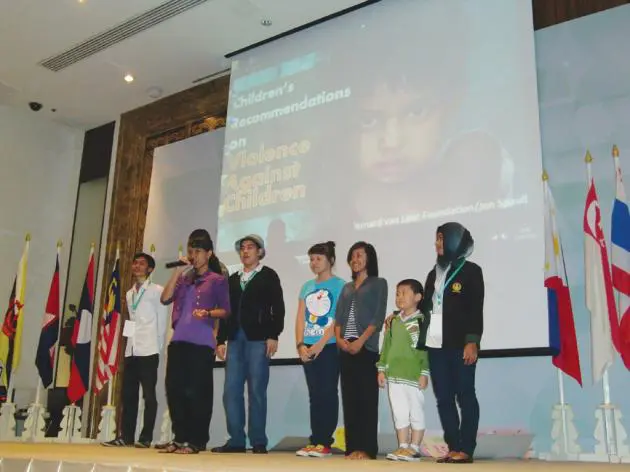
The representatives from seven Asean countries and China declared they wanted “child friendly spaces” for youngsters to enjoy playing and sharing with adults, as well as to improve their development.
They were speaking at a regional workshop on Implementation of the Convention on the Rights of the Child, the first ASEAN+3 workshop on children’s rights hosted by the Ministry of Social Development and Human Security (MSDHS) late last month in Thailand.
“One recommendation was for governments and non-government organisations to create these child friendly spaces in schools and communities – allowing them to voice their opinions on what they wanted from friends and adults,” said Warangkana Mutumol, Children on the Move Project Coordinator of Save the Children, who was conducting “brainstorming” sessions for children.
Seven-year-old boy, Tou Tou, the youngest representative from China, drew a picture showing a child-friendly space he wanted.
Warangkana said child friendly spaces would provide children with protected environments in which to join in organised activities to play, socialise, learn and express themselves. The spaces were playgrounds in which adults and children worked together to design playthings or toys made of materials easy to find, like banana trees or used tyres, to develop learning activities.
“Young children enjoy playing, but adults should not forget teenagers want something more than just playing. Teenagers told us at a child friendly space we provided for flood-affected children that they wanted knowledge useful in their lives, such as sex education and health education,” Warangkana said.
Child representatives also said they wanted governments to introduce and enforce laws on violence against children and disseminate knowledge and information about children’s rights and how to protect themselves from abuse and exploitation.
Children should be allowed to create a committee to help in monitoring and reporting on violence against children. All must be accessible to education and the government should provide quality education for all.
“The policy (for children) is good, but the problem is its implementation,” said Norisa I. Sabirin, a girl from the Philippines and Muhamad Ibrahim b Zaharuddin, a boy from Malaysia.
All the young people, including those from other countries – Mao Rosmey from Cambodia, Gayatri Wailissa from Indonesia, Nisnani Waseng from Thailand, Nguyet Minh Dong from Vietnam and Elton Seah Ding Qi from Singapore – agreed that children’s voices must be heard more by their governments so they understand the problems and can provide what children really want.
“The meeting gave topics that are common issues or problems all countries have encountered and are considered important. After discussions and field visits, the participants came up with recommendations for their own countries, ACWC (the Asean Commission on the Promotion and Protection of the Rights of Women and Children) and NGOs.
“ACWC will follow up to see how much they are able to implement these recommendations a year after the meeting,” said Saisuree Chutikul, from ACWC.
Pinchai Pinkaew, the director of the Office of Welfare Promotion, Protection, and Empowerment of Vulnerable Groups at MSDHS, said the meeting concluded that regional collaboration to create child protection standards had to be formed in response to the negative impact of migration in the region. It also emphasised the importance of information and best practice exchange to learn from each other how to protect and promote children’s rights and improve the capability of practitioners in member countries.
He said the recommendations and conclusions from the meeting would be proposed to the next Senior Officials Meeting on Social Welfare and Development or SOMSWD. He hoped the recommendations and conclusions would be implemented and lead to policy integration and collaboration among the member countries on children’s rights.
Wichien Chawalit, permanent secretary for MSDHS, said SOMSWD and ACWC must be a significant mechanisms that support and follow up on progress of children’s issues in the Asean+3 countries.
“We want authorities to treat well all children from all Asean countries when they stay in these countries,” Saisuree said.
