
Repairs start to head of Wat Arun 'yaksa'
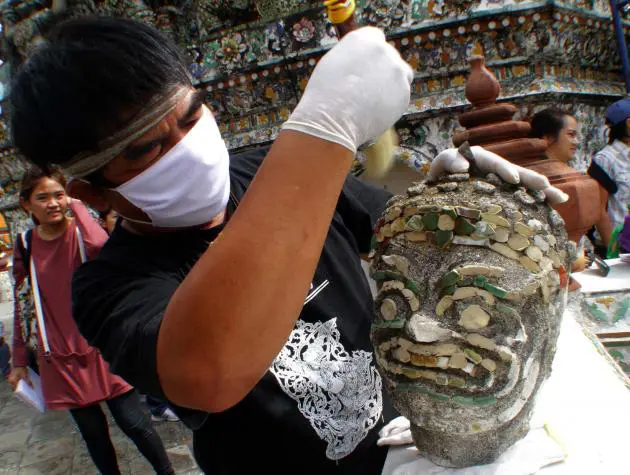


The Fine Arts Department yesterday started fixing a sculpture of the yaksa demon at Wat Arun, also known as the Temple of Dawn, the head of which was felled during a lightning strike last week.
Artisan Pasom Narata said the repairs will include cleaning of the broken points, strengthening the structure of the demon and reconnecting the head to the sculpture. The process, which includes redecorating the entire body of the demon, will take about two days, he said.
The repair site is high and small so there is no need to close the area.
When news that the sculpture’s head had fallen to the ground was reported on October 20, people started talking about a bad omen.
The department instructed officials to install a better lightning rod on the sculpture to prevent a recurrence of the incident.
An electric current ran down the original lightning rod fixed above the head of the sculpture during a downpour last week.
Earlier this year, the head and neck of a horse sculpture adorning another small pagoda at the temple broke off.
The Culture Ministry has prepared a Bt130-million |budget for the restoration of Wat Arun between 2013 and 2015.
Though constructed in the Ayutthaya period (1350-1767), Wat Arun or Wat Chaeng became a temple inside King Taksin’s palace during the Thon Buri period (1767-1782). Thailand’s most famous Buddha statue, the Emerald Buddha, was once enshrined at Wat Arun.
