
Students long for the joys of hands-on study


Play
Science experiments a dream-come-true for some
The way pupils study science today is not so different from the way we studied science decades ago.
In those days, pupils worked mainly from textbooks and there was a shortage of laboratories and experimental tools to help enhance their self-learning, particularly in rural areas.
People from different generations share the same attitudes toward learning. For example, we have been told that the process of changing a solid directly into a gas without the solid first becoming a liquid is called sublimation, and objects fall because of gravity – but how many of us learned these facts from an experiment? We know that milk has protein, so how can we learn what other kinds of drinks have protein? How many of us have done an experiment to find protein in different kinds of drinks?
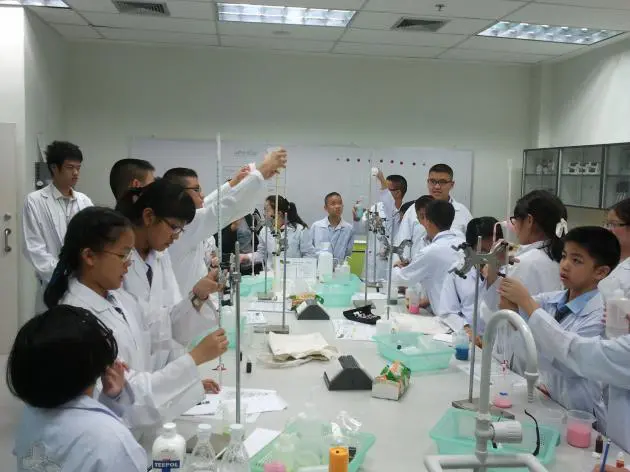
Around 60 students – clamorous, excited, and engrossed – carried out experiments on the chemistry of milk in two laboratories at Sirindhorn Science Home in Pathum Thani last week. And they showed how enjoyable this study was, and how it reflected what style of learning they preferred.
The activity was part of the official launch of the Thailand Children’s University project presided over by Her Royal Highness Princess Maha Chakri Sirindhorn on Tuesday.
Many students who took part in the activity told The Nation they were delighted when conducting the experiments.
One, Suwijak Mongkalakorn, 12, a Matthayom 1 (Grade 7) student from Bangkok Christian College, said: "I like doing experiments by myself because I see and learn while things are changing in the experiments. Seeing these changes is made even more interesting as I find out what I can do with my own hands."
Even leading schools in urban areas lack the necessary experimental tools and laboratories, according to many of the students who joined the activity at the Sirindhorn Science Home.
Ketsiree Supita, 11, a Prathom 6 (Grade 6) student from a gifted programme at Thidanukhro School in Songkhla, said she had not done many experiments at school as there was a lot of content for her teachers to cover. "I do the experiments once or twice a week. Also, we don’t have enough laboratories, tools and chemical substances to do all these experiments."
"Coming here and joining in this activity, I’m really happy because I like chemistry and I have used several kinds of chemical substances in the experiments," she added.
Suwijak said his teachers had to rush teaching to cover the jam-packed content in the curriculum. So they demonstrated some experiments instead of letting students do them, especially the experiments that take time.
Ketsiree and Suwijak also said they were happy with small group experiments as everybody in the group could join in the study. In big group experiments, the number of tools was not adequate for all group members.
"Lacking laboratories and experimental tools as well as having too much content for teachers to teach, many of our science teachers prefer to tell or explain scientific facts and knowledge rather than have their pupils learn from doing the experiments themselves," said Pornpun Waitayangkoon, president of the Institute for the Promotion of Teaching Science and Technology (IPST) in a recent interview with The Nation.
A study by Tom Corcoran, co-director of the Consortium for Policy Research in Education at the Teachers College of Columbia University, a US-based researcher with years of experience working with Thai science teachers, pointed out during a seminar in a separate event in September that too many topics were included in the Thai curriculum. He urged science teachers to focus on big ideas and organise units around concepts to help students understand.
Corcoran also urged Thailand to allocate more time to science education. Thailand in Grades 7, 8 and 9 (Matthayom 1, 2 and 3) allocates about half as much time as other countries to science. Thai students receive three classes a week or 150 minutes, while in most nations, students study science every day and for 250 minutes or more each week.
The Children’s University project also has a plan to give secondary-school students with talent in science a fast track to sit in on some university classes while still at school, and they will also be able to claim credits from the courses taken at the campus.
Both students – Ketsiree and Suwijack – and Nathawat Asvasermcharoen, 13, a Matthayom 1 student from Suankularb Wittayalai School, said they welcomed this plan and would love to join it.
"I would like to join the fast track. It is very challenging. And if I can study with university students, I will be able to graduate with a bachelor’s degree quicker," said Nathawat.
Ketsiree said she wanted lecturers to allow students to give up studying in university classes if they find the lessons are beyond their ability. They should also be allowed to start the classes again a year later after their ability had improved.
Suwijak said he wanted lecturers to be more patient with secondary-school students and explain more to them as they had fewer basics. Also, he was worried about adjustment of new senior classmates. He wanted university students to pair with secondary-school students to help them adjust to the new classmates and environment.
Germany originated the children’s university network idea. And one of its universities, Bielefeld, has successfully run a children’s university project, giving expert assistance. The German Academic Exchange Service (DAAD) has also funded two Thai experts who went for training in Germany on how to get children to engage more in science and math related subjects. Two German experts also worked with Thai staff in Thailand.
DAAD secretary-general Dorothea Ruland said: "We really want sustainability," adding that the experts from both countries would be funded to further the next stage of the project. "It should be spread to other universities so it is a kind of multiplier for the rest of the country,” she said.
