
Student apps can save lives, protect forests
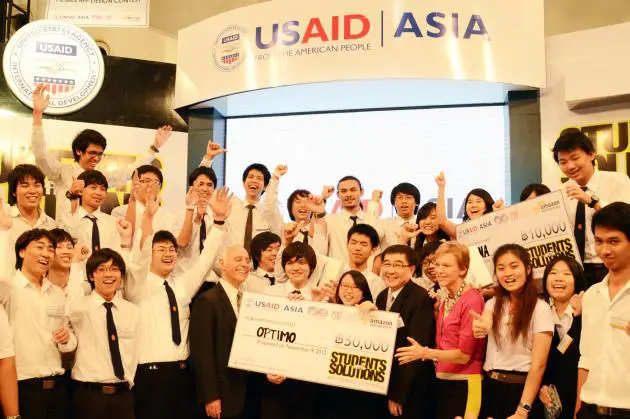


Flood-alert system for phones designed by contest winner
Most student contests benefit mainly the students themselves or their institutions; but a recent mobile application design competition promises much wider public benefits.
One student-designed app will report flooding when it occurs in different parts of Thailand, while another will help preserve the country’s forests.
The winning app enables mobile phone users to access updates of flooding situations. Another app that won the popular vote reports details of illegal logging incidents, locations and national parks information, and will be available next year for smart phone users to download.
Both mobile phone applications have been created by engineering students from King Mongkut’s University of Technology Thonburi (KMUTT).
“Our mobile application is not just an app, it’s a tool to help save people’s lives,” said Nuntipat Narkthong, 19, representing the winning “Team Optimo” – five computer engineering students, including himself, Budsapanee Pongsiriyaporn, Chattriya Jariyavajee, Nattaphat Laoharawee and Tanapon Pitichat.
“From first planning on how we should create the app, we have kept in mind that our mobile application would be able to work and help people in real life, and we aim at launching the “FloodFinder” app in the market next year, perhaps, before the middle of April,” he said.
Supadchaya Puangpontip, 20, who represented “Team Vana” – four computer engineering students who won the popular vote – said her team would make the “A-Eye” app available on the market next year.
Team Vana includes Chanida Deerosejanadej, Jitanun Meanchaianun, Patrawut Ruangkanokmas and Supadchaya. Its app won the popular vote after sweeping over 2,900 “Likes” on their video clips featuring their mobile app design on deforestation warnings. Visitors to the USAID Asia Facebook page voted for their favourite video clips featuring projects from six finalist teams during a month-long period prior to the final presentations.
The contest is called Students with Solutions 2012 and the FloodFinder app design impressed the panel of judges and hundreds in the public audience during final presentations held at Hitech Digital Live Studio, Digital Gateway Siam Square last week.
It was organised by the United States Agency for International Development Regional Develop-ment Mission for Asia (USAID Asia) and was launched late in June.
The competition focused on three development challenges in the Southeast Asia region: disaster resilience and response, deforestation and forest degradation, and human trafficking. All university students in Thailand were eligible to enter by submitting a concept paper outlining the problem to be addressed along with a mock-up of their mobile application interface and functions.
The winning team received a cash award of Bt50,000, along with tablet computers and trophy while the popular vote winner received a cash award of Bt10,000.
“The Students with Solutions contest looks to Thailand’s brightest to develop answers to their country’s most pressing development challenges,” said US Ambassador to Thailand Kristie A. Kenney. “Realising that mobile phones have transformed our lives, apps like these can provide easy ways to share information and create greater access to services.”
The FloodFinder app will provide real-time data of water levels by using a high-quality camera, GPS receiver and hi-speed mobile internet attached with smart phones. The application will estimate water levels from the photos taken by the camera and report water level information to a server which will share it with others using this app.
“Our application will provide users with reports on water levels around a certain area. It also allows people to estimate the degree of flooding in their own area. Users will be able to access an accurate source of water level data anywhere and anytime they need it.
“People will no longer have difficulty finding and sharing water levels in their area even if local electricity has been cut. The mobile network is usually still available even if the local electricity is not, which happens frequently when floods occur. People will be able to prepare themselves and to decide what to do in an incoming flood,” said Nuntipat.
Supadchaya said: “A-Eye mobile’s main features are the reporting of irregular incidents, maps, and detailed information of the national parks. It helps prevent and protect the forest resources through cooperation among local citizens, park rangers and park visitors.
From this information, people will learn the importance of the forest and the effects of deforestation. The application will raise awareness and make people highly value the forest. Furthermore, the A-Eye Application will be a virtual assistant for tourists travelling around the national parks.”
Now the competition has closed, both teams continue to develop their applications for use with different operating systems, including iOS, Android, BlackBerry OS and Windows Phone.
Nuntipat and Supadchaya said it was the first time they’d created whole applications. Their teams applied the basics of programming learned in classes with app creations, and searched for more knowledge and techniques from books, the internet and communities of app creation professionals on the internet.
Supadchaya also challenged interested students in other fields to try creating mobile apps. “If you like and are interested in doing so, you can learn how to create them from books and the internet. There is plenty of information there. You can do this even though you are not in computer engineering.”
