
Bangkok school debuts digital design laboratory


Play
FabLab allows students to apply their own ideas
Do you think young students can make use of a university engineering laboratory and learn from the experience? A school in Bangkok is already making use of such a lab to support its students’ learning. And the things they have come up with may well exceed your expectations of what a kid can do.
It is not just an experiment lab where tools like beakers, microscopes, electric circuits and chemical substances are provided for students to learn basic chemistry, physics and biology.
Using FabLab, students can learn more advanced and applied knowledge of such subjects by creating their own inventions from their own designs.
A FabLab is a low-cost digital workshop equipped with laser cutters, routers, 3D scanners, 3D milling machines and programming tools. There, university students can make almost anything. The FabLab@School, created by Assistant Professor Paulo Blikstein at Stanford University, is a new type of digital fabrication lab especially designed for schools and children, with several special characteristics, according to tltl.stanford.edu/projects/fablabschool.
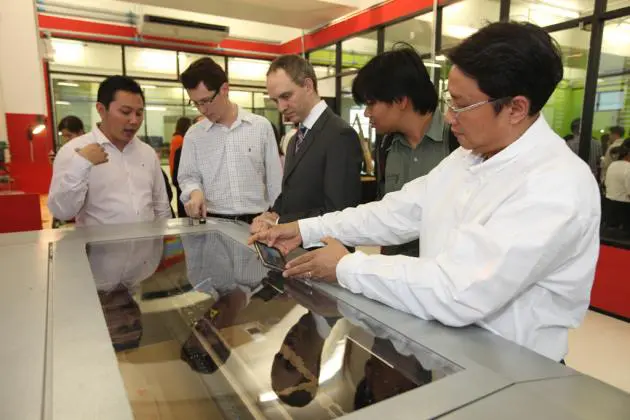
The Darunsikkhalai School for Innovative Learning (DSIL) last week opened its FabLab at the first Thailand Constructionism Symposium held at the school. It became the fourth FabLab@School in the world, after two in the US and one in Russia.
The Bt3-million lab has been funded by the family of Paron Israsenanaayudaya, chairman of the Suksaphattana Foundation and vice president of the Thaicom Foundation.
“Here we’re giving the best tools that exist to kids in Thailand at DSIL. They all have great ideas and are very creative. And, now with those tools, they can make those ideas come true and that’s really a powerful thing to put in the hands of our kids,” Blikstein said.
“Ten years ago, a lab like this would never exist in a secondary school. People would think this is crazy. Only engineering students can have a lab like this. So, we are bringing a lab that engineering students would have to kids who are eight-12 years old.
“We’ve proven that they can use a lab like this, they can create amazing things. We’ve seen that in Russia and the US and this will be a reality here in Thailand. There will be 12-year-old kids doing college-level engineering and that’s amazing,” he said.
This kind of lab could go well with schools that encourage students to learn by doing under the constructionism learning theory, which shows that students will be more deeply involved in their studies if they are constructing. So, they will face complex issues and make the effort to problem solve and learn because they are motivated by the construction. DSIL is among the schools practising constructionism.
With those hi-tech tools, people resisted Blikstein when he first introduced the lab to schools. They said kids could not deal with it and the lab was too expensive, complicated and dangerous for kids.
“It’s not dangerous to use the lab and the way we design this is that all the equipment that could be dangerous is in a separate space, so you can lock it and the other space can be completely safe. The way we design the lab, we’re thinking about children and not making it dangerous,” he said.
Those tools were all controlled by a computer. Students create their designs in the computer and the machines do all the manual work of cutting. Students do not have to use their hands. They just think and design and the machines do the rest.
A student’s surprise invention created from the FabLab in Russia is a good example of students who have used the labs. The schoolboy with no engineering background could even produce an automatic Bach-playing flute.
“He learned deeply about music, humanity and robotics at the same time.”
However, teachers should be careful, as some students do not try to invent creative things. They prefer to use the tools in the lab to create just flashy objects, like nametags.
“I’ve been to many countries around the world – Africa, South America, North America, Europe, Asia and Australia. They all are creative and have great ideas. The only difference is that some places have more and better tools. So, if they have an idea, they can make that idea into a real product or become reality.
“When you don’t have the right tools, the ideas stay in your head. So, you have an idea, you build it, and your next idea will be even better and that’s how you develop your talents, creativity, knowledge about science or engineering,” he added.
He is starting up FabLabs in Brazil, possibly in Australia and Finland. He has been targeting people in Singapore and South Korea with the hope that it will spread to many countries very soon.
