
TPBS chief urged to quit over show
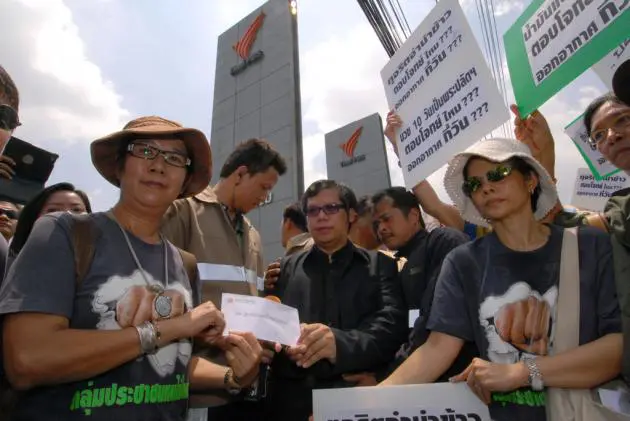


Demonstrators demand action after station airs final episode
Demonstrators rallied outside Thai Public Broadcasting Service (Thai PBS)'s offices yesterday, demanding the resignation of the station's management after it allowed the airing of the fifth and last episode of the "Tob Jote" programme, which debated issues surrounding the monarchy.
National police chief Pol General Adul Saengsingkaew said he had ordered the Special Branch Police Bureau to investigate whether the programme had violated the law. The probe was expected to take a few days. The agency would also monitor social media content relating to the issue.
Calling themselves "People Who Cannot Tolerate", about 100 people led by a woman calling herself "Black Coffee" called on Thai PBS director Somchai Suwannaban to resign to take responsibility for broadcasting the show’s last episode, which she claimed featured content upsetting to many Thais.
They demanded the Thai PBS management apologise to the whole country and threatened to take legal action if their demands were not met.
The group claimed to be the same that had earlier successfully called for suspension of the last episode of the programme, which was to have aired last Friday. They said they disapproved of the programme on the grounds its content implicated the much-revered high institution and would result in political conflict and national division.
The group said the programme was liable for violating Article 37 of the Broadcasting and Television Act 2008, which bans content viewed as an attempt to bring down the country’s constitutional monarchy or has content that adversely affects national security.
Meanwhile, academics and officials discussed the "Tob Jote" programme at a seminar at Chulalongkorn University.
Thai PBS director Somchai said the station had to deal with an urgent problem in how to get "Tob Jote" to continue after the editorial team ceased their production in protest at the suspension of the last episode.
He said that as a public television broadcaster, it had to allow people of all sides to debate with reason and conscience – but many people criticised the timing to discuss this sensitive issue as premature and possibly leading to conflict.
Somchai said many people had asked him which hat he was wearing. He said he chose any hat that would not bring about a confrontation.
"I disagree with many issues raised by Somsak [Jeamteerasakul, who was featured in the debate on the "Tob Jote" show), but we needed a neutral stage to allow the debate," he said.
Thammasat University legal expert Prinya Thaewanarumitkul said the point was not whether discussing the institution was permissible, but how to discuss this sensitive issue. Although having differing views was common in a democracy, conflict could create damage. Critics believed the programme was not balanced in terms of allowing people with different views to air their opinions, he said.
Jumpol Rodkamdee, Chulalongkorn University radio station director and adviser, said that media freedom must come with greater responsibility. Presenting sensitive issues opened the chance for violent conflict.
Colonel Nathee Sukolrat, deputy chairman of the National Broadcasting and Telecommunications Commission, said that the Thai PBS station director had the right to suspend the programme because he was the first defendant if the content of the programme was deemed illegal.
"This case will set a [precedent] because airing this sensitive issue is a new thing. I understand Somchai and it is the first case that we all have to learn together," he said.
Army chief General Prayuth Chan-ocha on Tuesday lambasted the programme, accusing it of criticising the high institution and saying it was premature for the media to present programmes critical of the monarchy.
He called for an end to what he described as an attempt to sabotage the monarchy in order to lead the country into an anarchistic ruling system. Prayuth also challenged anti-royalists and critics to leave the country.
"If you find that living in Thailand, with the monarchy institution and some [associated] legal provisions, makes you uncomfortable, you should find other places to live. I believe most people are comfortable here,’’ he said.
Prayuth added that the military feels that the monarchy is an institution that has long contributed to the country.
