
Grenades rock home of adviser
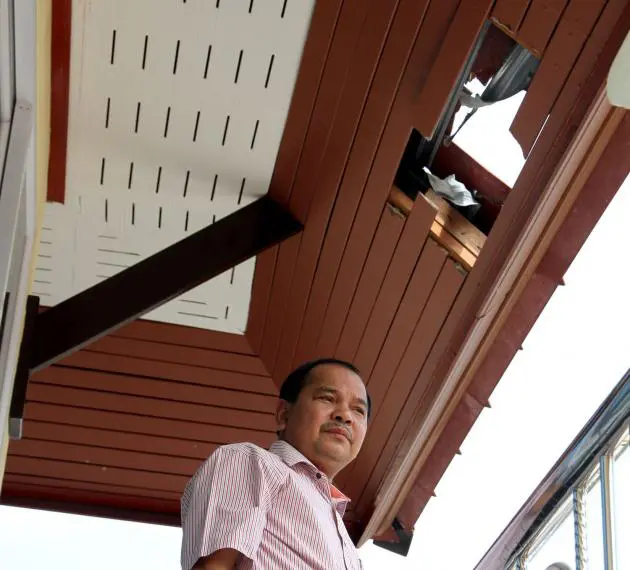


Wadah faction member says insurgents opposed to peace dialogue likely to be behind attack in Narathiwat
Two grenades were launched in the early hours of yesterday morning into the compound of the Narathiwat home of former local MP Nujmudeen Uma, who serves as a key government adviser on security measures in the deep South.
The blasts caused no injuries, but there was property damage.
The four-time MP told police that insurgents opposed to the ongoing peace dialogue between Thai authorities and insurgents’ representatives were likely behind the M79 grenade attack.
Nujmudeen’s home was subject to a similar M79 grenade attack in March last year, but police have made little progress on that case.
A member of the Wadah faction of MPs in the coalition-heading Pheu Thai Party, Nujmudeen said he had just returned from the recent meeting with representatives of the insurgents, as an adviser to Deputy Prime Minister Chalerm Yoobamrung.
He said he was sure that the new political initiative for peace in the restive South was the motivation for the attack, as eight other Wadah faction members had also been appointed to Chalerm’s team.
“I have no clue about who [specifically] is targeting me, as I have neither enemies nor [am I involved in] political conflicts,” he added.
Police are examining footage from security cameras near his home in an attempt to find evidence to support an witness account that two men fled the scene on a motorcycle after the pillion rider had launched two M79 rounds into Nujmudeen’s house at around 2am.
The attack was made on the front of the house, the same location as in the previous incident 13 months ago.
A key peace advocate, Deep South Watch centre director Sirsomphob Jitphiromsri said he feared a surge in insurgency violence in the region through to the next round of meetings in the peace process on April 28, as the recent frequent attacks had not yet been satisfactorily analysed and there was no conclusion as to who had initiated them.
“Before new preconditions are set or further clauses in the meeting are discussed or agreed upon in the next round, those opposed to the ongoing peace efforts, or extremists who want the violence to continue, will be encouraged to keep exploiting the gap, as time is on their side between now and April 28,” he said.
He urged the authorities and the Barisan Revolusi Nasional Coordinate’s members to come up with solutions at the April 28 meeting for an immediate end to the attacks, before other issues.
Meanwhile, at 5.30am yesterday, military ordnance personnel defused two improvised explosive devices planted at a passenger shelter in front of a college in Yala’s Muang district.
The devices, which were found by a street sweeper in a bag left on the seating, were later disposed of.
The two bombs, each made of 1.5 kilograms of home-made explosives, had been set to go off at 7pm on Sunday, but failed to detonate.
Police said the devices may have been intended to explode along with four other bombs that went off in Yala on Sunday, but wiring mistakes meant they were duds.
Security officials yesterday apprehended a Yala native, Hasan Mousordee, at his home on suspicion that he was behind the four Sunday explosions, which are seen as a sign of insurgents’ repeated disapproval of the peace dialogue. Mousordee protested his |innocence in custody at a military barracks.
The four bombs went off while Prime Minister Yingluck Shinawatra was visiting the deep South.
National Security Council secretary-general Paradorn Pattanathabutr said the grenade attack on Nujmudeen had not yet been classified as a security-related case, and added that a thorough investigation was needed before a conclusion as to the motive could be reached.
Insurgents’ violence has not increased across the board, but seems to be targeting senior government officials, whom he said had always been the prime targets.
Security measures are being fully implemented in Songkhla’s Hat Yai district before and during the four-day Songkran holiday break from April 13 to 16, said newly appointed Fourth Army Area commander Skol Chuentrakool, citing intelligence reports on insurgents’ efforts to undermine local tourism in the South.
He said escorts of senior officials based in the region and general security measures had increased as a result of a bomb attack that killed a deputy Yala governor and the provincial civil defence chief last week.
