
Panel agrees to get rid of party-dissolution penalty
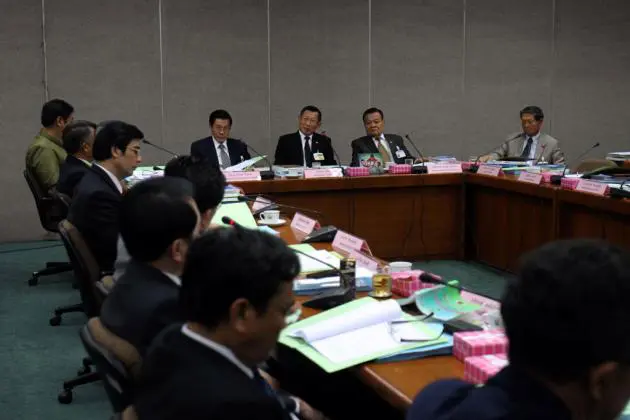


Members of the ad-hoc parliamentary committee vetting the constitutional amendment bill yesterday agreed to amend Article 237 of the charter to remove the penalty of political party dissolution.
However, they could not agree on whether to increase the penalty against any political party executive found to be involved in or abetting electoral fraud – an offence that could result in the disbanding of the political party involved.
Members of the panel, consisting of both MPs and senators, could not agree on the proposed amendment to Article 68 of the Constitution, which would prevent people from petitioning the Constitutional Court directly in the case of an attempt to overthrow a democratic administration.
The amendment would force members of the public to petition via the Attorney-General’s Office.
Opposition MPs from the Democrat Party in the panel said the proposed amendment to Article 68 was tantamount to limiting the right of members of the public.
Democrat MP Thaworn Senneam, a former public prosecutor, said during the committee’s meeting yesterday that public prosecutors – particularly some senior ones – have been close to politicians and enjoyed extra benefits offered by politicians in power, such as being appointed to executive boards of cash-rich state enterprises.
"There is a chance public prosecutors may side with the government, so the public should be allowed another channel to bring their case to court," he said.
Senator Direk Thuengfang, who chaired yesterday’s meeting, said that the proposed amendment to Article 68 was aimed at providing a "way out" for the country.
The committee is scheduled to convene next on April 24, when experts on matters regarding Articles 68 and 237 will be invited to provide their input. These include certain drafters of the 1997 and 2007 constitutions, legal expert Bokhin Palakula, former Thammasat University rector Surapon Nitikraipoj, and leader of the 2006 coup General Sondhi Boonyaratglin.
