
Youngsters learn from Japan how to care for environment


Play
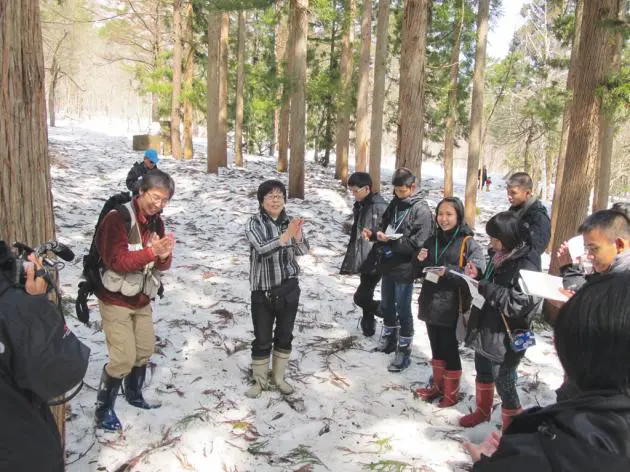
Children from three schools got the chance to learn first-hand how the Japanese take care of their environment. This field trip came as an award for their submissions in the 8th Stop Global Warming project, which was sponsored by Toyota Motor Thailand (TM
Mae Hong Son’s Khunyuamwittaya School, Bangkok’s Christian College and Debsirin Chiang Mai School won the top prizes.
The first-prize winner came up with a variety of environmental initiatives comprising increasing green space, designing a sustainable travelling project, making energy usage more efficient, offering a competition for cutting down on energy usage and reducing waste.
Ausa Kaewtiwang, a student from Khunyuamwittaya School, said that though creating the project was tiring, she felt energised now that her school has won the first prize.
She said the trip to Japan was good because she got to see how people there protected their environment and worked towards keeping carbon dioxide emissions low by doing things like riding their bicycle to work or school.
She said she would continue developing the project and share the knowledge with her juniors as well as the community.
“This field trip has taught me what I can do to care for the environment in my hometown, so it becomes a role model for neighbouring communities,” she said.
The project that won the second prize helps cut down on waste disposal and promotes garbage separation, while the third-prize winner promotes reduced energy consumption, monitored energy leakage as well as a campaign to restrict plastic-bag usage in school.
Sasikarn Leeratsirikul from the Debsirin Chiang Mai School said that during her visit to the Toyota Shirakawa-go Eco-Institute she learned how energy can be saved via things such as fuel cells and the protection of forests. She said her late-night trek through the forest taught her many things about nature. Plus, she got to experience how energy usage among cars, humans and homes can be harmonised at the Toyota Ecoful Town.
“I’m glad I was given a chance to visit Japan and see how they protect their environment. I will try to introduce the many good things I have learned in Japan once I return to my hometown,” she said.
Sasikarn said she and her friends would work on more eco-friendly projects for her school and the other 10 Debsirin schools. Representatives from the different Debsirin schools meet every two months.
Before heading home, the students said they would not stop their efforts to protect the environment and would try to inculcate a green culture among their juniors.
Apart from the school teams, three municipalities also got a chance to go to Japan for their winning green projects.
TMT’s senior vice-president Ekachai Ratanachaiwong said the company would continue hosting the Stop Global Warming project, adding that though Toyota was a private firm, it did not only focus on profits.
“We also want to contribute to society,” he said.
He added that the Stop Global Warming Project debuted in 2005 with the aim of promoting environmental issues among communities.
Moreover, he wants the schools and communities participating in the network to share their knowledge with other schools and neighbouring communities in order to expand the strategy and promote national sustainable development.
To date, the project has spent more than Bt153 million on green initiatives and green workshops with 226 municipalities and 267 schools in 77 provinces nationwide.
