
PM urges workers to upgrade skills
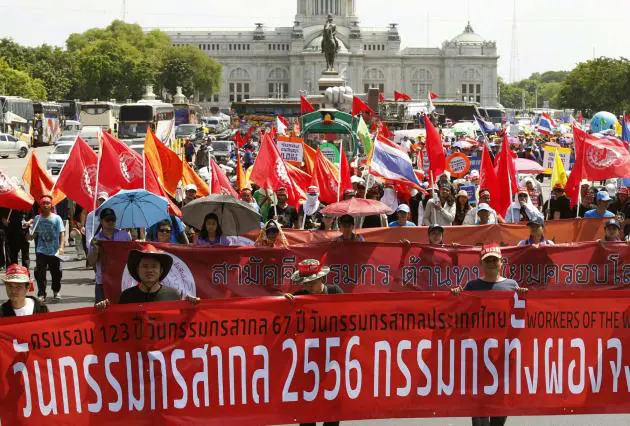


Yingluck says government backs labour group's list of demands
Marking Labour Day yesterday, Prime Minister Yingluck Shinawatra thanked workers for their contributions to Thailand’s economy but emphasised the need for labourers to improve their skills.
“Thank you for strengthening the country’s economy and quality of services as well as products,” she said as she presided over the official Labour Day celebration.
She emphasised, however, that workers needed to better their skills.
“Greater productivity and higher income for their workplaces means immunity against lay-offs,” Yingluck said. “Improvement of skills is a must also as the Asean Economic Community is about to begin.”
On her government’s plan for workers, Yingluck vowed to expand breastfeeding corners and nurseries at workplaces for a better quality of life for working mothers.
A higher number of breastfeeding corners and centres for unregistered workers were among demands made by the National Congress of Thai Labour (NCTL).
Yingluck has accepted all the demands, saying her government would make and integrate efforts to tend to the needs of both registered and unregistered workers.
NCTL president Chinnachote Saengsang said other demands included the establishment of a fund to ensure workers would definitely get compensation in the event of sudden business shutdowns.
“The last payment for workers from employers should also be exempt from tax,” he said.
Other demands included the scrapping of a policy to privatise state enterprises, better benefits from the social security scheme, the legal protection of people working at home, and paid paternity leave.
Labour Minister Phadermchai Sasomsap said the government had already responded to some of the demands.
“We have released an announcement asking entrepreneurs for cooperation in granting paternity leave,” he said.
The Labour Ministry is also consulting relevant parties as to whether some laws need to be adjusted to enforce paternity leave, he said.
REVIEWING ILO CONVENTIONS
Regarding the call for the government to ratify the International Labour Organisation’s Conventions No 87 and 98, Phadermchai said the Council of State was reviewing the relevant documents.
“After the review process is completed, we will forward them to the Cabinet and then to the Parliament,” he explained.
The ratification of these two conventions, according to the NCTL, would allow workers to assemble and negotiate.
Phadermchai shrugged off a recent survey that suggested workers had bigger debts and their living conditions had not improved, despite the government’s increase of the daily minimum wage to Bt300.
“The daily minimum wage has increased by about 40 per cent on average. Although commodity prices have increased, they did not jump that much,” he said. “I don’t think workers’ debts grew because of the hike in product prices.”
Chayanut Sakkanjanakul, an employee at a factory in Samut Prakan, said commodity prices had risen since the new minimum wage took effect.
“I hope the government will not stick with its original plan to peg the daily minimum wage at Bt300 for two more years.
“If the wage doesn’t really increase in the next two years, the government must control product prices,” he said.
