
White elephant caught on camera in Phetchaburi


Play
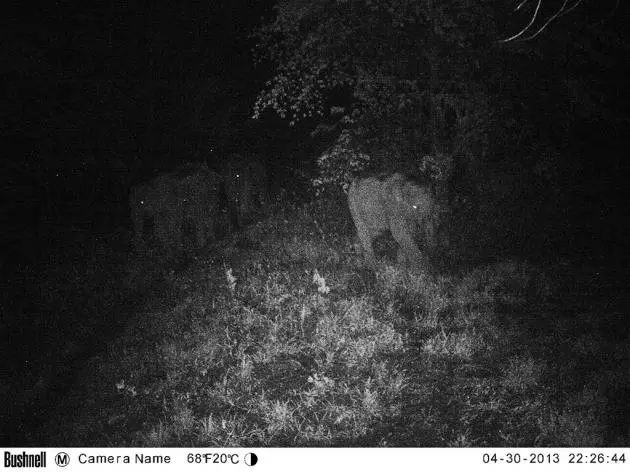
Apparent images of a much-sought-after white elephant spotted earlier near Kaeng Krachan National Park in Phetchaburi have been recorded by cameras set up in the jungle, leaving officials with a decision to make on whether to capture the rare, auspicious
A senior government veterinarian, Phattharaphol Manee-on, said recent video and photographs showed the albino elephant visiting a salt lick with a herd comprising five or six other wild elephants near Karang Sam Reservoir. Obtaining evidence of the herd’s existence only became possible when media presence in the area was reduced and artificial salt licks were created, Phattharaphol said.
A residence and a goat den that had obstructed the herd’s regular path will be relocated to give the elephants greater ease of movement, and more cameras will be installed at the salt-lick site and in nearby areas to improve the chances of photographing the beast, he said.
Chote Trachoo, permanent secretary of the Natural Resources and Environment Ministry, said more and clearer images were needed to verify that this elephant was actually an albino.
“A conclusion to capture it at this moment would be premature, as this is an important decision the ministry will have to make,” he said.
White elephants are commonly regarded as sacred. From the times of the ancient kingdoms through to this day, they are seen as rightfully belonging in the custody of the Thai monarch.
Meanwhile, a draft control measure on the trade of tusks and ivory authored by Thai officials and due to be ratified in an agreement with the Convention on International Trade in Endangered Species is ready and will be submitted to CITES on May 15.
Signing the agreement will require Thailand, in a three-year time frame, to implement nationwide monitoring of the trade in tusks and ivory within one year, and of possession of domesticated elephants, within six months to one year.
In a related development, ML Pipattanachat Diskul, a veterinarian attached to the Royal Household Bureau, yesterday said it was not the agency’s responsibility to decide whether to capture the white elephant. He said the Royal Household Bureau’s main responsibility regarding the matter was to examine a white elephant to determine whether it has the distinctive features required.
He also said that it would cost as much as Bt30 million to hold a traditional elephant-capture ceremony.
