
Two soldiers killed, 3 injured by bomb


Play
Thai Buddhists scared to live in Yala after slaying of six in Pattani last week
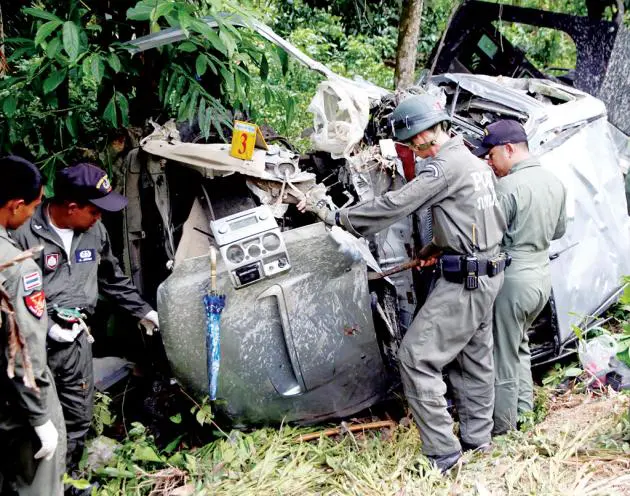
Two soldiers were killed and three others were seriously injured when a roadside bomb went off yesterday in Tambon Taloh of Narathiwat’s Reu Soh district. The five-strong team of Infantry Company 15124 was patrolling the area in an armoured pickup truck when insurgents hiding by the roadside detonated the bomb.
The bomb killed Sgt-Major Piyapong Imphram and Private Krittikorn Meunlin, and seriously wounded three soldiers, including team leader First Lieutenant Sukrit Kanchanakhlod. Police blamed separatists for the attack.
Meanwhile, Thai Buddhists in Yala said the May 1 drive-by shooting that killed six people, including a two-year-old boy, in Pattani’s Muang district had shaken them. Khuha Muk Community leader Rakchai Suwan said the recent attack was severer than previous incidents because the victims were innocent people. This had frightened the region’s Thai Buddhists, he said. “Many of us are now extra cautious when going out while some people have even moved away,” he added.
Another resident Suwan Panboonleu urged the insurgents to stop the attacks and join others in assisting Thailand’s development.
Religious leader Nimu Makaje said the Pattani attack stemmed from conflicts over the peace dialogue between the Thai government and separatists in Malaysia, and called on the Barisan Revolusi Nasional (BRN) liaison office chief Hassan Taib to name those who had carried out the drive-by attack.
Meanwhile, National Security Council (NSC) secretary-general Paradorn Pattanatabut confirmed yesterday that Thai government was considering the five demands made by the BRN, but that no decision had been made.
Paradorn also commented that if current Malaysian prime minister Najib Razak’s Umno party won the national election again, it would assist the government’s dialogue with the BRN, as the Umno party had backed the talks from the beginning.
He said that a Dusit Poll result and information acquired from the southern residents’ public forum hosted by the Southern Border Provinces Administrative Centre (SBPAC), would be tabled by the Thai team during the June 13 dialogue ses?sion with BRN representatives in Malaysia.
“We have to investigate the facts and find out if the BRN’s five demands truly reflected the views of local residents or whether they are just made by extremists,” he said, adding that he hoped the two parties would find a middle ground in solving their differences, especially in tackling problematic groups.
Paradorn also rejected as untrue rumours that former prime minister Thaksin Shinawatra was talking to the separatists and southern religious leaders in tandem with the Thai government were untrue.
He said the rumours were being spread by people who were against the dialogue as they knew that if the government’s talks with the BRN were associated with Thaksin, it would be easy to discredit any real progress made.
Paradorn’s comments followed a Dusit Poll survey result that said many southern people had rejected the BRN’s demands. The poll was conducted between May 2 and 4 on 542 respondents in Narathiwat, Pattani, Yala and Songkhla.
It was found that 65 per cent did not accept the demands as they believed the BRN did not have the right to make them and they violated the law.
Only 8 per cent believed the dialogue could lead to peace.
As for the peace dialogue itself, 35 per cent urged Thailand to be cautious in negotiating with the BRN, while 28 per cent suggested the government should talk to local people in order to learn more about their real problems.
About 40 per cent of respondents also urged the government to be sincere in solving the southern unrest, while 25.11 per cent called for stricter measures and 23 per cent said more aid should be provided to people affected by the violence.
A further 11.4 per cent said greater encouragement should be given to security officials, who risked their lives to perform their duties.
