
Court order to replant trees 'practicable'
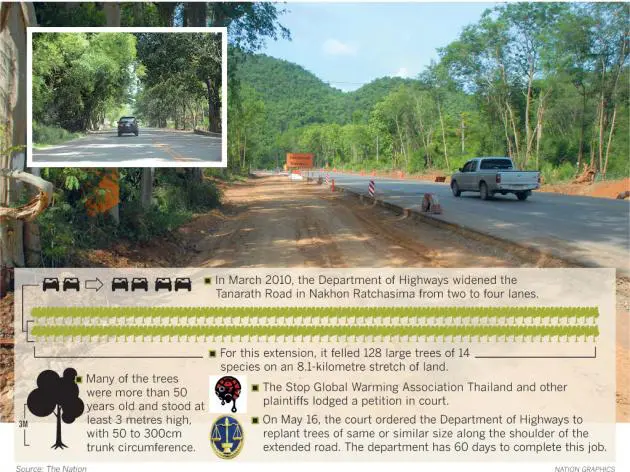


The Central Administrative Court verdict ordering the Department of Highways to replant a large number of trees along a Tararath Road section in Nakhon Ratchasima, were felled for an expansion project three years ago, is practicable, not far-fetched or un
The verdict on May 16 stipulated precisely what the plaintiffs want enacted, said spokesman Phairoj Minten. “But complying with the verdict doesn’t mean that exactly the same 128 trees must be replanted or that the new trees must be of the same size,” he said, and added, “But the number of trees must be 128, and they must be of a size close to the felled ones. The species are not important because the plaintiffs are not specific about that,” he added.
The 130 plaintiffs comprising three groups – local residents, motorists who regularly use the route, and members of the Stop Global Warming Association (SGWA) – want the road to be restored to its previous state, designated Route 2090, with large trees providing shades for the lanes.
“The court’s verdict needed to address all the issues and it is therefore delivered with precise description, to prevent it being complied with evasively or trickily,” he said.
The Department of Highways is required to comply with the verdict within 60 days. Director-general Chatchawal Buncharoenkij had earlier said he had activated a legal process to appeal against the verdict. The grounds were that it was not actionable, and not practical especially in ecological terms, because large trees have to be uprooted from elsewhere to be replanted on the 8.1-km stretch of the road that was widened from two to four lanes.
He said the newly grown trees, though large-sized, would not have roots strong enough to hold the trunks firmly, which may result in them being toppled by storms, endangering motorists.
“The Department’s efforts to appeal against the verdict is not a sign of arrogance against the court, but will lead to an extended explanation [during the appeal process] of the department’s full jurisdiction to carry out its duties,” he said.
“Otherwise it will become a precedent and hamper the operations of the Department of Highways in the long run for future expansions of roads,” he added.
