
Phongthep calls for business-sector involvement in providing educational services
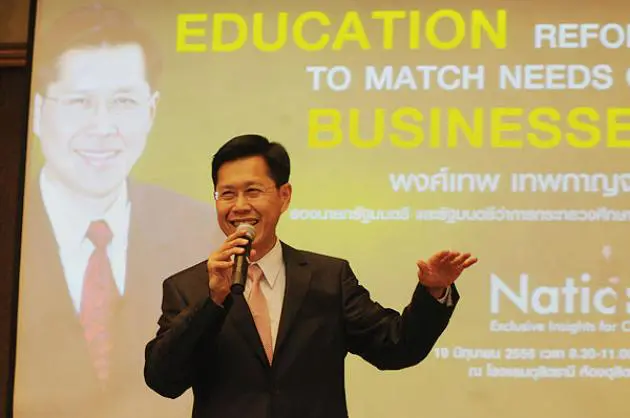


Speaking at a recent Nation Forum, Education Minister Phongthep Thepkanjana urged the business sector to step in and actively engage in the provision of educational services.
It is time for big corporations to start developing courses and producing graduates on their own to best respond to their needs, he said.
Phongthep’s idea received a warm welcome from many top executives present at last Wednesday’s event. CP All and Central Retail Corp (CRC) have, after all, already made efforts in this direction.
Held at the Dusit Thani Hotel, the latest Nation Forum embraced the theme of “Nation Exclusive Insights for CEOs Education Reform to Match Needs of Business”. Nation Multimedia Group (NMG) chairman Suthichai Yoon served as moderator at the event.
“We organise the Nation Forum every few months to bring together key players in society so that they can discuss existing issues and explore solutions together. We are discussing educational issues today because education is a way to solve all other problems in the country,” Suthichai said. About 40 business executives, including those from NMG, and academics attended the latest forum.
Everyone should join in efforts to provide educational services, because everyone is a stakeholder, Phongthep said, adding, “You will either reap or lose benefits from educational services.”
No room for politicking
The minister emphasised that politicking must have no place in the educational arena.
“The educational sector must be politically neutral. Educational policies should not be changed every now and then. We have to create [quality] education for the future generations,” he said.
In trying to persuade the business sector to play an active role in education, he pointed to the good example of such an approach in Germany.
Phongthep said Germany had identified 300 occupations that require technical skills and designed vocational courses accordingly with help from the private sector. Companies have either set up their own schools or conducted courses in collaboration with government agencies. “There are guaranteed jobs for graduates,” he added. CP All chairman and chief executive officer Korsak Chirasmisak said big corporations should definitely do more than merely handing out scholarships.
With funding from CP All, the Panyapiwat Institute of Management and Panyapiwat Technological College have sprung into operation and successfully supplied staff to CP.
Busaba Chirathivat, CRC senior vice president for Corporate Communications, said that in a bid to find suitable staff, Central had been working with eight Rajabhat institutes in conducting retailing courses.
“We have done so for 10 years already. Our senior staff has helped with writing textbooks and developing curricula for the courses,” she said, adding that the latest textbook revision had been undertaken last year.
Busaba said that so far, leading universities in the country had, however, not shown any interest in working with companies in developing their courses.
CRC has hired more than 20,000 people.
Mechai Viravaidya, founder and chairman of the Population and Community Development Association, said companies could in fact also help by training teachers.
“The private sector should come in and help. Don’t wait for the Education Ministry alone to conduct teachers’ training,” he said. In his view, companies’ top staff can organise such training for teachers. “Perhaps, four or five companies can join hands to take care of one school,” Mechai said. Phongthep said the various experiences discussed at the forum would deliver educational benefits.
Prioritising strategies
Speaking at the same event, SE-Education managing director Thanong Chotisorayth said the authorities had to embrace clear strategies and know which strategies should receive priority, if there was going to be an improvement in the country’s education.
“Now, the country lacks strategic teamwork, a best-practice process, a strategic focus and think-tank,” he said.
Thanong said he was willing to contribute to Thailand’s education, but he had found that education officials often chose to keep businessmen away.
Phongthep stressed it was not possible to focus on too many issues at the same time. “So, now we will focus on improving the curriculum and teachers’ reform first,” he said.
He also hopes for a consensus in pushing for reform.
“The efforts involve millions of people. There are between 500,000 and 600,000 teachers in the country. We can’t force all of them to strictly follow our guidelines. We therefore need a consensus [to achieve change for the better],” the minister said.
On the shortage of vocational graduates in the country, Vocational Education Commission chairman Anusorn Saengnimnuan said: “We have worked with some companies in solving the problem. But more than that, I think we have to do something about salaries and full scholarship, too. We need incentives to attract students to vocational colleges or schools.”
