
Court orders studies on water plan
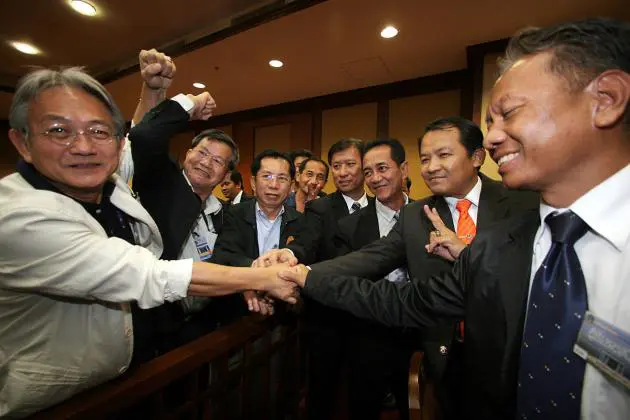


Play
The government is mobilising legal advice on how to unlock projects under the Bt350-billion water-management scheme after the Central Administrative Court yesterday ordered complete environmental and health impact assessment reports on projects likely to
PM’s Office Ministry permanent secretary Tongthong Chandrangsu said that after discussions with its legal team todayon June 28, the government would be able to tell private companies that won bids under the scheme, as well as the general public, how it will proceed with the investment. An option to appeal will also be discussed.
“The court’s order that public hearings be conducted is what the government intends to do. On the EIAs and HEIAs, we will need to look into legal technicalities thoroughly before making the next move,” he said. “As far as I know, not all projects would be affected, as some can proceed without the reports.”
Environmental impact assessments (EIAs) and health impact assessment (HEIAs) summarise approved measures to prevent and mitigate impacts on the environment and communities.
The court yesterday ordered the government to conduct EIAs and HEIAs before signing contracts with the winning bidders in its Bt350-billion water- and flood-management scheme. The government originally planned to sign the contracts in September.
The Stop Global Warming Association, which brought the case to the court, will today file a petition with the National Anti-Corruption Commission (NACC) against Yingluck and Tongthong for violating the Constitution in their implementation of the water mega-project.
“The court clearly said the government failed to comply with the Constitution’s Articles 57 (2) and 67 (2), which require the government to conduct EIAs and HEIAs before implementing its scheme. The projects will have severe impacts on local people and communities,” association president Srisuwan Janya said after the verdict was read.
“Yingluck and her PM’s Office permanent secretary must take responsibility for this mistake,” he added.
Srisuwan said yesterday if the government appeals to case to the Supreme Administrative Court, he would ask the court to issue an injunction ordering it to follow the lower court’s verdict, such as by completing public hearings and EIA and HEIA reports first.
On May 1, Srisuwan and a group of 45 plaintiffs filed the lawsuit against the prime minister, the National Water and Flood Policy Commission, the Water and Flood Management Commission, and the Strategic Committee for Water Resources Management.
They asked the court to order the scrapping of the government’s water- and flood-management scheme on grounds that the plan failed to comply with the Constitution. Moreover, construction under the plan would cause adverse environmental and social impacts, they said.
The court, led by judge Treetod Nikrothangkul, yesterday announced its verdict. It found that the government had failed to hold any public hearings among local residents before proceeding with the water- and flood-management plan. Moreover, the government did not conduct EIA and EHIA reports to estimate the projects’ potential environmental and health impacts on natural resources and local people’s livelihoods, the court said.
“It is the government’s responsibility to hold public hearings and conduct EIA and HEIA reports. This should not be left to private contractors, who may have a conflict of interest,” the judge said. He added that the court was not convinced that private contractors would strictly comply with the Constitution.
Srisuwan said yesterday that if the government appeals to case to the Supreme Administrative Court, he would ask the court to issue an injunction ordering the government to follow the lower court’s verdict, such as by completing public hearings and EIA and HEIA reports first.
