
Farmers unimpressed by govt credit-card scheme
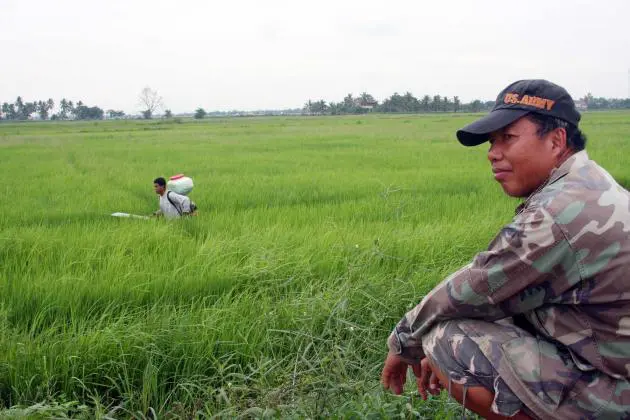


Many complain it is difficult to use, saying they prefer local shops.
The government project that offers credit cards to farmers is struggling because many farmers are much happier with ordinary shops, despite the fact they charge interest.
“What’s the point of using the credit card if it comes with a string of conditions and loads of inconvenience?” Somyong Soythong said.
He is a farmer and a kamnan in Phitsanulok’s Bang Rakam district.
Speaking for many local farmers, Somyong said when farmers wanted to use the credit cards they encountered several problems.
“For example, we are required to drive for 10 to 20 kilometres to get petrol for our pumps,” he said. “When we want to get some products, the shops participating in the farmers’ credit-card scheme also give us very limited choices.”
Somyong said things were better at local shops because shop owners offered a greater variety of products. “No matter what we want, the shop owners can find them for us,” he said.
Most farmers Somyong knows do not use the farmers’ credit cards, because they are not convenient. Instead, they agree to buy farming materials like pesticide and fertiliser on credit from local shops in their neighbourhood. They are willing to pay interest later on.
Speaking from Ayutthaya, 50-year-old Narongsak Ngamkhana also denounced the farmer’s credit card. “I don’t use it,” he said, “It’s very difficult to use the card. It has lots of conditions.”
Narongsak lamented that if the government really wanted to help farmers, it should remove complicated procedures.
Another farmer, Winai Sunimit, said he also shunned the credit-card scheme. “Not many shops accept payment by farmers’ credit cards. These shops are too far from our paddy fields,” he said.
Wichian Phuanglamchiak from the Thai Agriculturist Association said the farmers’ credit cards did not really benefit the cardholders.
“Credit cards may have their allure. But farmers have now realised that it’s not convenient to use these cards,” he said.
He estimated that only 10 per cent of farmers had used them.
Wichian said if the government wanted to help farmers with their farming costs, it should offer a subsidy. “The subsidy may be between Bt2,000 and Bt3,000 per tonne of rice if the government’s rice-pledging scheme has to lower the rice price,” he said.
Thai Farmer Support Association vice president Wichai Chittayawong shared a similar opinion.
“The assistance should be directly given to farmers,” he said.
Asked about this, Narongsak said he hoped the government would introduce practical projects for farmers.
“No matter what initiatives come about, they should not make farmers’ lives worse. Otherwise, farmers may stop farming,” he said. Narongsak owns 40 rai in Ayutthaya’s Uthai district. Using this land as paddy fields gives him a profit of only Bt35,000 to Bt40,000 per crop season.
“But if I sell my land, I may earn up to Bt1 million a rai,” he said.
