
Taking their cases to the masses


Play
Major political parties take to the streets to get their message out
The country’s two major political parties have taken to the streets to woo public support for their policies. It appears both parties began adopting this approach after observing the success of anti-government street protests by the red shirts and yellow shirts, which led to the premature end of four administrations.
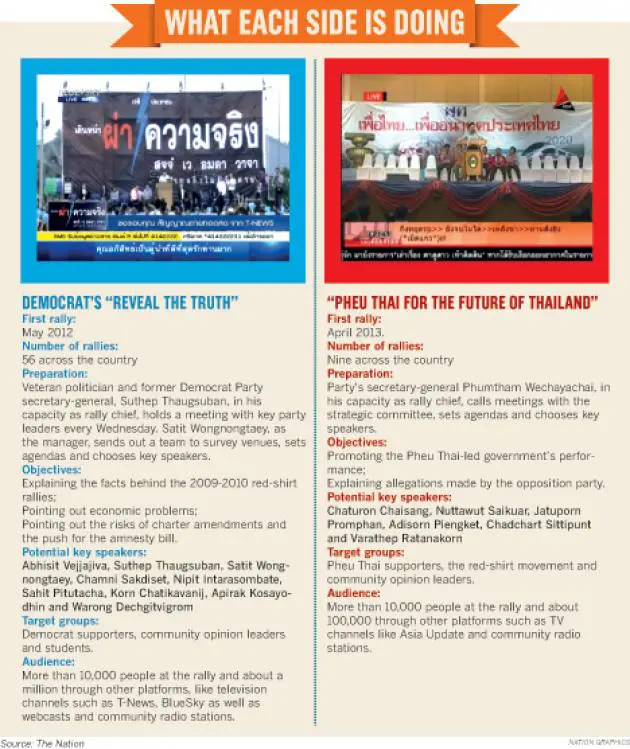
Starting in May last year, the opposition Democrat Party followed in the footsteps of the red shirts and yellow shirts by launching its “Reveal the Truth” rallies. The plan was to hold the rallies in each of the country’s provinces. This was followed four months ago, by the governing Pheu Thai Party’s series of rallies called “Pheu Thai: For the Future of Thailand”. So far, it has held nine such rallies.
Democrat MP Satit Wongnongtaey, the rally’s project manager, said the party needs to get the message across to the public that the government has a hidden agenda in pushing the amnesty bills – namely to whitewash former premier Thaksin Shinawatra’s wrongdoings.
“The government always maintains half-truths using those media channels it can control. We need [the rallies] to speak directly to the people and spread the truth,” Satit said. “It’s better than a press conference or a debate in the House. It’s a lively, dynamic approach and we have unlimited time.”
He claimed that each Democrat rally attracted an average of 10,000 people. The highest number recorded was 40,000, in Prachuap Khiri Khan, Satit said.
The weekly rallies are the brainchild of former Democrat secretary-general Suthep Thaugsuban. According to Satit, key Democrat figures meet every Wednesday to discuss details of the next rally. Seven to eight Democrats speak at such events, including party leader Abhisit Vejjajiva and Suthep himself.
The Democrats have held 56 weekly rallies spread across all four regions of the country. They have even staged rallies in provinces dominated by the red shirts.
According to Satit, a group that calls itself “Ayutthaya’s former red shirts” helped the Democrats stage rallies in many of the central provinces. “They also helped us persuade trouble-making red shirts to leave our rally site,” he said.
Satit also defended his fellow Democrats against allegations their roles are changing from being MPs to becoming “street activists”. Even Democrat chief adviser Chuan Leekpai, a vocal supporter of the parliamentary system, has become a frequent speaker at the weekly rallies.
“Khun Chuan still performs his duty in Parliament – 100 per cent. His standpoint has remained unchanged,” said Satit. “We, the Democrats, still believe in the
parliamentary system. But can we still trust in the system when the majority does not listen to anyone?”
Pheu Thai, which began its street campaigns almost a year after the Democrats, denied that its rallies were aimed at countering those of the opposition party.
Adisorn Piengket, a key speaker at Pheu Thai’s rallies, said they were not aimed at bringing the red shirts together to protect the government. “We only want to promote the government’s work and counter the views of the opposition,” he said.
“We don’t care much about the Democrat rallies,” Adisorn said, adding that the Pheu Thai rallies were held in provinces where it had a strong support base, such as locations for the planned high-speed railway lines.
However, the rallies were sometimes held in places where the ruling party was heavily attacked. “We chose Phitsanulok province because it’s a political base of a Democrat MP [Warong Dechgitvigrom] who always attacks the government,” Adisorn said.
The mastermind of the Pheu Thai rallies is the party’s secretary-general, Phumtham Wechayachai, who also selected five to six people as key speakers at each rally, according to Adisorn. “We have maintained more than 10,000 audience members at each rally,” he said.
However, a researcher who helped organise a reconciliation forum in 2011 said the political parties’ street rallies could lead to further political conflict.
Mathus Anuvatudom, from the Office of Peace and Governance at King Prajadhipok’s Institute, said the rallies were one-sided – only looking at those issues of interest to their supporters.
“If both parties are sincere about creating harmony, they should join the same forum, with academics acting as mediators,” Mathus said.
“Over the past two years, the reconciliation efforts have been hopeless. I think the opposition may believe that everything the government does is aimed at bringing Thaksin home. Yet, many government actions also reinforce the opposition’s notion. This is a reason why the Democrats and Pheu Thai go their separate ways,” he said.
Mathus’s concerns appear to be well-founded. Adisorn said Pheu Thai’s next goal was to hold its “Pheu Thai Meets the People” rallies in every province, while the Democrats will hold a “Reveal the Truth” rally in Bangkok from August 4 and 6, in the run-up to the parliamentary debate on an amnesty bill on August 7. The goal of the rally is to pressure the government to withdraw the draft law, said Satit.
